Physics Waves and Monochromatic light
 Call Kai
 Learn
Learn Practice Test
 Spaced Repetition
 Match
Match Flashcards
 Knowt Play
1/43

There's no tags or description
Looks like no tags are added yet.
Name | Mastery | Learn | Test | Matching | Spaced | Call with Kai | Chat |
|---|
No analytics yet
Send a link to your students to track their progress
44 Terms
Waves
Means of transferring energy from one place to another via a travelling disturbance or oscillation
The classes of waves
mechanical and electromagnetic
Mechanical waves
Waves that require a medium through which to travel The wave is a series of vibrations passing from molecule to molecule in a medium Examples: water waves Waves on a rope Waves on a spring Sound waves
Characteristics of Electromagnetic waves
do not require a medium to pass through Travel through a vacuum at the speed of light.
Transverse waves
Waves in which the direction of vibration is perpendicular to the direction of motion. These can travel in all three states of matter. Examples: Electromagnetic waves Water waves
Longitudal waves
Waves in which the direction of vibration of the particles is parallel to the direction of motion. These can only travel in solids and liquids. Example: Sound waves Waves on a spring
formula for velocity of a wave
v=fλ
Frequency
the number of cycles/oscillations that pass a point in a second The standard unit for frequency is (Hz) 1Hz = 1s
Properties of a wave (diagram)
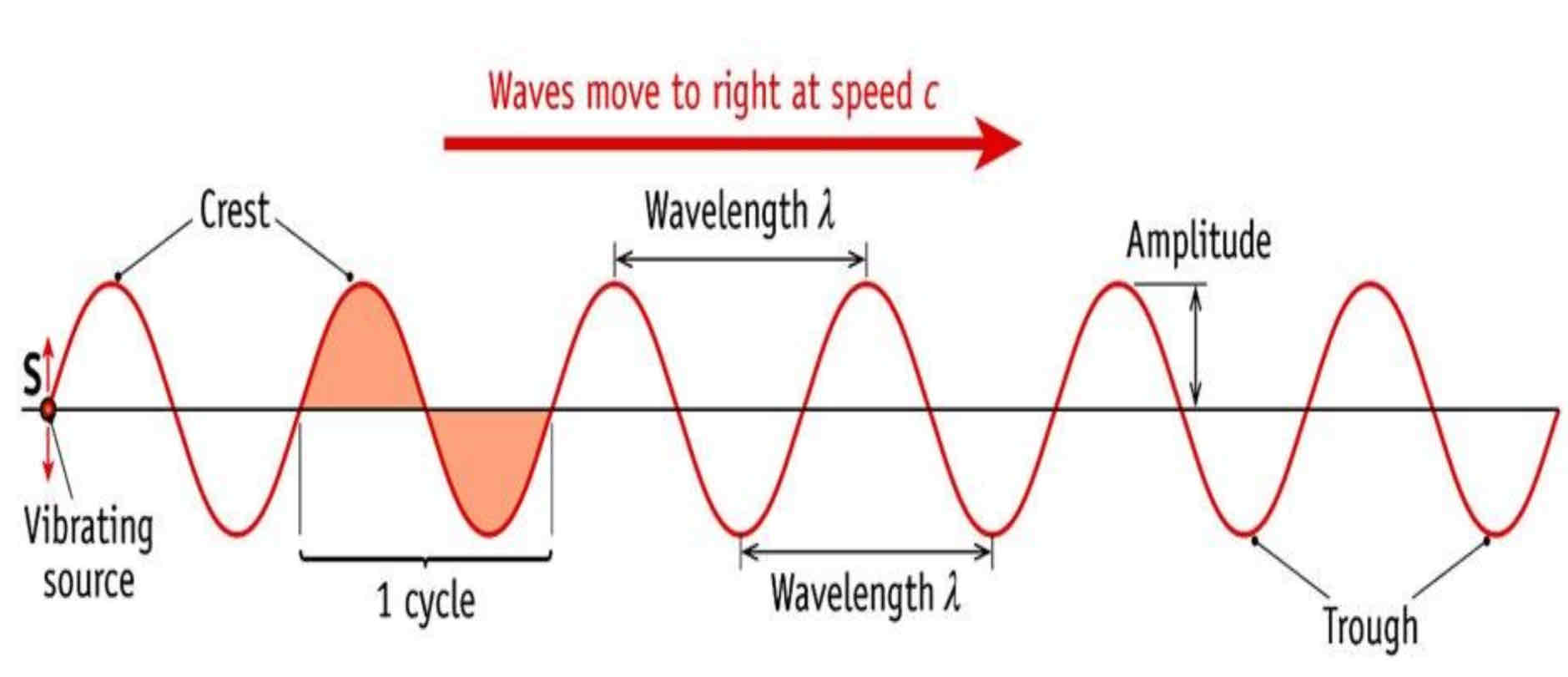
Wavelength(λ)
Distance from one point on a wave to the corresponding point on the next cycle
Frequency (f)
A measure of the number of oscillations of the wave per second
Velocity of a wave(v)
Distance travelled by any point on the wave in one second
Amplitude(A)
Maximum displacement of a wave from its mean position.
Periodic time(T)
Time taken to complete one oscillations of a wave
Reflection of a wave
The bouncing back of a wave when it hits a surface through which it cannot pass. Speed
Refraction of a wave
The bending of a wave as it passes at an angle from one medium to another Speed and wavelength will decrease if it enters a denser medium Frequency will remain unchanged
Red shift
Doppler effect is used to calculate the speed of stars If a star is moving away
Diffraction
the spreading out of a wave after it passes through a gap or an obstacle] Only significant if the gap is similar in size to the wavelength
Interference
When two identical sets of waves overlap
constructive interference
When two waves from coherent sources are in phase and meet to create a wave of greater amplitude
destructive interference
When two waves from coherent sources are out of phase and meet to create a wave of lower amplitude
Coherent sources
Have the same wavelength and amplitude. They are identical and have a constant phase difference
Polarisation
When the vibrations of a wave are confined to one plane only Unpolarised waves vibrate in different planes (e.g light: sunglasses unpolarise light waves)
The Doppler Effect
the apparent change in the frequency of a wave caused by relative motion between the source of the wave and the observer. If the source moves towards the observer the observed frequency is higher than that of the source. If the source moves away from the observer the observed frequency is lower.
Formula for doppler effect
f' = fc / c ∓ u
(If source and observer move toward each other
Stationary wave
Formed when two periodic waves of the same frequency and amplitude moving in opposite directions meet
Nodes
Points on a stationary wave where there is 0 displacement from the equilibrium position. This means the medium at a node isn’t moving up or down.
Anti-node
Points on a stationary wave where displacement from its mean position is at a maximum.
Electromagnetic spectrum
All electromagnetic rays travel at the speed of light
Order of the Electromagnetic spectrum (smallest to largest)
Gamma Rays
X-Rays
UV Rays
Visible Light
Infrared Light
Microwaves
Radio waves
Wavelength of light
Normal white light consists of many different wavelengths (colours). Light which is not a mixture of different wavelengths is called monochromatic light. The colour of monochromatic light depends on its wavelength.
Formula for the grating constant
d=1/n(Number of lines per metre)
Formula for wavelength of light
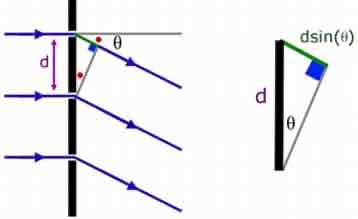
nλ=dsin(angle between straight line and the order in question) n=order (first order
Derivation of diffraction grating formula:
Dispersion (monochromatic light)
The splitting up of light into It's constituent colours. Occurs naturally in a rainbow. In a lab you can use a prism or diffraction grating.
Colours of light
Primary: Combine to form white light (Red
Applications of the Doppler effect.
Radar, temperature measurement, underwater acoustics, the red shift
What does the red shift tell us about our universe?
That it is expanding
How do Polaroid sunglasses help the wearer?
It prevents glare by restricting light to one plane.
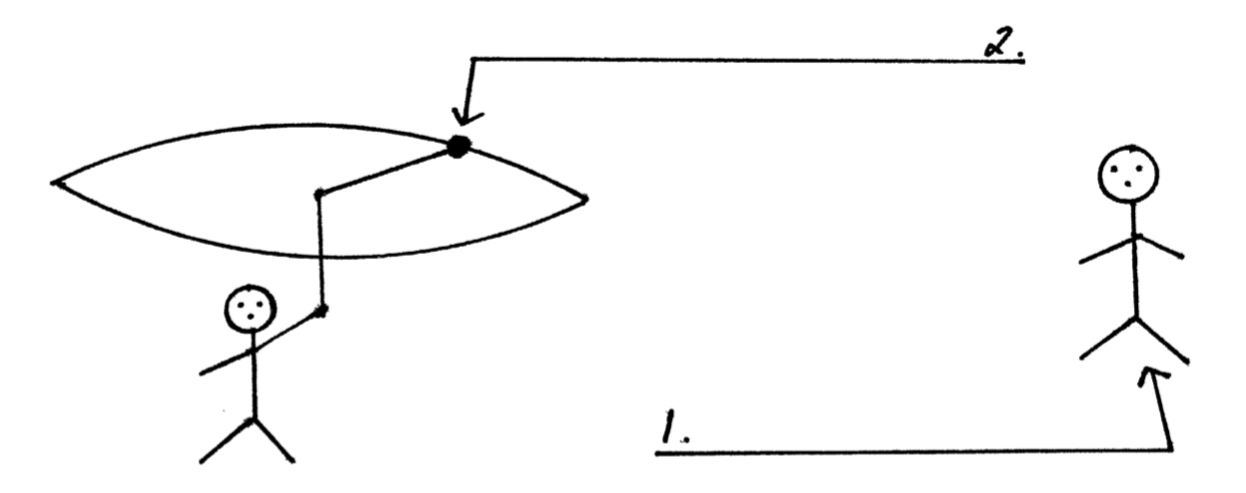
Describe a laboratory experiment to demonstrate the Doppler effect
What is stress polarisation?
when a transparent material (like plastic or glass) is put under stress (pushed, pulled, or bent), and it changes how light passes through it.
State an application of stress polarisation
To identify weaknesses in plastics
Difference between transverse and longitudinal waves
Longitudinal waves have their direction of vibration parallel to their movement. Transverse waves have their direction of vibration perpendicular to its motion
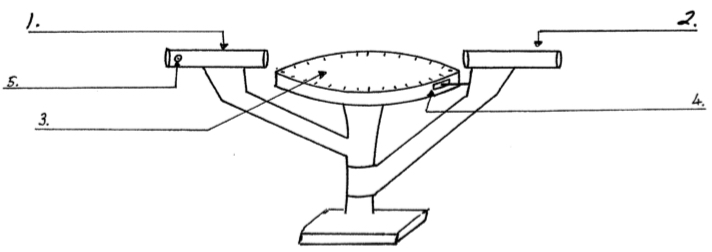
The spectrometer diagram and explanation
The Slit:
Light enters through the slit. The width of the slit may be adjusted using the width control
Have the slit as narrow as possible so that images may be accurately located with the cross wires of the telescope.
However if the slit is too narrow then the light from the images may be too faint.
The collimator:
The slit happens to be at the focal point of the converging lens at the far end of the collimator.
As a result of this a parallel beam of light leaves the collimator. Thus light leaving the collimator appears to have come from far away (infinity).
The collimator is in a fixed position. It can not be rotated.
The Table:
The circular table is graduated in degrees and can be rotated.
The table should be horizontal. There are levelling screws to make sure the table is horizontal.
Usually a prism or a diffraction grating or a Young's double slits is placed on the table
The telescope:
The telescope is focussed to pick up light from the collimator which creates the illusion of light coming from far away.
There are cross-wires in the telescope to enable the exact position if the images to be determined.