Physics 2213 Exam 1
 Call Kai
 Learn
Learn Practice Test
 Spaced Repetition
 Match
Match Flashcards
 Knowt Play
1/21

There's no tags or description
Looks like no tags are added yet.
Name | Mastery | Learn | Test | Matching | Spaced | Call with Kai | Chat |
|---|
No analytics yet
Send a link to your students to track their progress
22 Terms
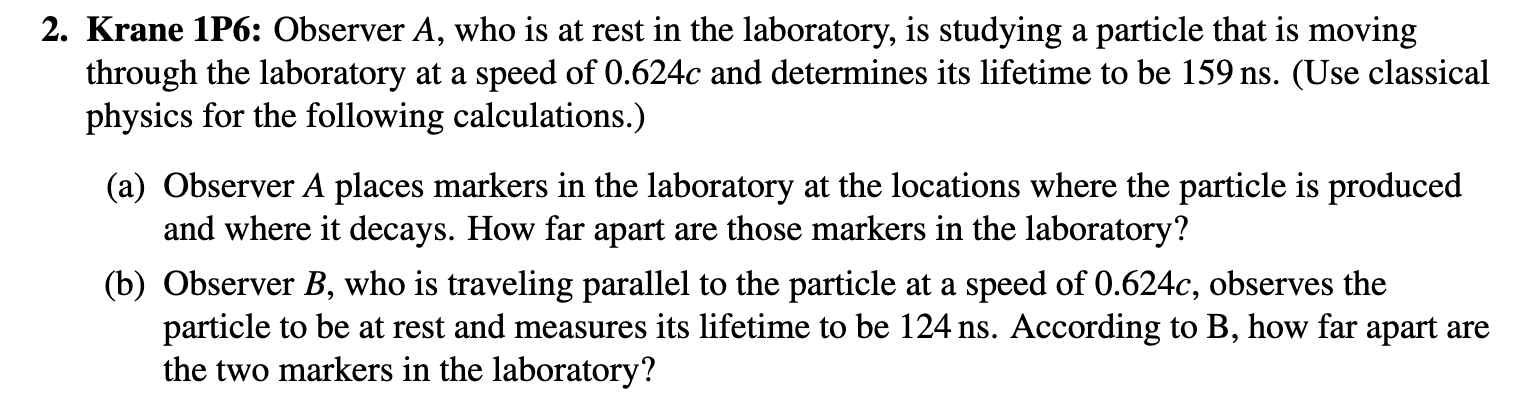
a). d=vt
b). d=vt but v is now negative

Use the time dilation formula and solve for t_0

Use the velocity transformation formula where u is the velocity of the frame of reference.


a). Use the doppler effect formula with lambda = c/f and solve for u
b). Use u = -v(that we found in part a) and solve for lambda’


Use length contraction
Δx’=Δxγ
Δy’=Δy
tan(θ’)=Δy’/Δx’
tan(θ)=Δy/Δx = Δy’/Δx’/γ =γ tan(θ’)
since tan(θ’) at the 45 degree angle = 1: tan(θ)= γ

Use length contraction formula.
tan(34)=y/x
tan(52)=y’/x’=y’/x’γ
tan(52)=tan(34)*γ
Solve for u in γ

a/b). Use doppler shift
c). Account for the time that it takes the light to travel back
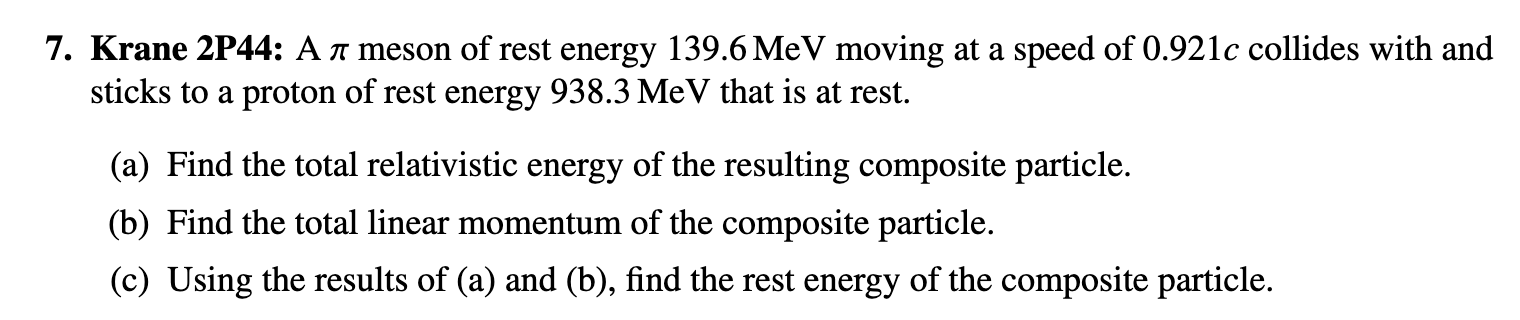
a). Find the initial energy (make sure to remember units)
b). Find the initial momentum (make sure to remember units)
c). Use E=sqrt((pc)²+(E0)²)

Use vx’ and vy’ equations. u is the speed of the frame of reference, vx,y is the speed of the other space ship
Why doesn’t the photoelectric effect work for free electrons?
A single free electron cannot completely absorb a photon while simultaneously conserving both energy and momentum. The photoelectric effect is when a light ray is shined at a metal surface and a photoelectron is released. The photon hits the metal surface and the metal atoms absorb the energy of the photon and release an electron. Since momentum & energy have to be conserved, the metal atoms recoil. However, free electrons dont have any surrounding atoms to absorb the recoil energy so energy/momentum won’t both be conserved. Instead, the photon bounces back at an angle with lower energy (compton scattering)

Use 2d sin θ = nλ

Watch out for e in units


Use energy conservation so
Ephoton+Eelectron=Escattered photon+Escattered electron
Ephoton+mec²=Escattered photon+(Kelectron+mec²)
Ephoton=Escattered photon+Kelectron
now you know Ephoton

Ephoton=hc/λ
Kphotoelectron=Ephoton - ϕ
To find the recoil KE of the atom, use conservation of momentum:
Pphoton=Pphotoelectron + Pal atom
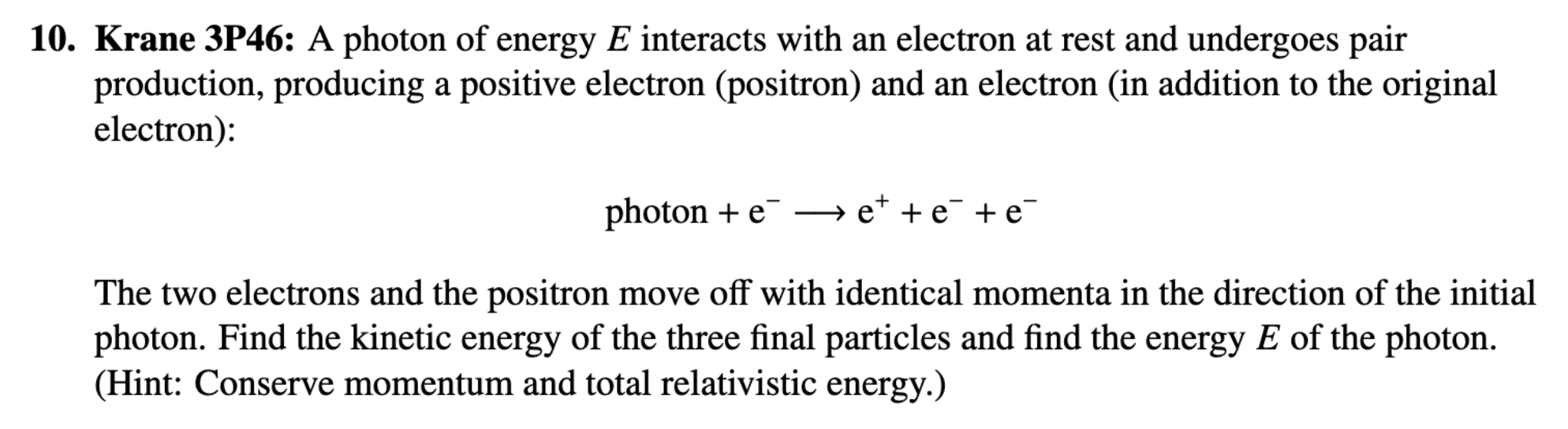
Use conservation of energy and conservation of momentum. Plug in the Eparticle to conservation of energy to solve for Ephoton and then plug that into conservation of momentum to find Eparticle and then use that to fine KE

Also find the x’, t’ where the light signals would be coincident
a). use lorentz transformations
b). Find mid point and time of the light rays and then convert using lorentz transformations
Energy equations
E=K+Eo=γmc²
Time Dilation
Proper time: The time for the observer where from their perspective, it looks like both events happen at the same location
Proper time is always shorter than dilated time

Length Contraction
Proper length: The length for the observer where the object/endpoints are stationary from their perspective.
Proper length is always longer than contracted length

Unit of energy
eV
Unit of Momentum
eV/c
Unit of mass
eV/c²