Chronic Kidney Disease
 Call Kai
 Learn
 Practice Test
 Spaced Repetition
 Match
 Flashcards
 Knowt Play
1/65

There's no tags or description
Looks like no tags are added yet.
66 Terms
What is azotemia and what does it indicate?
An increase in BUN and creatinine that indicates a decrease in GFR
Pre-renal azotemia
Decreased blood flow to the kidney - dehydration
Renal azotemia
Intrinsic kidney disease - CKD or AKI
Post-renal azotemia
Obstruction or uroabdomen
What is CKD?
Structural and/or functional defect in the kidney(s) that is present or 3 months or longer
True or false: CKD is irreversible and progressive.
True
Major risk factor for CKD
Age
Most common cause of CKD
Idiopathic tubulointerstitial disease
Causes of CKD
- idiopathic (most cats, 50% dogs) tubulointerstitial disease
- glomerular disease (50% dogs)
- sequelae of AKI
- neoplasia
- congenital disorder
True or false: CKD eventually affects all areas of the nephron.
True
Clinical signs of CKD
- PU/PD
- dehydration
- decreased appetite
- weight loss
- lethargy
- vomiting
- uremic stomatitis
What causes PU/PD in CKD?
Loss of renal tubules -> loss of medullary concentration gradient -> poor urine concentrating ability and dehydration
What causes vomiting, weight loss, lethargy and anorexia in CKD?
Loss of glomeruli -> decreased GFR -> accumulation of uremic toxins that impair normal body functions
Examples of uremic toxins
- urea
- phosphates
- sulfates
- potassium
What are some clinical consequences (other than clinical signs) that may result from CKD?
Anemia and hypoxia
Renal secondary hyperparathyroidism and fibrous osteodystrophy
Arterial hypertension
Why does anemia result from CKD?
Impaired renal interstitial causes decreased renal hormone production of erythropoietin
Why does renal secondary hyperparathyroidism result from CKD?
Impaired renal interstitial causes decreased renal hormone production of calcitriol
Why does arterial hypertension result from CKD?
- fluid retention in very end stage
- RAAS activation
- sympathetic stimulation
What is the result of arterial hypertension?
End-organ damage of the heart, brain, eyes, and kidney
This exacerbates renal disease even more
What are the 2 endogenous markers of GFR?
BUN and creatinine
What loss of renal function is required to result in clinical azotemia?
75% loss
True or false: patients with early CKD are not azotemic.
True
What is the most sensitive, measurable marker for GFR? Why?
SDMA - it increases at 25-40% renal loss, and it is less affected by other factors
When is SDMA most useful? Why?
In muscle wasted animals - their creatinine will be falsely low
What else besides GFR can impact BUN?
- increased wth GI bleeds
- decreased in liver failure
Laboratory results of CKD
- azotemia
- hyperphosphatemia
- hyper or hypo kalemia
- metabolic acidosis
- non regenerative anemia
- poorly concentrated urine
- proteinuria
What does hyperphosphatemia result in?
Increases Ca x P product/precipitation -> GI mineralization -> uremic gastropathy
Inhibits calcitriol synthesis -> renal secondary hyperparathyroidism
Is hypo or hyper kalemia common in cats with CKD?
Hypokalemia - waste K+ in the urine
When does hyperkalemia occur in CKD?
In very end stage kidney disease in dogs - anuric/oliguric
Complication of certain drugs - ACEi, ARBs, spironolactone
What type of metabolic acidosis results from CKD and why?
Secretional - loss of bicarb in the urine
Titrational - accumulation of uremic toxins
What is considered poorly concentrated urine in CKD?
< 1.030 in dogs
< 1.035 in cats
What amount of renal function loss must occur to see poorly concentrated urine?
66% renal function loss
Exceptions to poorly concentrated urine in CKD
Dogs with purely glomerular disease
Occasionally cats for no reason
Why may an animal with CKD not necessarily present very ill?
The body tends to adapt to the loss in renal function for awhile
How may kidneys appear on U/S in CKD?
- small
- irregular margins or infarcts
- decreased corticomedullary definition
Stage 1 CKD
Non azotemic, but other evidence of kidney disease
Creatinine cutoffs for azotemia
Creat dog < 1.4 mg/dL
Creat cat < 1.6 mg/dL
What happens as CKD stage increases in a patient?
Increased likelihood of clinical signs
Increased risk for acute on chronic kidney disease (uremic crisis)
Name the UPC values in dogs and cats that indicates proteinuria vs non-proteinuria.
< 0.2, non proteinuric
> 0.5, proteinuric

Stage 2 CKD creatinine
1.4 or 1.6 - 2.8
Stage 3 CKD creatinine
2.9-5.0
Stage 4 CKD creatinine
> 5.0
Normotensive BP
< 140
Prehypertensive BP
140-159
Hypertensive BP
160-179
Severely hypertensive BP
> 180
Features of renal diets (there's alot)
Restricted protein, P, Na
Vitamin B supplemented
Acid-base neutral
High calorie/fat
Polyunsaturated fatty acids (antioxidant)
K supplemented in cats
When should a renal diet be initiated?
Generally begin in stage 3 CKD/late stage 2
Or, proteinuric CKD
Why do we not want to switch a patient to a renal diet in early CKD?
These diets are low in protein, which is important for healing, so it can be detrimental to start too early
Medications for treating hypertension
1. ACE inhibitors, angiotensin receptor blockers
2. Calcium channel blockers (amlodipine)
3. Direct vasodilator (hydralazine) - last resort
When should hypertension therapy be initiated?
Persistent hypertension (2 measurements over 1-2 weeks)
Immediately if evidence of end organ damage - hypertensive retinopathy, encephalopathy, cardiac remodeling
Target phosphorous in each stage of CKD
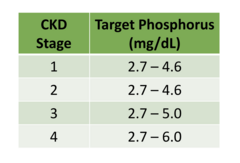
Treatment of hyperphosphatemia
Low P diet
Phosphate binders - binds phosphate in gut
Examples of phosphate binders
- aluminum hydroxide
- calcium carbonate/acetate
- lanthanum carbonate
- sevelamer
- ferric citrate
Treatment of hypokalemia
Diet (feline renal diets)
Supplementation - potassium citrate or gluconate
Treatment of hyperkalemia
- dietary restriction
- reduce doses of ACEi, ARBs, spironolactone
Treatment of metabolic acidosis
- diet
- potassium citrate or sodium bicarbonate
When should we treat anemia in CKD in dogs and cats?
Dog PCV < 30%
Cat PCV < 25%
If animals are clinical for anemia, how should we treat?
Transfusion
Treatment of anemia if not clinical
Darbepoietin
Carenzin-CA1 (molidustat) - cats only
Treatment of acute on chronic kidney disease
- IV fluids
- supportive care
- treat exacerbating disease
What SQ fluids should be used in CKD patients that cannot maintain their own hydration?
Balanced, isotonic fluids (LRS, P-lyte, Norm R)
Supportive care for CKD patients
- appetite stimulants
- esophageal tube
- antiemetics
- GI protectants if GI bleeding suspected
How should we monitor CKD?
Initially, every 1-4 weeks
In stable patients, every 3-6 months
What parameters should we monitor in CKD patients?
- PCV
- chem
- UA
- BP
- UPC
- comorbidities
Median survival time for dogs and cats with CKD
Cats > 2 years
Dogs 9 months