Measures of Disease Risk and Burden
 Call Kai
 Learn
 Practice Test
 Spaced Repetition
 Match
 Flashcards
 Knowt Play
1/34

There's no tags or description
Looks like no tags are added yet.
35 Terms

smallpox
What measure gives us the probability that one will become sick with a disease in a given period of time?
incidence of disease
What is cumulative incidence proportion?
the number of NEW cases of disease out of the population at risk of developing that disease
usually expressed as a cumulative proportion over a given time
the number of cases per 10, 100, 100k, etc
What is a formula associated with cumulative incidence proportion?

units: proportion or percent (ex: cases per 10,000)
What are case definitions?
a set of uniform criteria used to define a disease for public health purposes (can be really specific)
intended to aid in epidemiologic surveillance
different from a clinical diagnosis to initiate treatment for individual patients
Calculate the cumulative incidence proportion given this graph. Give it’s interpretation.


37 new cases per 1000 w/n this 12 month time period

42 out of 10k per year
What are two measures of disease risk?
incidence
attack rate
What is similar about incidence and attack rate?
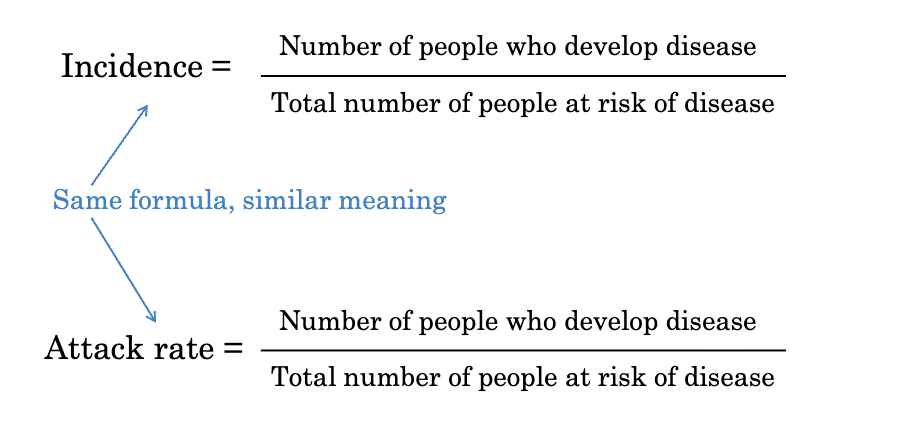
same formula, similar meaning
What is the difference between incidence and attack rate?
incidence: generic term, can refer to acute and long term disease
attack rate: an out-break/acute specific name for the cumulative incidence proportion
What do you do if not all people are in the population for the full observation period (people die, born, move in and out)? What would you use in the denominator then when calculating incidence?
would calculate incidence rate instead of cumulative incidence proportion

What is incidence rate?
when we utilize the “person-time” for all people
take into the amount of time that someone was at risk rather than the total amount of people, bc we don’t always have surveillance over people, some people move in, some die, new people are born, etc.
units = cases per person time
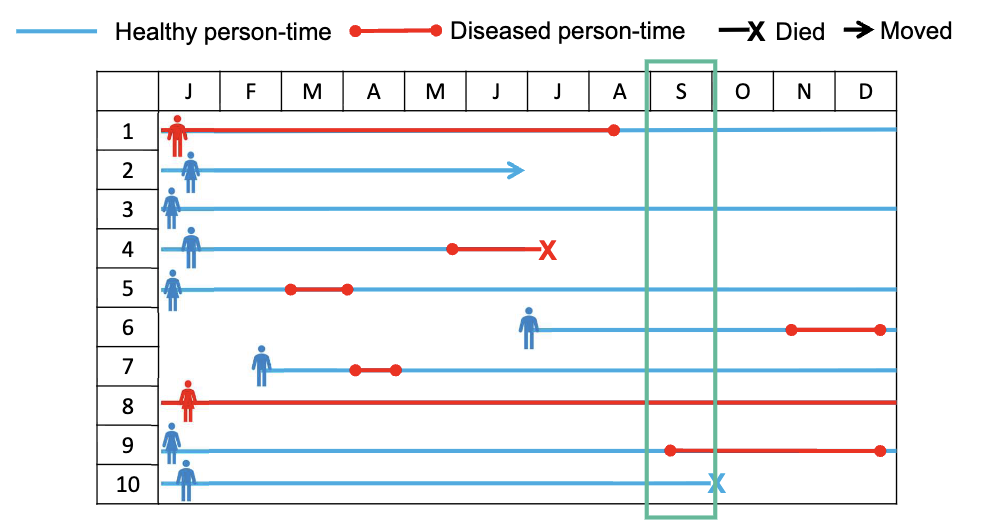
Give an example of calculating incidence rate based off of this graphic and interpret your results.


What is prevalence?
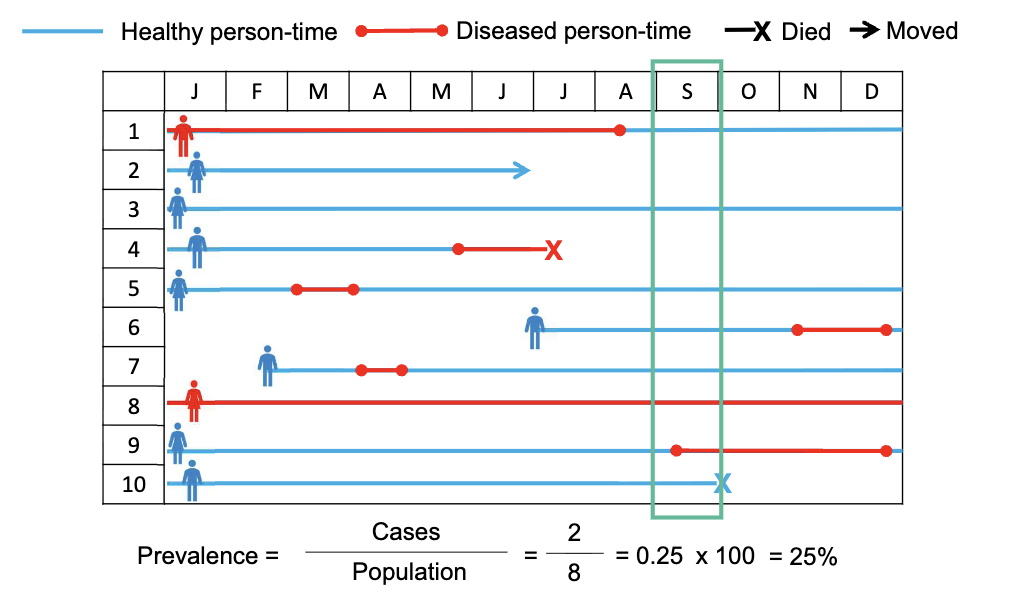
the total number of cases of disease in a population at a specified time
usually expressed as a percent
tell us about the burden of disease
helps to direct public health planning efforts

Calculate prevalence given this chart for people in the month of July.


Calculate prevalence given this chart for people in the month of September.

C
What are two different types of prevalence measures?
point prevalence
period prevalence
What is point prevalence an indicator of?
indicates current disease of that specific point in time


What is period prevalence an indicator of?
disease over a specified period of time


Is prevalence an indicator of disease risk?
no, a single prevalence estimate gives no indication of the risk of disease however prevalence estimates repeatedly measured over time are influenced by disease risk
influenced by the rate at which cases are lost and incidence
What influences the rate at which cases are lost?
survival time
cure for illness
out migration
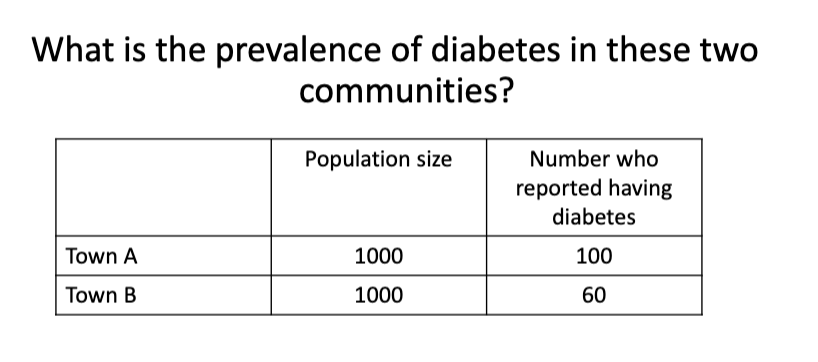
Town A: 10%
Town B: 6%
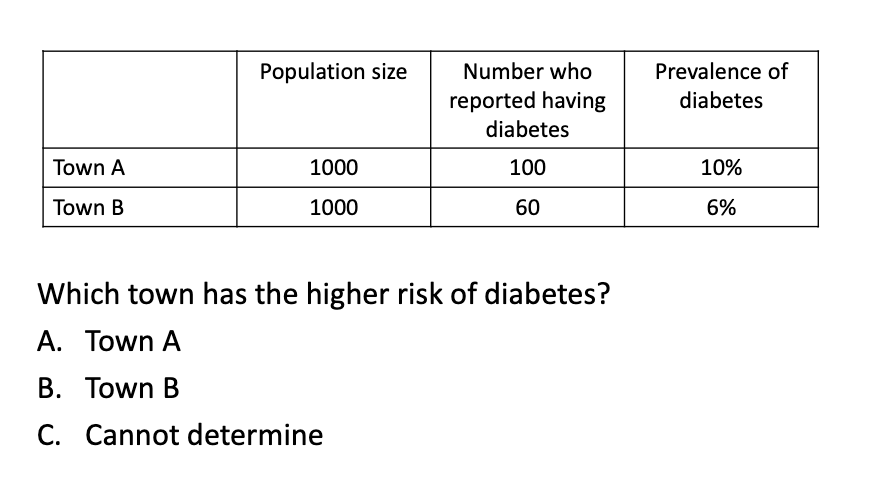
C
prevalence can’t tell us risk only incidence can

B
Describe the relationship between prevalence and incidence.



In what case can prevalence increase?
if there is an effective treatment that does not result in a cure, increasing the duration of the illness and increasing the number of people alive with the disease

What does incidence tell us about?
tell us about the risk of disease
can help determine the cause of a disease/etiology
can help to plan public health prevention efforts
Write the impact of incidence and prevalence:

incidence: no change
(no way to prevent the disease, only made for those who already have the disease)
prevalence: decrease
Write the impact of incidence and prevalence:

incidence: no change
prevalence: increasing
(more people who have the disease that are living)
Write the impact of incidence and prevalence:

incidence: up for only a short period of time (only after bc we would diagnose people faster)
prevalence: increase
Write the impact of incidence and prevalence:

incidence: down
new intervention reduces risk
prevalence: unknown
depends on how much longer survival time