IAL edexcel unit 1 physics
 Call Kai
 Learn
 Practice Test
 Spaced Repetition
 Match
 Flashcards
 Knowt Play
1/101

There's no tags or description
Looks like no tags are added yet.
102 Terms
When can you use suvat?
For any object moving with constant acceleration
What does each letter in suvat stand for and their unit
s = displacement (m)
u = initial velocity (m s−1)
v = final velocity (m s−1)
a = acceleration (m s−2)
t = time interval (s)
uvat
v = u + at
suat
s = ut + ½at²
suvt
s = (vt+ut)/2
suva
v² = u² + 2as
Acceleration time graph with zero slope
A zero slope (horizontal line) represents an object undergoing constant acceleration
What does the area under the accleration time graph represent?
The change in velocity
Does the steepness of a acceleration time graph mean anything
The steepness of the slope is meaningless
Acceleration time graph for constant velocity

Acceleration time graph for increasing velocity

Acceleration time graph for increasing acceleration
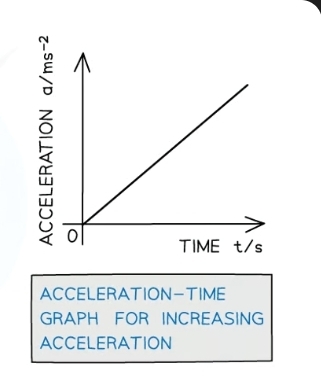
What does the slope on a displacement time graph represent?
Velocity
What does a straight positive slope in a displacement graph mean?
Constant velocity in a positive direction
What does a curved negative slope mean in a displacement time graph?
The curved slope represents an acceleration and the negative slope represents motion in the negative direction
What does a zero slope (horizontal line) mean in a displacement time graph?
Rest
What does the area under a curve mean in a displacement time graph
Nothing
Displacement time graph constant velocity
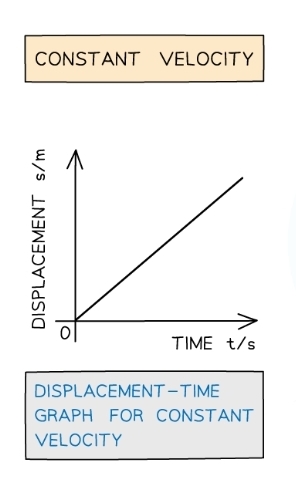
Displacement time graph velocity increasing at a constant rate

Displacement time graph velocity increasing, acceleration increasing at a constant rate

What does the slope in a velocity time graph represent?
Slope represents constant acceleration
What does a straight negative slope mean in a velocity time graph?
A straight line represents uniform acceleration and a negative slope represents an increase in velocity in a negative direction
What does a curved positive slope represent in a velocitu time graph?
A curved line represents non uniform acceleration and a negative slope represents increase in velocity in the negative direction
What does a zero slope (horizontal line) represent in a velocity time graph?
Motion with constant velocity
What does the area under a velocity time graph represent
Displacement
Velocity time graph for constant velocity

Velocity time graph for increasing velocity

Velocity time graph for increasing acceleration

What is a scalar quantity
Scalars are quantities that have magnitude but no direction
What is a vector quantity
Vector are quantities that have both magnitude and direction
What is the difference between distance and displacement? (In context of a student walking home)
Distance is scalar. Displacement is vector. The overall distance they travel includes the total length of all roads including twist and turns. The overall displacement of the student would be a straight line between their home and school regardless of obstacles
Examples of scalar quantities
Distance, speed, mass, time, energy, volume, density, pressure, electric charge, temperature
Examples of vector quantities
Displacement, velocity, acceleration, force, momentun
How can you notate scalae and vector?
The arrow does not represent the direction it goes to, just that it is vector and has direction

What are vectors represented by?
Vectors are represented by arrows
Arrowhead shows direction of vector
Length of arrow represents magnitude
What is a resultant vector?
A single resultant vector can be resolved when it is represented by 2 vectors which in combination has the same effect as the original one.
What is a component in a resultant force
When a single resultant vector is broken down into parts thats a component
Drawing of resultant vector

What are 2 methods for adding vectors
Calculation: if the vectors are perpendicular
Scale drawing: if the vectors are not perpendicular
How do you combine vectors using a scaled diagram (triangle method)
Link vectors head to tail
Resultant force is formed by connected tail of first vector to head of second vector

How do you combine vectors using a scaled diagram (parallelogram method)
Link vectors tail to tail
Complete resulting parallelogram
Resultant vector is the diagonal of the parallelogram

In combining vectors via calculation, how do you find the magnitude?
Link vectors A and B from head to tail
Form resultant vector from linking tail of a to head of b
Use pythagoras theorem

In combining vectors via calculation, how do you find the direction?
The direction of the resultant vector is found from the angle it makes with the horizontal or vertical.
Calculating the angle of this resultant vector from hor or ver using trigonometry

How to calculate vertical component (initial speed) in suvat
× = usin(theta)
How to calculate horizontal component (final speed) in suvat
x = ucos(theta)
Free body diagrams in equilibrium
Three forces on an object in equilibrium form a closed vector triangle

Newton first law
A body will remain at rest or move with constant velocity unless acted on by a resultant force
Newton second law of motion
The acceleration of an object with constant mass is directly proportional to the resultant force on it
Newton third law of motion
Whenever two bodies interact the forces they exert on each other are equal in magnitude, opposite in direction, and of the same type.
Terminal velocity
When drag force is equal to driving force the velocity reaches its maximum value and the object is at terminal velocity
Explain what happens when a skydiver falls (terminal velocity)
Weight > drag, skydiver is in free fall. Their velocity increases due to downward force of weight.
Increase in velocity means increase in air resistance and acceleration decreases
Weight = drag, accleration is 0, resultant force is 0 this is terminal velocity
What is gravitational field strength?
Force per kg that acts in an object and can be found using g = f/m
On earth its 9.81
What does freefall mean
There is constant acceleration, the only force is weight. Drag forces are ignored, in freefall all objects must fall with sane value for acceleration regardless of mass and weight
Newton third law of motion
Whenever two bodies interact, they exert on each other are equal in size, act in opposite directions and are of the same type
p = mv
momentum (kg ms-¹) = mass (kg) / velocity (ms)
The principle of conservation of linear momentum
In a closed system, total momentum before a collision is equal to momentum after a collision
What is a moment
Thr turning effect of a force.
Moment (N m) = Force (N) × perpendicular distance from pivot (m)
Centre of gravity definition
The point through which all the weight can be considered to act
Stability in wider base objects vs stability in narrower base objects
An object is stable when its centre of gravity lies above its base.
The wider base an object has the lower its centre of gravity and its more stable
The narrower base an object has the higher its centre of gravity and the object is more likely to topple over if pushed
Principle of moments
For a system to be in equilibrium, the sum of clockeise moments about a point must be equal to the sum of the anticlockwise moments (about the same point)
Work definition
Amount of energy transferred when an external force causes an object to move over a certain distance
Formula if force is parallel to direction of objects displacement for work done
Change in work done = average force applied in direction of motion (N) × displacement (m)
Kinetic energy equation
Ek = 1/2 mv²
Kinetic energy (J)
Mass (kg)
Velocity (ms-¹)
What is kinetic energy?
The energy an object has when its moving. The faster an object moves, the greater its kinetic energy.
What happens in kinetic energy in terms of falling
When an object is falling its gaining kinetic energy since its gaining speed. This energy transferred from gravitational potential energy its losing. An object will maintain this kinetic energy unless speed changes.
What is gravitational potential energy?
Energy stored in a mass due to its position in a gravitational field. If a mass is lifted up it will gain gpe. If a mass falls it will lose gpe.
The equation for gravitational potential energy for energy changes in a uniform gravitational field
Gpe = mgh
Change in gravitational potential energy (J)
mass (kg)
gravitational field strength (9.81 Nkg-¹)
change in height (m)
What is power
Rate at which energy is transferred, or work done per unit time
Power formulas
P = E/t or P = W/t
Energy (J)
Time (s)
Work done (J)
What is efficiency
Ratio of the useful power or energy transfer output from a system to its total power or energy transfer input
Efficiency formulas
Efficiency = Useful energy output / total energy input
Efficiency = Useful power output / total power input
What is density
Density is the mass per unit volume of an object. Objects made from low density materials typically have a lower mass.
Density formula
Density = mass / volume
mass (kg or g)
volume (m³ or cm³)
density (kg / m ³ or g / cm³)
How to calculate volume of a sphere
(4/3) × pi × r³
How to calculate cylinder volume
pi × r² × h
Archimedes principle
An object submerged in a fluidnat rest has an upward buoyancy force (upthrust) equalnto the weight of the fluid displaced by the object.
The object sinks until the weight of the fluid displaced is equal to its own weight.
Upthrust formula
upthrust = pvg
p = density
v = volume
g = gravity
Viscous drag definition
The frictional force between an object and a fluid which opposes the motion between the object and the fluid
Viscous drag formula
F = 6 × pi × viscosity × r × velocity
viscous drag (N)
viscosity (Pa s)
radius of object (m)
velocity (ms-¹)
Are fluids with low viscosity easy to pour
Fluids with low viscosity are easy to pour and those with high viscosity is difficult to pour
What are the forces acting on a sphere falling through a fluid
weight = force (viscous drag) + upthrust
mg (sphere) = mg (fluid displaced) + upthrust
Conditions for stokes law equation
The flow is laminar, the object is small, the object is spherical, low velocity
What is laminar flow
All the layers are moving in the same direction and they do not mix. In turbulent flow the layers move in different directions and the layers do mix
What is the relationshio between viscosity and temperature
Liquids are less viscous as temperature increases
Gases are more viscous as temperature increases
When does a material obey hookes law
The extension of the material is directly proportional to the applied force up to the limit of proportionality
Hookes law formula
F = kx
applied force (N)
springs constant / stiffness (N m-¹)
chanhe in extension (m)
Limit of proportionality
The point beyond which hooke’s law is no longer true when stretching a materual
Elastic limit
The maximum a material can be stretched and still return to its original length. (After limit of proportionality) (gradient is equal to spring constant)
What is stress
Applied force per unit cross sectional area of a material.
Types of forces (in material)
Tensile forces, which pull on an object and extend it
Compressive forces, which push onto an object and compress or squash it
Stress formula
Stress = force / area
stress (Pa)
Force (N)
Cross sectional area (m²)
What is ultimate tensile stress
Maximum force per orifinal cross sectional area a wire is able to support until it breaks
What is extension
Extension per unit length
Deformation of a solid due to stress ij the form of elongation or contraction
Strain formula
Strain = change in extension / original length
What is young modulus
Measure of the ability of a material to withstand changes in length with an added load, showinf elasticity of a material.
Ratio of stress and strain
A stress strain graph is a straight line wity its gtadient equal to young modulus
Young modulus formula
Young modulus e = stress / strain
Yield point
Where the material continues to stretch even though no extra force is being applied to it
Elastic defornation
Till the elastic limit, is a change of shape where the material will return to its original shape when the load is removed
Plastic deformation
After yield point, change of shape where the material will not return to its originl shape when the load is removed
Breaking stress
Stress at the point where the material breaks. At yield point the atoms in the material had started to move relative to each other at the breaking stress they seperate completely