Topic I - Transposition
 Call Kai
 Learn
 Practice Test
 Spaced Repetition
 Match
 Flashcards
 Knowt Play
1/27

There's no tags or description
Looks like no tags are added yet.
28 Terms
Transposition
Movement of a transposon
Types of Transposition
Replicative - Copied and inserted elsewhere
Non-Replicative - Cut out of one place and inserted elsewhere
Movement of Transposon
Moved by non-homologous recombination
Does not require homologous sequence between donor and target
Does not require RecA protein
Can move between different genera of bacteria with little sequence homology
Regulation of Transposition
Tightly regulated, occurs rarely to prevent negative effects (insertion mutations) in the bacterial genome
Characteristics of Transposons
Inverted terminal repeats (IR)
Gene encoding transposase enzyme
Short direct repeats of target DNA surrounding transposon
Inverted Terminal Repeats (IR)
Located at the end of transposon
-Sequences “point inwards” towards each other

Genes Encoding Transposase Enzyme
Enzyme that mediates transposition
-Located inbetween IRs
Short-Direct Repeats
Short-direct repeats of target DNA surrounding transposon
-NOT part of the transposon
-Insertion Site in target DNA is duplicated during transposition
Direct repeat generation is based on mechanism of transposition
Inverted vs Direct Repeat
Direct Repeat - ACCATC
Inverted Repeat - CTGCGGC
-Very ends are “Inverted repeats” (inverted sequence/orientation)
-Outside those ends are “Direct Repeats” (same sequence, same orientation)
Between the IRs is the transposase/regulator

Types of Bacterial Transposons
Insertion Sequence (IS) elements
Composite Transposons
Non-Composite Transposons
Insertion Sequence Elements
Minimal transposons
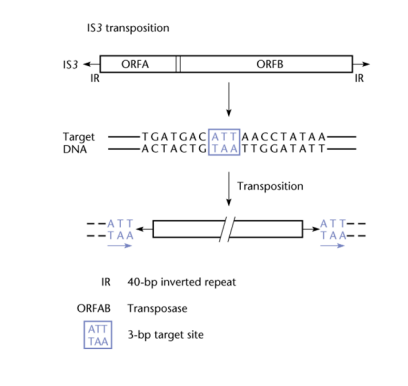
-Only 750-2000bp
-Inverted repeats at the ends
Transposase and regulator of transposition in the middle
-Almost all bacteria carry IS elements, allows for Hfr formation
Insertion Sequence - IS3 Example
ORFA alone encodes the regulator of transposition
-ORFAB together encodes the transposase

Composite Transposons
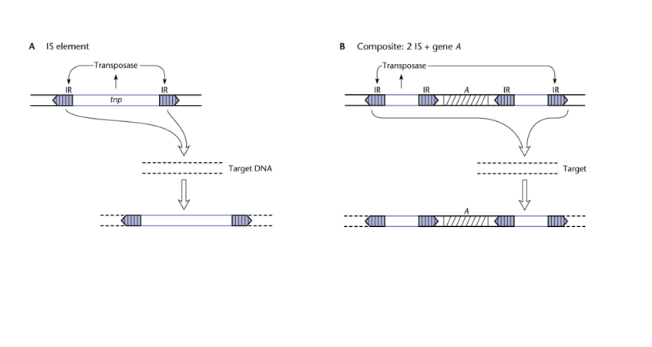
Consists of TWO IS elements in the same or opposite direction
-Other genes are in teh middle
-NOT involved in transposition, often antibiotic resistance genes

Composite Transposons - Movement
IS elements can transposae individually or with the entire composite transposon
-IRs of both IS elements are the same
-Transposase can recognize the “outside ends” of composite transposon and move the entire thing
Composite Transposons - R Plasmids
Composite transposons are involved in R-plasmid formation
-Composite transposon formed when two IS elements inserted near each other in bacterial chromosome
-Two IS elements transferred DNA between them (containing antibiotic resistance genes) onto plasmid that moves by conjguation
Non-Composite Transposons - Components
Short, IR on ends (no IS elements)
Transposase and regulator of transposase
Resolvase enzyme
res site
Other genes (often antibiotic resistance genes)
Always transposes as a COMPLETE UNIT

Non-Composite Transposons - Diagram

Mechanisms of Transposition
Results in insertion of a transposon into a target DNA molecule
-Requires inverted repeats at ends of transposon, signals transposase to location of transposon
Always results in duplication of a short sequence at the target site (generates direct repeats)
-LOW TARGET SPECIFCITY —> will insert transposon into any target DNA (at random)
Replicative Transposition - Requirements
Used by non-composite transposons, requires:
Inverted repeats
Transposase - catalyzes recombination
Resolvase - promotes recombination
res (resolution) site - sequence where resolvase acts
-Requires template during transposition process for replication
Replicative Transposition - Duplication
Original transposon sequence is duplicated
-Copy of the transposon stays at the original site
-Copy is found at a new target site
All DNA, including IRs, is duplicated
-Allows for multiple copies of transposon to accumate in a single genome
Replicative Transposition - Characterization
Characterized by the formation of a cointegrate
-Donor and recipient DNA molecules are fused to make one large molecule
-Contains two copies of the transposon
Cointegrate is a temporary structure that is resolved via recombination

Mechanisms of Replicative Transposition
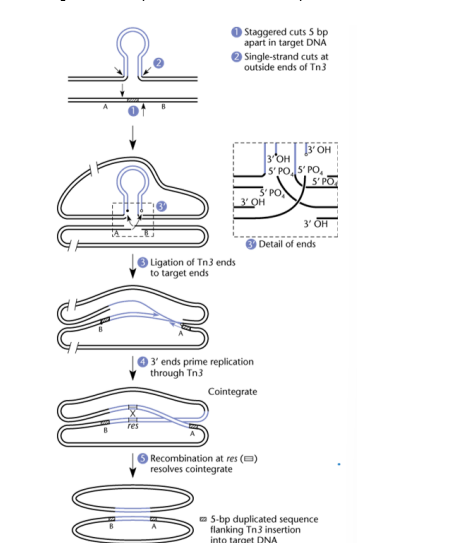
Transposase Cuts DNA
Pair of staggered, single-strand cuts is made in the target sequence
Pair of single-strand breaks is made at opposite ends of the transposon (at the inverted repeats, one cut per strand)
Each free 3’ end of the transposon is joined to 5’ end of the cut target site by transposase
Free 3’ ends of target DNA provide a primer for replication —> extending this creates copy of transposon
Remaining 3’/5’ ends are joined together by DNA ligase to form the cointegrate
Resolution: Recombination between TWO res sites in cointegrate is promoted by resolvase
Separates cointegrated into donor + target molecules, each contains copy of transposon
Target site is duplicated to form direct repeats
Replicative Transposition Diagram
Non-Replicative Transposition
Used by composite transposons
-Transposition occurs by a cut and paste mechanism
No duplication of transposon
No co-integrate is formed
No resolvase/res site needed
Mechanisms of Non-Replicative Transposition
Transposase - makes double-stranded break at each end of transposon
Uses inverted repeats to identify where to make these cuts
Transposases makes a pair of staggered single-stranded breaks in the target DNA (one in each strand)
Free 3’ ends of the transposon are joined to the free 5’ ends of the target DNA (the overhang)
Gaps are filled by DNA replication, and nicks are sealed by DNA ligase
This creates direct repeats in the target sequence
Broken ends in the donor DNA (at the site of the original double-stranded cuts) may be religated together
If this does not happen, the donor DNA will be destroyed
Transposons and Genetic Diversity
Transposons can produce genetic diversity, can pick up genes and
Move them within the chromosome
Transfer them between DNA molecules
-Produces repetitive sequences in genomes, mediates large-scale chromosome changes and rearrangements
Parkhill - Case Study
Examined two strains of Bordetella (pertussis vs bronchiseptica)
-Pertussis is highly pathogenic, causes whooping cough, has lots of IS elements (>360) and makes pertussis toxin
-Bronchiseptica is low pathogenicity, asymptomatic respiration infections with no IS elements, no pertussis toxin expressed
Why is B. pertussis More Pathogenic?
B. pertussis genome has significant deletion and rearrangement, mediated by IS elements
-Caused loss of many surface-exposed virulence factors (poor immune system recognition)
-Lost regulation of toxin production