Microbio Lecture 2- Survey of microorganisms (viruses and other infectious agents)
 Call Kai
 Learn
 Practice Test
 Spaced Repetition
 Match
 Flashcards
 Knowt Play
1/65

There's no tags or description
Looks like no tags are added yet.
66 Terms
infectious agents
viruses, viroids, prions
microorganisms
bacteria, cyanobacteria, algae, fungi, protozoa
Virus
A noncellular particle that infects a host cell and directs it to produce progeny particles. (more viruses)
only living when in a cell
Different viruses infect all forms of living cell
virus or virion consists of
a viral genome (DNA or RNA)
contained within a protein capsid
Host Range
The range of host species infected by a given virus.
viruses on earth
10^32
viral genome contain
only information for taking over host cell − "Early" genes
And information for making viral proteins - Capsid, genome replication proteins
bacteriophage infection
1. Phage binds host enevlope and insters DNA
2. Progeny phages are replicated
3. Phages are released
burst size
The number of virus particles released from a lysed host cell.
ending polio
bill and melinda gates foundation
vaccinate millions of children, helping reduce polio cases by over 99% globally
wild polio in africa eradicated
gaza war: polio is a new threat
viruses infect
specific hosts
TEM
transmission electron microscope
shows is internal structures of cells
measles in us
us lost its measles elimination status in october
Viroids (5)
smaller than a virus
RNA only (single stranded and circular) , no protein capsid
They are replicated by host RNA polymerase.
RNA can have catalytic activity
- Capable of infecting plants
prions (4)
- Protein only, no nucleic acid tht infects animals
- Cause of "mad cow" disease
- Protein structure abnormal that alters the conformation of other normal proteins.
- Induces same protein in brain to alter structure
viral infected tulips
Tulip virus •
Transmitted directly from plant to plant through the bulbs
• Has been purposely maintained for its desirable variegation
normal protein confirmation
prp^c
abnormal protein confirmation
prp^sc
Prion (in cows)
mad cow disease
bovine spongiform encephalopathy
prions in humans
Creutzfeldt-Jakob disease
prion in sheep
Scrapie
prion in deer
chronic wasting disease
SEM
scanning electron microscope, only shows shape not insides
Kuru
Prion disease suffered by the Fore due to consuming humans through cannibalism specifically by consuming the brains/nervous system of the dead. Symptoms include insomnia, lack of coordination/balance, eventually death.
virion
a viral particle
virion consist of
-nucleic acid (DNA or RNA)
- Nucleic acid is surrounded by a protein coat called a capsid
- May have additional layers
Nucleocapsid
viral capsid + nucleic acid
virions lacking envelopes
naked viruses
virions having envelopes
enveloped viruses
Capsid (5)
composed of protein subunits called capsomeres
• Surrounds and protects the nucleic acid of a virus
• Determines shape (helical or isometric)
• Vehicle of transmission from 1 host cell to another
• Made of protein subunits called protomers
viral size
determined with the aid of electron microscopy;
in nanometer range 20-1000 nm length and 10- 400 nm in diameter
100-1000 times smaller than the cells they infect
largest human virus
Poxvirus
Poxvirus
- ~200-350 nm, brick-shaped (irregular shape)
- dsDNA enveloped virus
- Causes smallpox and cowpox
smallest human viruses
Parvovirus and poliovirus/picornavirus
18-30 nm
parovirus
o ssDNA, non-enveloped virus
o Causes fifth disease, anemia in immunocompromised
poliovirus/ picornavirus
o ssRNA, non-enveloped virus
o Causes poliomyelitis, hepatitis A
viral shapes
filamentous or helical
polyhedral
complex
filamentous or helical +ex
• Shaped like hollow tubes with protein walls
• Filamentous, resembles long rods
• May be rigid or flexible
• Viral nucleic acid is within a hollow, cylindrical capsid that has a helical structure
• e.g. rabies virus, ebola virus
Symmetrical Virions
Icosahedral viruses
Filamentous viruses
poly-hedral virus +ex (5)
Many-sided •
Shape of many animal, plant and bacterial viruses
• Capsid shape is usually icosahedron (most common shape)
Capsomeres form an equilateral triangle
e.g. adenovirus, poliovirus
icosahedral capsid
An icosahedron is a regular polyhedron with 20 equilateral faces and 12 vertices
natures fav shape
capsomere
- ring or knob-shaped units made of 5 or 6 protomers
pentamers
(pentons) 5 subunit capsomers
hexamers
(hexons) - 6 subunit capsomers
complex shape 4 +ex
Some viruses, especially bacteriophage, have complex structures - e.g. tail sheaths, tail fibers, plate, pin
• Capsid (isometric head) contains the viral nucleic acid
• many viruses do not fit into the category of having filamentous/helical or icosahedral capsids -
examples are the bacteriophages and poxviruse
influenza viruses are
RNA viruses that lack capsid symmetry.
Instead, the RNA segments are coated with nucleocapsid proteins.
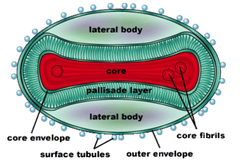
poxviruses (5)
Their genome is surrounded by several layers.
A core envelope studded with spike proteins
An outer membrane
Also contain a large number of accessory proteins
These are needed early in viral infection.
two types of virions
enveloped and naked
enveloped virions
has an additional outer covering over the protein capsid - Present on some virions that infect animal (human) cells
naked virions
has no envelope around the capsid - Virtually all bacteria viruses are naked
viral envelope
An outer, flexible, membranous layer covering the capsid of some viruses
• Protects the capsid
• Composed of lipids, proteins, and carbohydrates
• Matrix protein lies just inside the lipid envelope
• Site of attachment with viral spikes or peplomer
Envelope is derived from
m the host cell's plasma membrane
ex of viruses with envelope
e.g. herpes simplex virus, an enveloped icosahedral virus
viral spikes (peplomers)
-present on some enveloped viruses
- carbohydrate-protein complexes that project from the surface of the envelope
- used by some viruses to attach to the host cell
-- especially tailless animal viruses
-- bacterial viruses use tail fibers to attach to the host cell

host immune system
recognizes and reacts with surface proteins
Virus escapes antibodies by
changing their surface proteins.
e.g. Influenzavirus, changes its spikes = Why you get the flu more than once
viral spikes are a means of
identifying some viruses
clump red blood cells due to spikes (hemagglutination); the basis for several clinical lab tests
Influenzavirus has the ability to
clump red blood cells due to spikes (hemagglutination); the basis for several clinical lab tests
antigenic drift
changes through evolution causes our body to not recognize the H/N in influenza
natural occurring mutations
antigenic shift
two or more different strands get in the same individual
more than one strand enters individuals
Types of influenza virus
Type A- can infect multiple species
Type B- has not been categorized into subtypes
Type A influenza
Most common cause of human flu epidemics has HN
The "H" stands for hemagglutinin, and the "N" stands for neuraminidase.
flu shot holds
3 or 4 strands of flu
3 strands
trivalent
4 strands
quadrivalent
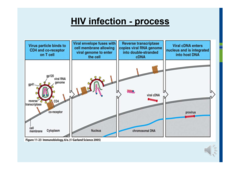
HIV viral envelope
1. binds to CD4
2. binds to CCR5 or CXCR4 and gets closer to host cell
3. entire nucleocapsid enters host cells