3007 wk 10 lec (no wk 9)

0.0(0)
Studied by 0 people
call kaiCall Kai
learnLearn
examPractice Test
spaced repetitionSpaced Repetition
heart puzzleMatch
flashcardsFlashcards
GameKnowt Play
Card Sorting

1/22

flashcard set

Earn XP

Description and Tags

triage

23 Terms

1
New cards
term image
2
New cards

Triage meaning

  • Sort

  • Seperate

  • Organise


Consider the clinical urgency of a patient’s presentation

e.g. what is the max amount of time a patient can wait until they receive medical care (consider risk of deterioration)


3
New cards

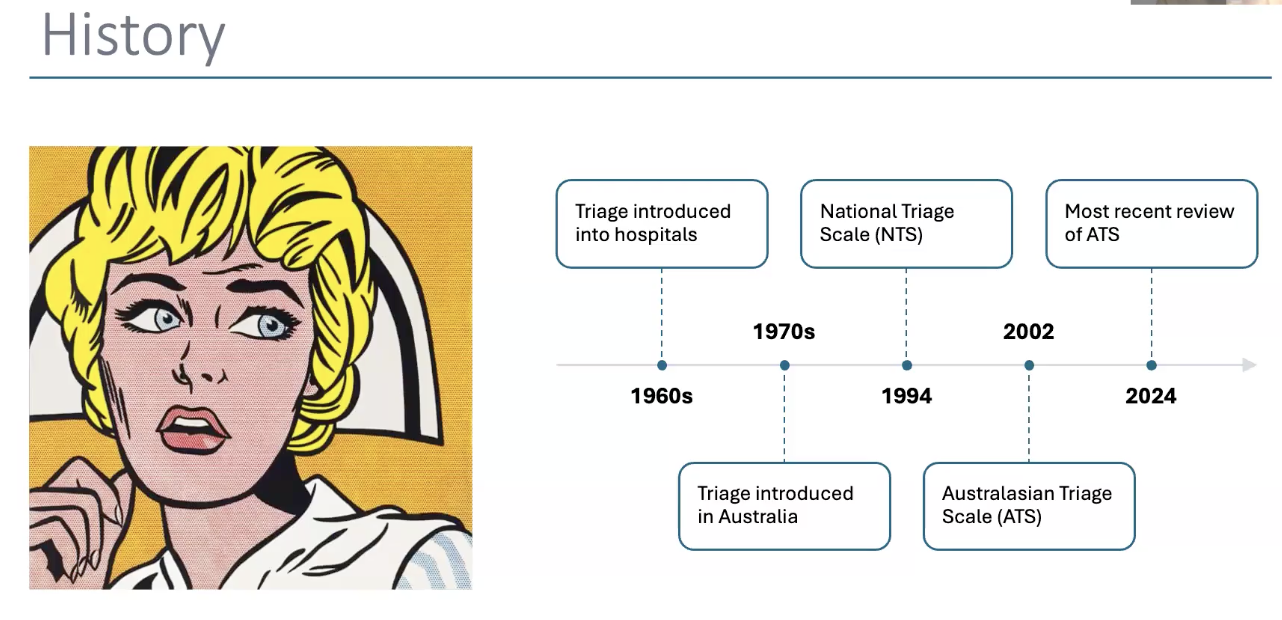
History of Triage

Originates from military settings

  • Considering the resources we have

  • The urgency of care

  • The time and resources required compared to the possible outcome (e.g. doing so much for little benefit such as the pt may be close to death)

<p><strong>Originates from military settings</strong></p><ul><li><p>Considering the resources we have</p></li><li><p>The urgency of care</p></li><li><p>The time and resources required compared to the possible outcome (e.g. doing so much for little benefit such as the pt may be close to death)</p></li></ul><p></p>
4
New cards

Purpose of Triage in Healthcare

To ensure emergency care is delivered according to clinical urgency and patient need

  • Analysing and assessing the patient


5
New cards

Systematic approach to triage

1) Patient presents

  • Consider red flags


2) Does the patient require immediate intervention?


NO

  • Conduct triage assessment

    • S&S

    • Primary survey (ABCDE) +/- vital signs

    • PMHx

    • Focused SYMPTOM assessment

    • Identify red flags!!!


After assessment, you identify urgent intervention required:

= Assign TRIAGE CATEGORY

YES

= Assign TRIAGE CATEGORY

<p><strong>1) Patient presents</strong></p><ul><li><p>Consider red flags</p></li></ul><p></p><p><strong>2) Does the patient require <mark data-color="#c70000" style="background-color: rgb(199, 0, 0); color: inherit;">immediate intervention?</mark></strong></p><p></p><p><strong>NO</strong></p><ul><li><p>Conduct triage assessment</p><ul><li><p>S&amp;S</p></li><li><p>Primary survey (ABCDE) +/- vital signs</p></li><li><p>PMHx</p></li><li><p><strong><mark data-color="#980000" style="background-color: rgb(152, 0, 0); color: inherit;">Focused SYMPTOM assessment</mark></strong></p></li><li><p><strong><em>Identify red flags!!!</em></strong></p></li></ul></li></ul><p></p><p><em>After assessment, you identify urgent intervention required:</em></p><p><strong>= <mark data-color="#d30000" style="background-color: rgb(211, 0, 0); color: inherit;">Assign TRIAGE CATEGORY</mark></strong></p><p><strong>YES</strong></p><p><strong>= <mark data-color="#d30000" style="background-color: rgb(211, 0, 0); color: inherit;">Assign TRIAGE CATEGORY</mark></strong></p>
6
New cards

Triage Categories

1 = Immediate

  • Immediate risk to airway

  • Cardiac arrest


2 = Emergency (< 10 mins)

  • Airway risk

  • Severe blood loss


3 = Urgent (< 30mins)

  • Patent airway

  • Moderate respiratory distress

  • Moderate blood loss


4 = Semi urgent (<60mins)

  • No resp distress

  • Mild haemorrhage


5 = Non urgent (<120mins)

  • Minimal to no pain lol


→ Consider the contexts of the presenting problem and the patient themself

e.g. domestic violence? repeat presentations? possible MH?

<p><strong><mark data-color="#a90000" style="background-color: rgb(169, 0, 0); color: inherit;">1 = Immediate</mark></strong></p><ul><li><p>Immediate risk to airway</p></li><li><p>Cardiac arrest</p></li></ul><p></p><p><strong><mark data-color="#c25e00" style="background-color: rgb(194, 94, 0); color: inherit;">2 = Emergency</mark></strong><mark data-color="#c25e00" style="background-color: rgb(194, 94, 0); color: inherit;"> (&lt; 10 mins)</mark></p><ul><li><p>Airway risk</p></li><li><p>Severe blood loss</p></li></ul><p></p><p><strong><mark data-color="#007c0e" style="background-color: rgb(0, 124, 14); color: inherit;">3 = Urgent </mark></strong><mark data-color="#007c0e" style="background-color: rgb(0, 124, 14); color: inherit;">(&lt; 30mins)</mark></p><ul><li><p>Patent airway</p></li><li><p>Moderate respiratory distress</p></li><li><p>Moderate blood loss</p></li></ul><p></p><p><strong><mark data-color="#160096" style="background-color: rgb(22, 0, 150); color: inherit;">4 = Semi urgent </mark></strong><mark data-color="#160096" style="background-color: rgb(22, 0, 150); color: inherit;">(&lt;60mins)</mark></p><ul><li><p>No resp distress</p></li><li><p>Mild haemorrhage</p></li></ul><p></p><p><span style="color: rgb(0, 0, 0);"><strong><mark data-color="#ffffff" style="background-color: rgb(255, 255, 255); color: inherit;">5 = Non urgent </mark></strong><mark data-color="#ffffff" style="background-color: rgb(255, 255, 255); color: inherit;">(&lt;120mins)</mark></span></p><ul><li><p>Minimal to no pain lol</p></li></ul><p></p><p><strong><em>→ Consider the contexts of the presenting problem and the patient themself</em></strong></p><p><em>e.g. domestic violence? repeat presentations? possible MH?</em></p>
7
New cards

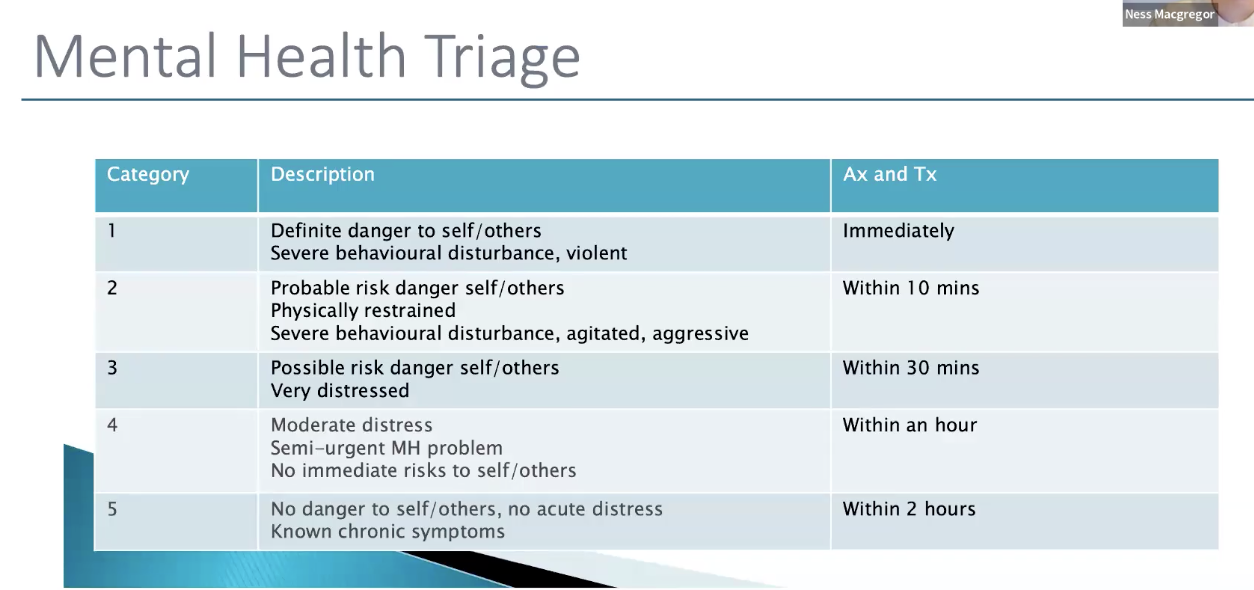
Mental Health Triage

Category 1 (immediately)

  • Definite danger to self/others


Category 2 (<10 min)

  • Probable risk danger self/others


Category 3 (<30min)

  • Possible risk danger self/others

  • Very distressed


Category 4 (<1hr)

  • Moderate distress

  • Semi-urgent MH problem


Category 5 (<2hrs)

  • No danger to self/others


<p><strong><mark data-color="#bf0000" style="background-color: rgb(191, 0, 0); color: inherit;">Category 1 (immediately)</mark></strong></p><ul><li><p>Definite danger to self/others</p></li></ul><p></p><p><strong><mark data-color="#ed7b00" style="background-color: rgb(237, 123, 0); color: inherit;">Category 2 (&lt;10 min)</mark></strong></p><ul><li><p>Probable risk danger self/others</p></li></ul><p></p><p><strong><mark data-color="#0c9500" style="background-color: rgb(12, 149, 0); color: inherit;">Category 3 (&lt;30min)</mark></strong></p><ul><li><p>Possible risk danger self/others</p></li><li><p>Very distressed</p></li></ul><p></p><p><strong><mark data-color="#1700cb" style="background-color: rgb(23, 0, 203); color: inherit;">Category 4 (&lt;1hr)</mark></strong></p><ul><li><p>Moderate distress</p></li><li><p>Semi-urgent MH problem</p></li></ul><p></p><p><span style="color: rgb(0, 0, 0);"><strong><mark data-color="#ffffff" style="background-color: rgb(255, 255, 255); color: inherit;">Category 5 (&lt;2hrs)</mark></strong></span></p><ul><li><p>No danger to self/others</p></li></ul><p></p>
8
New cards

Triage Process

Visual scan of the patients awaiting triage

We are NOT diagnosing here! We are simply assessing and reviewing the severity of presentations in order to correctly organise and coordinate the appropriate care for the patient


  • Introduce yourself and your role

  • Identify the PRESENTING PROBLEM(USE OPEN ENDED QUESTIONS)

    • Ask appropriate questions

    • Collect physiological data

  • Allocate triage category using your clinical judgement and presenting factors

    • Determine where treatment is required

    • End the interaction appropriately


Finish by DOCUMENTING FINDINGS


9
New cards

Triage Role

Generally a SENIOR role

  • Making significant clinical decisions and using clinical judgement (one that often requires great experience)

  • Critical thinkning

  • Understanding patient flow and how to stream line / connect patients to the rights services and treatment is critical in patients receiving the best health outcomes

    • An aspect which senior nurses are often most familiar with


10
New cards

Example questions to use in Triage

“What’s changed?”


“What is your emergency today?”


“Have you had this before?”


Using visual cues and acting out (esp for patients with minimal English)

  • Remaining professional

  • Speaking with the appropriate tone and pace


11
New cards

Things to note and be mindful of in Triage

Environment

  • Privacy

  • Distractions

  • Isolation


Special populations

  • Ambulance

  • Batcalls

  • Paediatric (e.g. considering differences in vital sign parameters)

  • Elderly

  • Pregnancy

  • First Nations People

  • Disaster events (e.g. multiple people presenting with the same issue from the same situation)


Consider our duty of care

  • Mandatory reporting

  • Preservation of forensic evidence

  • Emotional & psychosocial support


12
New cards

Challenges with Triage

  • Crowded and busy - lots of people

  • Environment

  • Time (constant pressure)


  • Aggression (think about the news on aggression in ED lol)

  • Communicable disease (e.g. COVID, chickenpox, influenza)


13
New cards

Ethical tension in Triage

Prioritisation of someone over another

Deliberately delaying the treatment of a person for someone else


  • Considering beneficence and non-maleficence

  • Distributive justice


14
New cards

Summary of Triage

  • Rapid systematic patient assessment

    • Determine urgency


  • Triage starts from when you first see the patient


  • Collect only PERTINENT (relevant to the presentation) information and consider any RED FLAGS


  • Remember that you are the patient’s FIRST impression / interaction on emergency (may influence future presentations etc.)


  • Triage is an ONGOING process


15
New cards
16
New cards
17
New cards
18
New cards
19
New cards
20
New cards
21
New cards
22
New cards
23
New cards