PHYSL 210 Special Senses 3
 Call Kai
 Learn
 Practice Test
 Spaced Repetition
 Match
 Flashcards
 Knowt Play
1/35

There's no tags or description
Looks like no tags are added yet.
36 Terms
Photoreceptors in darkness
They are depolarized and release glutamate onto bipolar cells.
Effect of light on photoreceptors
Light hyperpolarizes photoreceptors, decreasing glutamate release.

Photoreceptor and bipolar cell signaling
Both produce graded responses because they lack channels that mediate action potentials.
First visual pathway cells to generate action potentials
Ganglion cells.

ON-bipolar cells without input
They spontaneously depolarize.
OFF-bipolar cells without input
They spontaneously hyperpolarize.
ON-bipolar glutamate receptors
Inhibitory metabotropic receptors trigger cGMP breakdown and hyperpolarize the cell.
ON-pathway response to light
Bipolar cells depolarize, increasing ganglion-cell action potential frequency.
ON-pathway response to darkness
Ganglion cells are not stimulated to fire action potentials.
OFF-bipolar glutamate receptors
Excitatory ionotropic receptors act as nonselective cation channels.
OFF-pathway response to darkness
Glutamate depolarizes bipolar cells, stimulating ganglion cells to fire.
OFF-pathway response to light
Ganglion cells generate fewer action potentials.
Function of coexisting ON and OFF pathways
They improve image resolution by enhancing perception of contrast at borders.
Nasal retinal pathways at the optic chiasm
They cross to the contralateral side.
Temporal retinal pathways at the optic chiasm
They remain on the ipsilateral side.
Binocular visual zone
The region where the left and right visual fields overlap.
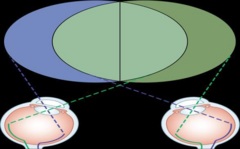
Monocular visual zone
The part of the visual field associated with only one eye.
Sound transmission
Vibrations of molecules carry sound through gases, liquids, or solids.
Sound in a vacuum
Sound cannot travel without molecules.
Sound frequency
The number of cycles per second; it determines pitch.
Sound amplitude
It corresponds to loudness.
Sound waves in air
They produce alternating zones of compression and rarefaction.
Middle ear ossicles
Malleus, incus, and stapes.

Tympanic membrane and sound
Incoming sound causes the membrane to deflect.

Ossicle movement
Movement of the middle ear bones moves the oval window membrane.

Basilar membrane movement
It activates sensory receptors in the cochlea.

Round window membrane
It moves during sound transmission through the cochlea.
Cochlear duct location
It lies between the scala vestibuli and scala tympani.
Organ of Corti
The cochlear sensory structure contains inner and outer hair cells.
Hair-cell stereocilia
Tip links connect the stereocilia and can become stretched or slack.

Stretched hair-cell tip links
They are associated with potassium entry and neurotransmitter release.
Cochlear nerve fibers
They synapse with interneurons in the brainstem.
Auditory pathway beyond the brainstem
A multineuron pathway passes through the thalamus to the auditory cortex.
Auditory cortex location
Temporal lobe.
Hearing aid
An amplifier in the auditory canal activates existing auditory machinery.
Cochlear implant
An external audio sensor activates electrodes that stimulate the cochlear nerve.
