Behavioral Ecology Exam 2
 Call Kai
 Learn
 Practice Test
 Spaced Repetition
 Match
 Flashcards
 Knowt Play
1/46

There's no tags or description
Looks like no tags are added yet.
47 Terms
How does a predator get better at spotting camouflaged prey, why do prey and predators keep escalating, and why use more than one sense?
Search image: a learned picture of one prey, from seeing the same camouflaged prey over and over. Mixed prey → no search image. Result: faster, more accurate
Arms race: prey adapt, predators counteradapt, back and forth forever
Multiple senses: more cues = more efficient feeding. Vision helps most
Hook: “Where’s Waldo.” Find him a few times and you spot him instantly.
Optimal diet model: 3 assumptions
Want: maximize energy per unit of time (rate)
Find: food is found one at a time, as often as it’s common
Judge: foods can be ranked by profitability
Hook: “Rate, Run-into, Rank.”
Profitability formula
Profitability = energy ÷ handling time (J/s)
Handling time: time spent dealing with food before eating it (cracking, peeling)
Search time is NOT included
Example: 10 J ÷ 8 s = 1.25 J/s
Hook: a pistachio is less profitable than an M&M, because it takes forever to crack.
Calculating the optimal diet
Rank by profitability → add one at a time (A, A+B, A+B+C…) → rate each → pick the highest
Rate = avg energy ÷ (avg search + avg handling)
Why it peaks: more foods = less search, more handling
Slide answer: eat A, B, C, ignore D and E (0.83 J/s)
If energies differ, average them too
Hook: “Rank, Add, Rate, Pick.” Keep adding buffet dishes until the next one isn’t worth the time.
Zero-one rule vs. partial preference
Zero-one rule: each food is always eaten or always rejected. No “sometimes”
Partial preference: sometimes eating a food, which breaks the rule
Crows broke it, probably because they don’t have perfect knowledge
Hook: zero-one = a light switch (on or off). Partial preference = a dimmer.
How do crows open clams, what did researchers measure and predict, how close were the crows, and what rule did they break?
Open clams: drop them on rocks
Measured: energy, number of drops (handling time), and abundance (search time)
Predicted: eat clams over 29 mm, reject smaller ones
Result: very close. Over 30 mm almost always eaten, under 28 mm almost always rejected
Broke the zero-one rule: partial preference near the cutoff, from imperfect knowledge
Hook: crows are good at math but not perfect. Near 29 mm, they guess.
Which ants chose salt vs. sugar based on distance from a salted road, and what does that say about diet?
Setup: sugar vs. salt vials placed 1–1000 m from a road salted every winter
Near the road: chose sugar (fewer than 10% picked salt)
Farther away: chose salt more and more
Conclusion: sodium shortage affects diet. Not just energy
Hook: ants near the road already get salt from it. Ants far away are salt-starved and crave chips.
What 3 costs does Brown’s model add to patch use, when does the animal quit, and why isn’t travel one of them?
3 costs of feeding: energy, predation risk, missed opportunity
Quits when its food rate = those costs (the quitting harvest rate)
Same costs → same quitting rate
Travel isn’t one: these are costs while eating in a patch. Travel is between patches and is already in the MVT
Hook: “Energy, Enemies, Elsewhere” = everything that costs you while you eat.
When should an animal leave a patch, how is the average rate calculated, and how does travel time change it?
Leave when your right-now food rate drops to equal the average rate for the environment
Average rate = total energy ÷ (travel time + time in patches)
In plain words: leave when this patch is no better than moving on
Longer travel → stay longer. Shorter travel → leave sooner
Hook: if the next popcorn bowl is across the room, scrape yours clean. If it’s right next to you, switch early.
What does the patch model answer, what are diminishing returns and marginal benefit, and what are the 4 assumptions?
Answers: how long to stay in a patch
Diminishing returns: food comes fast at first, then slower as the patch empties
Marginal benefit: your right-now food rate. It keeps dropping
4 assumptions (“Greedy, Twins, Same Trip, Drains”):
Greedy: maximize energy rate
Twins: all patches identical
Same trip: travel time is constant
Drains: diminishing returns in every patch
Hook: a greedy kid walking between twin candy bowls, always the same trip apart, and each bowl drains.
Giving-up density (GUD): what it is, high vs. low, and what changes it
GUD = leftovers. The food still in the patch when the animal walks away
More leftovers (high GUD) = it felt unsafe, so it left early
Fewer leftovers (low GUD) = it felt safe, so it cleaned the plate
Feels unsafe → more leftovers: open areas, predators nearby, light
Feels safe → fewer leftovers: cover like bushes
Same costs = same leftovers. A full bowl and a half bowl in the same spot both get eaten down to the same crumbs. The full one just takes longer (bats)
Hook: sketchy alley vs. your couch. In the alley, you leave half your fries. On the couch, you lick the plate.
How do animals judge how good a patch is when they don’t know, and how long do they stay in a mixed vs. uniform environment?
Bayesian estimation: combine what you’re finding now (sample) with what you already know about patches in the area (prior)
Why: the patch model assumes animals know patch quality, but real animals have to estimate it
High-variance (mixed rich and poor) → stay longer. This patch might be a jackpot
Uniform (all the same) → leave sooner
Hook: scratch-offs. If some win big, keep scratching. If they all pay the same, move on.
How do prey avoid being seen, what do slow prey do once they’re spotted, and how do tiger moths escape bats?
Crypsis: coloring that matches the background. Prey choose matching backgrounds, especially when danger is high
Evasive maneuvers: slow prey can’t outrun predators, so they make sudden, unpredictable moves
Tiger moths: bats hunt with sonar, so the moth stops flying and drops erratically
Hook: crypsis = camo. Tiger moth = “can’t outrun it? Fall out of the sky.”
Vigilance and the group size effect
Vigilance = looking out for predators
The cost: you can’t eat (head down) and watch (head up) at once, so more watching = less eating
More danger → more watching, less eating (elk in wolf areas, females only)
Group size effect: bigger group → each animal watches less → eats more
Hook: you can’t text and watch the road at the same time. But if friends are watching the road, you can text.
Dilution effect and selfish herd
Dilution effect: more animals around = lower chance you’re the one killed
So animals join bigger groups when risk is high (fish: groups of 10 under risk vs. 2 without)
Selfish herd: predators grab animals on the edge, so move to the center
Edge animals scan more and eat less
Hook: dilution = 1-in-100 odds. Selfish herd = human shield.
Flash disappearance
Prey show a bright color while fleeing, then hide it when they stop
The predator keeps searching for the bright animal and loses track of it
Hook: turning off a flashlight. The predator was following the light, and suddenly it’s gone.
How do prey fight back against predators, alone vs. in groups, and what does it accomplish?
Harassment: one animal rushes around a predator and makes noise
Why: it tells the predator “I see you, and I’m ready to fight”
Example: ground squirrels wave and heat up their tails at rattlesnakes, which sense heat. They don’t bother with gopher snakes, which can’t
Mobbing: many animals harass the predator together
Why: a group is more annoying and dangerous than one animal alone
Move-on hypothesis: mobbing makes the predator leave
Why it works: a predator that’s been spotted and swarmed can’t hunt by surprise, so it moves somewhere else
Evidence: owls left in 20% of mobbings, and mobbing species had 10x less predation
Hook: harassment = one heckler. Mobbing = a whole crowd booing. Move-on = booed off the stage.
Why do prey advertise themselves, what does each hypothesis predict, and which one did the deer support?
Advertise: stotting or tail flagging, showing yourself on purpose
Alarm signal: warns friends. Prediction: alone → do it less
Pursuit-deterrence: tells the predator “you lost the surprise.” Prediction: farther predator → do it more
Deer: alone = in groups, and more flagging with distance → pursuit-deterrence
Hook: alarm talks to friends. Pursuit-deterrence talks to the predator. Deer talk to the predator.
What’s a behavioral trade-off? When predators are around, what do animals do less of, and when do they take the risk anyway?
Trade-off: give up one thing to get another. Very common with predators
Predators around → do less: moving, eating, mating
Take the risk anyway when the prize is big:
A mate: males leave shelter sooner if a female is near
Food when hungry: feed in riskier spots with more food
How did the smell of injured newts affect male mate search, and how did it change in breeding season?
Injured-newt smell = danger
More danger smell → fewer males entered traps, even with a female inside
Breeding season → less avoidance, especially in males
Trade-off: mate vs. safety
Hook: “I want the date, but not if it smells like a crime scene.” Except in breeding season, when males get brave.
When do squirrels carry food to safety vs. eat it on the spot, and why?
Trade-off: eating safely vs. eating efficiently
Bigger food → carried more: same carrying cost, but big food takes longer to eat, so more time exposed
Farther from the tree → carried less
Small (1 g) food: almost never carried
Hook: eat a cracker on the spot. Take a sandwich somewhere safe, unless safety is too far.
What’s the difference between dispersal and migration, what are the 2 types of dispersal, and what’s the opposite of breeding dispersal?
Dispersal: short, one-way move
Migration: long, two-way round trip
2 types of dispersal:
Natal: leaving your birthplace
Breeding: leaving one breeding site for another
Opposite of breeding dispersal: site fidelity, staying at or returning to the same breeding site
Hook: dispersal = moving out of your parents’ house. Migration = a vacation and coming home. Natal = “native” (birthplace). Fidelity = loyalty to your spot.
What pushes animals to disperse vs. migrate, and which reason causes both?
Dispersal only = DRAMA:
Avoid relatives (inbreeding). Males leave more
Breeding failed
Migration only = WEATHER:
Food moves (wildebeest follow grass)
Unstable environment
BOTH = CROWDS: more crowding or less food → more leaving
Hook: “Drama → disperse. Weather → migrate. Crowds → both.”
What does win-stay lose-shift tell an animal to do, how did dragonflies show it, and what’s the difference between personal and public information?
Win-stay lose-shift: breeding went well → come back. Went badly → move
Dragonflies: all successful males came back, but only about half of the unsuccessful ones
Personal info: your own results (what win-stay lose-shift uses)
Public info: watching how others did (kittiwakes)
Hook: win-stay lose-shift = a slot machine. If it paid, keep playing. If not, switch. Personal info = your one meal. Public info = reading the reviews.
How did researchers test whether kittiwakes watch their neighbors to decide whether to return, and what happened?
Setup: researchers removed eggs to make nests fail
Treatment: everyone failed
Control: only the focal bird failed, and its neighbors succeeded
Results:
Neighbors succeeded → 70% came back
Everyone failed → under 50% came back
Conclusion: kittiwakes use public information (they watch their neighbors)
Hook: “My nest failed, but everyone else did great, so it’s a good spot and I got unlucky.” If everyone failed, the spot is bad, so leave.
What are resident, partial, and migratory populations, what makes a population shift between them, and what are the 2 explanations for having both types?
Resident: no one migrates. Partial: some do. Migratory: everyone does
What makes it shift: who does better by migrating
Only some individuals do better leaving → those leave, the rest stay → partial
Everyone does better leaving → everyone leaves → migratory
Works in reverse: if migrants start doing worse, they stop
Why some leave and some stay (2 ideas):
Genetic: you’re born a migrant or a resident. Both types stick around because each does better when it’s rarer (frequency-dependent selection)
Condition-dependent: each animal decides based on how it’s doing. Strong ones stay, weak ones leave
Dippers proved #2: some birds switched year to year, and you can’t switch your genes
Hook: a ladder: resident ↔ partial ↔ migratory. Each animal climbs toward whatever pays off. “Born that way” vs. “depends how you’re doing.”
In dippers, who did better, residents or migrants, what decides which birds migrate, and how do we know it’s not genetic?
Residents did better: about 2.6 more offspring, every year
Condition decides: only birds in bad condition migrate
Not genetic: some birds switched between migrating and staying, so it’s flexible (plastic)
Hook: migrating is the backup plan. Strong birds keep their homes, and weak ones leave. You can’t switch your genes, so switching proves it’s not genetic.
Orientation vs. navigation vs. bicoordinate navigation
Orientation: keeping a direction (a compass)
Navigation: finding a specific place (a map)
Bicoordinate navigation: knowing where you are using two gradients, like latitude and longitude, even somewhere new
Example: sea turtles use the magnetic field as a map. It’s inherited
Hook: compass vs. map. Bicoordinate = x and y on a graph.
Clock shifts
Why: sun compass + wrong time → misjudges the sun → wrong direction
How far: 15° per hour (6 hours = 90°)
Which way (face the normal direction):
Behind (late) → clockwise
Ahead (early) → counterclockwise
Lights on later = behind. Lights on earlier = ahead
Monarchs: 6 hours behind → 90° right → west instead of south
Why do dung beetles roll in a straight line, how do they keep it straight day and night, and do they have a compass or a map?
Why: escape the pile so no one steals the ball
How: climb on the ball and “dance” to get bearings
Cues: sun by day, moonlight by night, Milky Way on moonless nights
Compass only (orientation), no map, unlike warblers
Hook: escape the crowd in a straight line. Compass, not map.
What happened when warblers were moved 1000 km east during migration, and what does that show they use?
Normal spring direction: northeast
Moved 1000 km east, then direction tested in Emlen funnels
Displaced birds went northwest, correcting back toward their goal
Shows: bicoordinate navigation (a map), unlike dung beetles
Hook: driven 1000 km east while you sleep? A compass keeps you going northeast. A map tells you to correct.
What 3 compasses do animals use to find home, and what do pigeons, salmon, sea turtles, and monarchs each rely on?
3 compasses: sun, stars, magnetic
Pigeons: sun → magnetic on cloudy days, plus smell. Backups matter
Salmon: smell of their home stream + magnetic
Sea turtles: magnetic (field reversed → turned the wrong way)
Monarchs: sun, using their antennae
What are the 5 assumptions of the ideal free distribution, and what do “ideal” and “free” mean?
Maximize fitness
Habitats differ in resources
More individuals → lower fitness for each (negatively density-dependent)
Everyone is an equal competitor
Move freely, at no cost
Ideal = they know habitat quality and are equal.
Free = they can go anywhere at no cost
Hook: grocery checkout lines. Everyone knows which line is shortest (ideal) and can switch lines anytime (free).
What does the IFD predict about how many individuals settle in each habitat and how their fitness compares, and what happens as density rises?
Better habitat → proportionally more individuals (twice as good = twice as many)
Everyone ends up with the same fitness
As density rises: the best habitat fills up first, then the next one, until all are used
Guppies: matched the IFD once they learned where the food was (not in the morning, but by noon and evening)
Hook: everyone switches to the shortest line until all lines take the same time.
What is an isodar, how do you make one, why does the IFD predict a straight line, and what did the pike show?
What it is: a graph that tests the IFD. Each year = one dot (number in habitat 1 vs. number in habitat 2)
Why a straight line:
A better habitat gets more animals, but each animal does equally well (more food, more mouths, same share)
So the split stays the same every year. If one habitat is twice as good, it always has twice as many
Same split every year → dots line up straight
Name: iso = same, dar = Darwinian fitness. Every dot is a year of equal fitness in both habitats
Pike (50 years, 2 basins):
More pike → lower fitness (the IFD’s assumption) ✅
Dots made a straight line (the IFD’s prediction) ✅
Hook: a large pizza and a small pizza at a party. Twice as many people crowd the large one, so everyone gets the same slices. Bigger party or smaller party, the crowd always splits the same way, so it graphs as a straight line.

What is conspecific attraction? Explain the Allee effect and conspecific cueing, and who did redstarts’ songs attract?
1. The twist
The IFD says more neighbors = lower fitness
But some animals prefer to settle near their own species (conspecific attraction)
2. Two reasons
Allee effect: when there are very few of you, more neighbors = higher fitness
Why: easier to find mates, spot predators, and so on
Conspecific cueing: others being there = a sign the spot is good
Why: if others chose it, it’s probably safe and has food
3. Redstarts
Playing male songs drew in new immigrant adults
Returning adults and yearlings didn’t care
Why: the newcomers didn’t know the area, so they used others as a clue
Conservation use: playing songs helps endangered birds settle in restored habitat
Hook:
Allee effect = a party with 3 people is worse than one with 30
Cueing = a crowded restaurant is probably good
Territory vs. home range: which one do you fight for? Who can afford to defend one, and what shrinks it?
1. Territory vs. home range
Territory: you fight others to keep it
Home range: you use it, but don’t fight for it
2. Who can hold a territory? (damselflies)
Fighting for a territory uses up a lot of energy (fat)
Males with a territory had more fat than males without one, so you need to be in good shape to get one
Males that had to keep fighting to hold it used up their fat and had the least
Takeaway: only healthy, well-fed animals can afford a territory
3. What makes a territory smaller? (kites)
More food: you can get enough to eat in a smaller area, so you don’t need a big one
More competitors: defending a big area against lots of rivals is too much work, so you defend a smaller one
Hook: territory = your house (you kick people out). Home range = your neighborhood. Only people with money to spare can afford a house. Lots of food or lots of rivals = a smaller house.
What is game theory, what does the hawk-dove model assume, what’s its payoff matrix, and what does it predict?
Game theory: your best move depends on what others do
Hawk: fights until it wins or gets hurt. Dove: only displays, never fights
Assumes: only 2 strategies, identical fighting ability, payoffs depend on the opponent, v (prize) and c (cost)

How is the sequential assessment model different from hawk-dove, what does it predict, and what did crabs show?
Name: sequential = step by step, assessment = sizing up. So: size up your opponent step by step
Assumes: fighters differ in strength, there are many strategies, and each animal compares the opponent to itself
Rule (ESS): keep fighting only while winning is still worth the cost
Predicts:
Low-cost moves first (test cheaply)
Even matches last longer (hard to tell who’d win)
Few deaths: the likely loser backs off before getting hurt
Crabs: both predictions held. Piglets: seeing each other first → shorter, milder fights
Hook: job interview rounds. A quick phone call first (cheap test). Clear mismatches get cut early. Close candidates go through more rounds. People who know they won’t get it withdraw.
⚠ MC trap: hawk-dove = identical fighters, 2 strategies. Sequential assessment = fighters differ, many strategies.
In Magellanic penguins, when were fights intense vs. mild, and why?
Two fight types: bill duels (low-cost) and overt fights (intense, cause cuts)
Nests are worth more before egg-laying (before mid-October)
Results:
Overt fights early, bill duels later
Better nests → more fights than duels, and those males fought longer and got more cuts
Conclusion: fighting intensity depends on nest value
Hook: fight hard over the nest before the eggs, then just bicker.
How did female size affect how long male newts fought?
Size-matched males fought over a female
Bigger female → longer wrestling
Conclusion: resource value affects fight duration
Hook: newts wrestle longer for a bigger date. With the penguins: worth more → fight harder.
What’s the challenge hypothesis vs. the winner effect, and which animals show each?
Challenge hypothesis: rivals → testosterone up → stays aggressive
Sparrows: alone in captivity (no rivals) → lower testosterone
Tilapia: just watching a fight → testosterone up
Winner effect: winning → more likely to win again
Mice: more past wins → attacked faster, won more, higher testosterone
Hockey players: testosterone rose more after watching a game they won
What are an ESS, a pure ESS, and a mixed ESS, and how do you read a payoff matrix to check for a pure ESS?
ESS: a strategy that can’t be invaded
Pure ESS: one strategy wins
Mixed ESS: both coexist because each can invade the other. Their average fitness is equal
Reading the matrix: row = you, column = opponent, and the number is your payoff
Column check: in a population of all X, look down the X column. X vs. X > Y vs. X → X can’t be invaded → pure ESS
Hook: “Can a newcomer do better than the locals?” If not, the locals are an ESS.
How do you tell if a payoff matrix has one pure ESS, two pure ESSs, or a mixed ESS, and why does each happen?
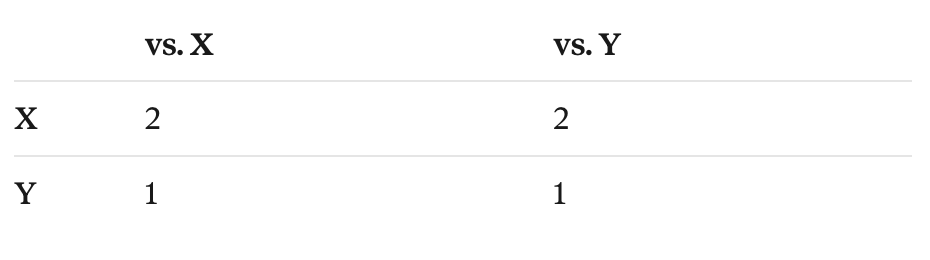

One safe → that one is the pure ESS
X is better against everyone, so it takes over
Hook: the fun person everyone copies
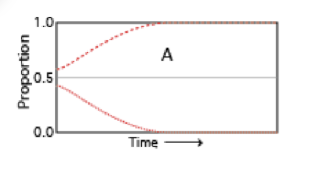
Both safe → both pure
You do best with your own kind, so the majority wins
Graph A: above 50% → 100%. Below → 0%
Hook: same language
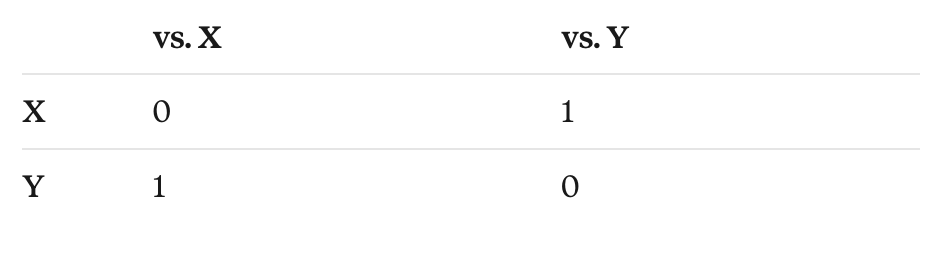
Neither safe → mixed
You do best with the other kind, so the rare one grows back
Graph B: high and low both meet in the middle
Hook: talkers and listeners

Using hawk-dove, when is hawk a pure ESS vs. a mixed ESS, how many hawks are in a mixed ESS, and why can’t everyone be a dove? (v = 8, c = 4 and v = 8, c = 10)
v = 8, c = 4 → pure hawk
vs. Hawk | vs. Dove | |
|---|---|---|
Hawk | 2 | 8 |
Dove | 0 | 4 |
2 > 0 → doves can’t invade ✅
v = 8, c = 10 → mixed
vs. Hawk | vs. Dove | |
|---|---|---|
Hawk | −1 | 8 |
Dove | 0 | 4 |
−1 < 0 → doves invade. 4 < 8 → hawks invade
Hawks = v/c = 80%
Rule: v > c → pure hawk. v < c → mixed (v/c hawks)
Why not all doves? One hawk gets 8 vs. the doves’ 4, so it spreads
Hook: fight when the prize beats the injury. Otherwise, only a few fighters fit.
Why does rock-paper-scissors have no pure ESS, and what does that say about 3-strategy games?

Each strategy beats one and loses to one
Exactly 1/3 each stays put, but any imbalance cycles forever
A 3-strategy game CAN have no pure ESS. Every 2-strategy game has at least one (pure or mixed)
Hook: it’s a loop. Whoever’s winning creates the thing that beats them.
What does an assessor do, what are its payoffs against hawks and doves, and why is it always a pure ESS?
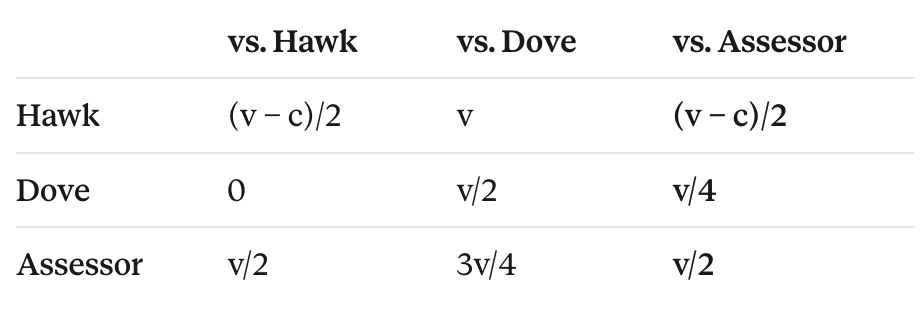
Assessor: fights only if it’s bigger. If it’s smaller, it backs off. (This is sequential assessment turned into a strategy)
Invasion check (assessor column): in a population of assessors, the assessor gets v/2, which beats a hawk (v/2 − c/2) and a dove (v/4). Newcomers die out
Why it always wins:
Hawks lose because they get hurt fighting bigger assessors
Doves lose because they give up even when they’d win
The assessor only fights when it’ll win, so it never pays the injury cost
So the assessor is a pure ESS for ANY v and c
Hook: hawk = always swings. Dove = never swings. Assessor = only swings when it’ll win. It gets the prize without the bruises, so nobody can beat it.