Psychology 4th edition Schacter Chapter 11 - Development
 Call Kai
 Learn
 Practice Test
 Spaced Repetition
 Match
 Flashcards
 Knowt Play
1/79

There's no tags or description
Looks like no tags are added yet.
80 Terms
Developmental Psychology
The study of continuity and change across the lifespan.
Germinal Stage
The 2-week period of prenatal development that begins at conception.

embryo
the developing human organism from about 2 weeks after fertilization through the second month

Human embryonic and fetal development

Embryonic Stage
The period of prenatal development and lasts from the 2nd week until about 8th.
Fetal Stage
The period of prenatal development that lasts from the 9th week until birth.

Fetal Neural Development
Begins with neuron development in the first trimester; completing with myelination by end of 3rd trimester.
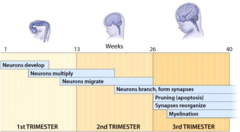
Myelination
The formation of a fatty sheath around the axons of a neuron.

Teratogens
Agents that damage the process of development, such as drugs and viruses.

Fetal Alcohol Syndrome
A developmental disorder that stems from heavy alcohol use by the mother during pregnancy.

Infancy
The stage of development that begins at birth and lasts between 18 and 24 months.

Motor Development
The emergence of the ability to execute physical action.

Reflexes
Specific patterns of motor response that are triggered by specific patterns of sensory stimulation.

2 general rules of development
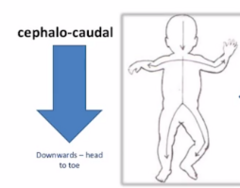
1) Cephalocaudal
2) Proximodistal
cephalocaudal rule (top to bottom)
describes the tendency for motor skills to emerge in sequence from the head to the feet.
Cephalo = Head
Caudal = tail
proximodistal rule (inside to outside)
describes the tendency for motor skills to emerge in sequence from the center to the periphery.

Cognitive Development (Piaget)
The emergence of the ability to think and understand.

Stages of Cognitive Development
1) sensorimotor,
2) preoperational,
3) concrete operational, and
4) formal operational

Sensorimotor Stage (stage 1 A: birth-2yo)
A stage of development that begins at birth and lasts through infancy in which infants acquire information about the world by sensing it and moving around within it.
Infant experiences the world through movement and senses, develops schemas, begins to act intentionally, and shows evidence of understanding object permanence.

Schemas
theories about or models of the way the world works

Assimilation
The process by which infants apply their schemas in novel situations.
Accommodation
The process by which infants revise their schemas in light of new information.
Object Permanence
The belief that objects continue to exist even when they are not visible.

Preferential looking time (Fantz)
A technique that uses the length of a stare to determine if the stimulus "violates a belief."
Childhood
The stage of development that begins at about 18 to 24 months and lasts until adolescence, which begins between 11 and 14 years.
Piaget's Cognitive Developmental Theory
Jean Piaget's principle that from infancy to adolescence, children progress through four qualitatively different stages of intellectual growth.
Piaget's stages of cognitive development
1. sensorimotor
2. preoperational
3. concrete operational
4. formal operational

Preoperational Stage (Stage 2 A:2-6yo)
Children develop a preliminary understanding of the physical world.
Acquires motor skills but does not understand conservation of physical properties
Child begins this stage by thinking egocentrically but ends with a basic understanding of others minds.

The impossible Event

Egocentrism (preoperational)
The failure to understand that the world appears differently to different people.
Concrete Operational Stage (Stage 3 A:6-11yo)
Children learn how various actions or "operations" can affect or transform "concrete" objects.
Child can think logically about physical objects and events and understands conservation of physical properties.

Conservation (Concrete Operational)
The notion that the quantitative properties of an object are invariant despite changes in the object's appearance.
Formal Operational Stage (Stage 4 A: 11+yo)
The final stage of cognitive development that begins around the age of 11, during which children learn to reason about abstract concepts.
Desires and emotions
Children have difficulty understanding different emotional reactions in others, until about 6 YOA
Theory of Mind
The understanding that human behavior is guided by mental representations.
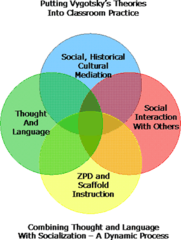
Lev Vygotsky's Sociocultural Theory
kids live in a rich social environment that affects the way their cognitive world is structured
Three fundamental skills are
- joint attention
- Social Referencing
- Imitation
Joint Attention
the ability to focus on what another person is focused on
Social Referencing
the ability to use another person's reactions as information about the world
Attachment
The emotional bond that forms between newborns and their primary caregivers.
Imitation
the ability to do what another person does (or meant to do)
Strange Situation
A behavioral test developed by Mary Ainsworth that is used to determine a child's attachment style.

precocious development
Relatively mature at birth (or hatching) and are self-sufficient.
super-precocious development
Animals are extremely mature at birth
Altricial Development
infants that need assistance for an extended period of time

Harry Harlow (1905-1981)
conducted attachment exp. with baby rhesus monkeys
○ Recces monkey wanted to stay closer to the cloth one
Monkeys were deprived of social contact in first 6 months, they:
1) Developed behavioural abnormalities
2) Incapable of communicating with or learning form others
3) Incapable of normal sexual behaviour.

Attachment Styles (Ainsworth)
The expectations people develop about relationships with others, based on the relationship they had with their primary caregiver when they were infants
secure, avoidant, ambivalent, disorganized

Attachment Styles: Secure (60%)
Infant may or may not be distressed with PCG leaving. Non-distressed acknowledges return of PCG with glance or greeting - Distressed infant goes to PCG and is calmed by presence.
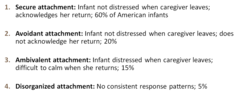
Attachment Styles: Avoidant (20%)
Infant not distressed when PCG leaves; infant doesn't acknowledge return of PCG
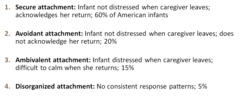
Attachment Styles: Ambivalent (15%)
Infant distressed when PCG leaves. Infant refuses attempts at calming when PCG returns; attempts to crawl or squirm away.

Attachment Styles: Disorganized (5%)
Infants show no consistent pattern of responses to PCG leaving and returning.

John Bowlby (1907-1990)
infants innately channel signals to primary caregivers to form attachment.
Infants do so by:
1) Crying
2) Eye Contact
3) Motion
4) Making a mess

Temperaments
characteristic patterns of emotional reactivity (variable, stable and biologically-determined)
Internal Working Model of Relationships
They set of beliefs about the self, the primary caregiver, and the relationship between them.

Distribution of Temperaments
Easy babies: 40% (Conform to PCG)
Difficult babies: 10% (antagonistic)
Slow-to-warm-up babies: 15%
35% undecided?
Piaget's three stages of moral development
1) Realism to Relativism
2) Prescriptions to Principles
3) Outcomes to Intentions
Realism to Relativism (Piaget)
Moral rules are invoidlable truths (realism) -->
Moral rules are inventions and not discoveries that people agree on (relativism)
Prescriptions to principles (piaget)
moral rules are guidelines for specific actions in specific situations (prescription) -->
moral rules are expressions of more general principles, such as fairness and equality. Can be abandoned/modified (principles)
Outcomes to Intentions (piaget)
Morality of action is judged on the outcome of action (outcomes)--->
Morality of an action is critically dependent on the actors state of mind (intent)
3 stages of moral reasoning (Kohlberg)
1. Pre-conventional
2. Conventional
3. Post-conventional

Preconventional Stage
morality of the action is primarily determined by its consequences for the actor.

Conventional Stage
Morality of action is primarily determined by the extent to which it conforms to social rules.
i.e. Peoples opinions on your prison sentence vs the actual punishment of incarceration

Postconventional Stage
morality of an action is determined by a set of general principles that reflect core values.

Moral Intuitionist perspective
Perceptions of right and wrong are evolutionarily emotional reactions.
Evolved to react emotionally to issues of reproduction and survival.

Adolescence
The period of development that begins with the onset of sexual maturity (about 11 to 14 years of age) and lasts until the beginning of adulthood )about 18 to 21 years of age).
Sexual orientation predominately establishes in this phase - preceding knowledge about it
Sexual Orientation Influenced by
1) Biology (Genes)
2) Size of cerebral hemispheres
3) Hormones
4) Gender nonconforming behaviours
Key structures of the brain governing emotion, mood, anxiety and aggressiveness resemble those in straight people of the opposite sex.
Puberty
The bodily changes associated with sexual maturity.

Primary Sex Characteristics
Bodily structures that are directly involved in reproduction. i.e. Genitals.

Secondary Sex Characteristics
Bodily structures that change dramatically with sexual maturity but that are not directly involved in reproduction.

Brain changes: Cellular(Synaptic) Pruning
Includes both axon and dendrite completely decaying and dying off, is the process of synapse elimination that occurs between early childhood and the onset of puberty in many mammals, including humans.

During puberty, brain also changes with connections
between temporal and parietal lobe develop further and proliferation and pruning in prefrontal cortex
Konrad Lorenz (1903 -1989)
discovered imprinting in newly hatched goslings.
Followed any moving object so it will provide it food

National Institute for Child Health conducted research that showed that attachment style is strongly influenced by
maternal sensitivity and responsiveness but not by quality/amt/stability/type of day care
Moral intuitionist perspective
perceptions of right and wrong are evolutionarily emotional reactions
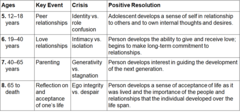
Erik Erikson (1902-1994)
developed stages of human development that all humans go through (for adolescents: "identity vs role confusion"

Erik Erikson Key Events "Crisis"
Feeding to School

Erik Erikson Psychosocial Strengths and Env. Influence

Erik Erikson Key Events "Crisis" Pt II
Peer Relationships to Reflection on Life
Adulthood
The stage of development that begins around 18 to 21 years and ends at death.
Changes during adulthood:
1) Physical (degrading)
2) Cognitive (slowing, reduction in performance - relies on multiple structures to adjust loss of performance)
3) Emotion (stabilizing, focusing on positiveness)
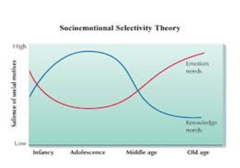
Socio-emotional selectivity theory
younger adults are oriented toward future-pertinent information while older adults focus on positive emotional satisfaction in present - older adults focus on/remember more positive experiences
Development Theories
Explanations formulated by researchers about why people act and behave the way they do and how they change over time.