Psych 1004: Developmental psych
 Call Kai
 Learn
 Practice Test
 Spaced Repetition
 Match
 Flashcards
 Knowt Play
1/164

There's no tags or description
Looks like no tags are added yet.
165 Terms
What is developmental psychology
Study of change across the lifespan: emotional, social, cognitive, perceptual, physical/motor, and genetic
Developmental psychology goal
Describe both typical and atypical development.
Dante’s three stages of life
Each stage represented a level of morality:
Adolescenza: too trusting.
Gioventute (25–45): the morally superior stage.
Senettute (45–70): too cynical.
Significant figures in dev psych
freud
alfred adler
jung
Freud on devpsych (3)
Childhood experiences influence adult behaviour. Development starts very early.
Unconscious behaviour. Processes we aren't actively aware of influence behaviour. Today these are often called implicit processes.
Defence mechanisms. Psychological processes used to cope with or defend against unpleasant emotions. These link to the modern emotion-regulation and coping literature.

Alfred Adler on childhood development
Children have unique perceptions shaped by their social context, and these influence behaviour.
Main drivers of development: a sense of belonging and competency. These terms are still used today, especially in social psychology.
Jung contribution to devpsyc
Development is lifelong
Two halves of life, split at around age 40:
First half: focused on external needs such as a home, a career and building a future.
Second half: focused on self-reflection, such as accepting ageing, returning to hobbies and becoming more aware of suppressed thoughts and feelings.
Key debates in dev psyc
Nature vs nurture
Critical periods vs sensitive periods
stages vs continuous development
universal vs culturally specific
Arguments for nature (nature vs nurture) ARGUMENTS
Gesell's maturation theory
Chomsky's universal language theory
Gesells maturation theory
Development follows biological timetables. Motor milestones occur in a universal sequence: roll → crawl → walk.
Chomsky’s universal language theory
Language is too complex to learn purely from the environment. Humans must be pre-wired with language learning devices
Infants can discriminate all phonemes across the world's languages.—> environment then narrows this to the phonemes of the languages they're exposed to.
Arguments for nuture
Behaviourism: Environmental interactions are the most important part of development. Research should focus on observable behaviour, not unobservable internal processes.
John watson’s little albert study
A loud, unpleasant noise was repeatedly paired with a white rat, which Albert initially didn't fear.
Albert came to fear the rat even when it was shown without the noise.
Watson's conclusion was that children can be conditioned to learn and behave in particular ways.
Modern consensus on nature vs nuture
Development is an interaction between nature and nurture. Research now aims to understand how much each one contributes
Critical periods
Definition | Limited time windows when a skill must be learned |
If missed | Irreversible changes |
Evidence for critical periods
Imprinting in ducks
Foetal development: Limbs and organs form within strict windows, mostly in the earlier weeks of pregnancy. Disruptions during these windows cause irreversible changes
Sensitive periods
Time windows when experience has a greater influence on development |
Compensation is still possible |
Evidence for sensitive periods
Victor ("Wild Boy of Aveyron"): Raised without human contact (reportedly by wolves) for about 12 years
remained largely non-verbal but showed limited recovery, such as spelling out some words. He never achieved conversational fluency.
Genie: Discovered at age 13 in 1970 after severe neglect and social isolation.
ran extensive language studies; regained some ability to semi-communicate but never developed fluent grammar
Orphanage studies (sensitive periods
Enriched environments that promoted movement led to faster development of gross and fine motor skills. vs
Post-Cold War Romanian orphanages offered minimal stimulation and care. Children showed delayed motor development: they couldn't sit upright or stand at expected ages, and some were still crawling when older.
After removal and support, partial recovery occurred for some children
critical vs sensitive period debate
Early childhood is especially important, and some skills develop there. But human learning is adaptive, and compensation is possible for some aspects. Again, the focus is on relative contributions.
Stagelike vs continuous development
Stage-like: People are fundamentally different at each stage. They gain new skills they didn't have before.
Continuous: Skills are present but gradually improve in efficiency and proficiency.
Dimensional change card sort method
Children aged 3 and 5 sort cards by one rule (e.g. colour), then the rule switches (e.g. shape).
5-year-olds pass. They inhibit the old rule and adopt the new one.
3-year-olds fail. They persist with the first rule.
dimensional stage card sort interpretation
Stage view: 5-year-olds are at a different stage. They have gained inhibition, and 3-year-olds lack it.
Continuous view: 3-year-olds can inhibit but can't yet coordinate the processes efficiently enough to show it in this task. The task is too hard, which doesn't mean the skill is absent.
Universal vs culturally specific/mediated development
Universal: Developmental patterns are found in all children.
Culturally mediated: Cultural context alters developmental outcomes. Either some processes are unique to certain cultures, or universal processes are expressed differently across cultures.
Universal play
Play occurs across cultures, usually through social interaction with family and friends.
Children increasingly initiate play and use more verbal play as language develops.
Use of objects (toys, figures, blocks) is cross-cultural.
mmon in Western contexts and less so in East Asian cultures
Culturally mediated play
Culturally mediated aspects:
An older study found Irish-American children engaged in more fantasy play, while Taiwanese children engaged in more realistic, home-based play (e.g. playing house).
The broader literature suggests fantasy play is more co
Cross-sectional research in dev psych
Compares different age groups at one point in time. Example (a made-up graph): racist views by decade of age, with older groups showing higher levels.
Pros: Common, quick and easy.
Cons: Group differences are only suggestive of development, and it's hard to isolate cause and effect ; differences may come from life experience; cohort effects
longitudinal research in dev psych
Tracks the same individuals over time. Each participant acts as their own control.
Allows individual trajectories to be compared and group summaries to be produced.
Pros: Better at isolating cause and effect, and reduces cohort effects.
Cons: It's still vulnerable to cohort effects. A single cohort is followed through one historical period, so the results are tied to that period. A study run 50 years ago might give different results from one run now.
sequential design in dev psych
Combines cross-sectional and longitudinal approaches. Multiple cohorts start at different times and are each followed longitudinally (e.g. one cohort from 2010–2015, another from 2013–2018).
Best at separating age-related change from cohort effects.
Cons: Rare, because it's very time-consuming (often a decade or more) and expensive. Results can't be interpreted until many years later.
Observation study types
Structured: The researcher uses a checklist of predetermined behaviours. Usually done in a lab, where conditions can be controlled to elicit the behaviours.
Unstructured: Flexible observation of whatever behaviours naturally occur. Usually done in natural settings.
Piaget theory overview
cognitive-developmental theory
Children are active agents, "little scientists." They form hypotheses, experiment and draw conclusions to understand the world.
Through this process, they build schemas, which are knowledge systems for categorising information.
Piaget: schema mechanisms (5)
AAEED
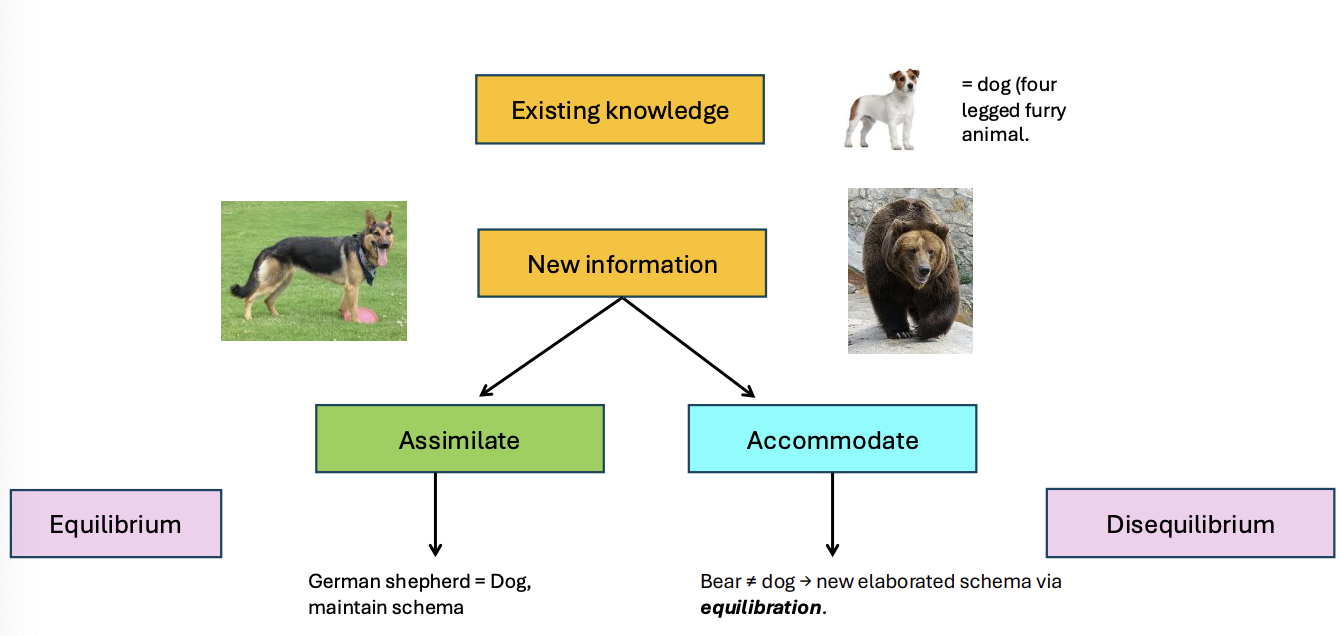
Assimilation | Fitting new information into an existing schema |
Accommodation | Changing a schema to fit new information |
Equilibration | The process of balancing new information against existing knowledge |
Equilibrium | New information fits existing schemas, so knowledge is in harmony |
Disequilibrium | New information conflicts with existing schemas, which triggers accommodation and leads to a new equilibrium (equilibrium′) |
Central properties of piaget theory
stage development but still has transitions
invarient sequence: all pass through sequences in same order but different speed
universality: applies to all childlren
Brief transitions: transition period where children waiver between different cognitve styles of 2 stages
Piaget four stages
Sensorimotor: 0-2
Pre-operational: 2-7
Concrete operational: 7-12
Formal operational: 12+
Sensorimotor 6 Substages
simple reflexes; literal accomodation
primary circular reactions: random movements leading to unexpected outcomes- eg moving hand toward mouth, sucking on finger; repeated-→ cause and effect
secondary circular reactions: actions on external objects, like dropping a toy -→ object permanence
intentional behaviour: actions with a goal in mind- moving a cloth to retrieve a toy
tertiaty circular reactions: creative experimentation like dropping a toy to see what haooens
symbolic functioning: mental representations
sensorimotor Substage age grouping
1: 0-1
2: 1-4
3: 4-8
4; 8-12
5: 12-18
6: 18-24
Sensorimotor key achievements
Object permanence
A-not-B error
Symbolic functioning
A-not-b erorr
A toy is repeatedly hidden under cloth A, and the infant retrieves it.
The toy is then visibly hidden under cloth B. The infant still searches under A.
Interpretation: The infant can't separate the object's existence from their original sensory experience of finding it at A.
Symbolic functioning
Symbolic play: for example, pretending a banana is a telephone.
Deferred imitation: imitating an action seen earlier, at a later time and in a different context. This requires holding a mental representation of the behaviour.
Pre-operational stage characteristics
Rapid but non-uniform symbolic development that builds on symbolic functioning.
Weaknesses of the pre-operational stage
Egocentrism: Seeing and reasoning about the world only from your own perspective
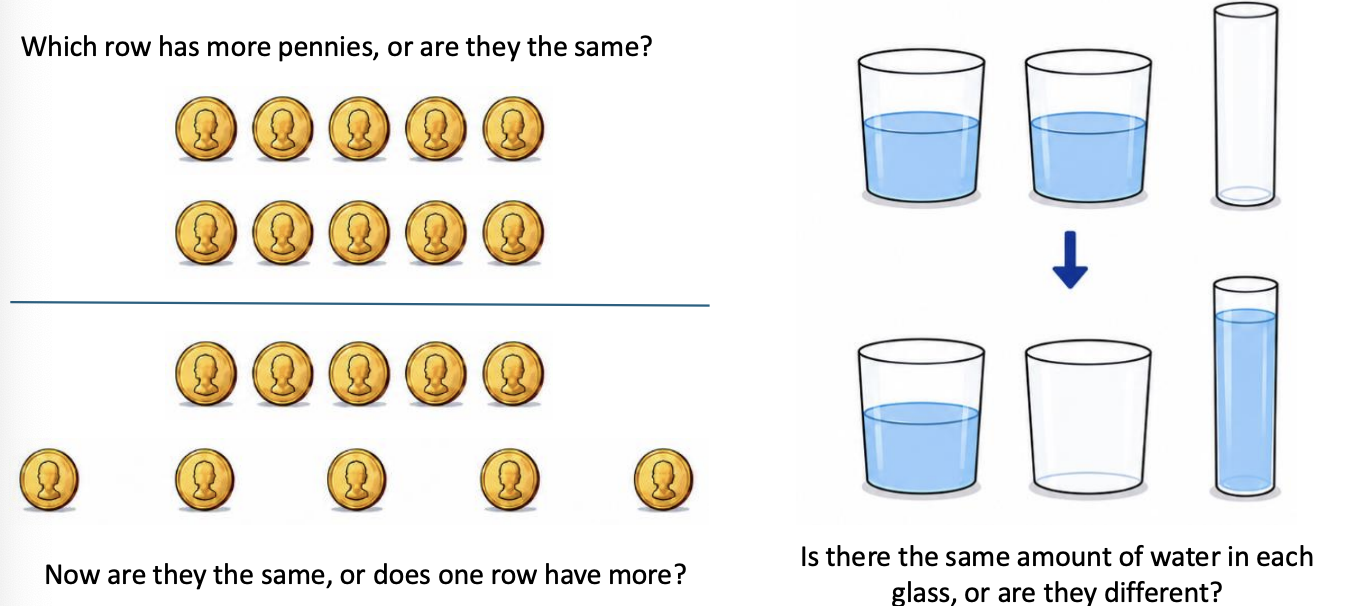
Centration: Focusing on one perceptually striking feature (e.g. height) and ignoring others (e.g. width)
Egocentrism examples
A 3-year-old says his crying baby brother "probably thinks he's missing something on television," projecting his own reasons for crying rather than considering hunger or thirst.
Reasoning. In the Three Mountains Task, a child is asked what a doll or person sees from a different viewpoint. Children typically say the doll sees exactly what they see.

Centration examples
Focusing on one perceptually striking feature (e.g. height) and ignoring others (e.g. width). This is shown in conservation tasks:
Number: Two equal rows of coins are judged "the same." When one row is spread out, children say it now has more.
Liquid: Equal water is poured into a differently shaped glass. Children watch the pour but say the amount differs, because the water level is higher.
Children fail because they can't see that quantity is conserved despite a change in appearance.
Concrete operational stage
Children can reason logically about concrete objects but have limited abstract reasoning.
Pendulum task
Children experiment with strings of different lengths and different weights to work out what makes a pendulum swing faster. Piaget focused on how children solved it, not just whether they succeeded.
Concrete-operational children use unsystematic trial and error. They can't isolate the effect of each variable, so any correct answer comes from open exploration.
Formal operational stage
Abstract and hypothetical reasoning. Children consider multiple variables systematically, changing one at a time.
They're not tied to direct experience. They can form a hypothesis first and then work out how to test it.
They pass the pendulum task.
Piaget believed people remain in this stage for life.
Drawing phases - piaget
Phase | Type of realism | Description |
Scribbling (about 2–4) | Fortuitous realism | Scribbles that the child sees as resembling something real (e.g. "this is a cup"), even if adults can't |
Pre-schematic | Failed realism | Elements are drawn but unconnected, e.g. a cup's stem detached from the cup, or a person without a body |
Intellectual realism | Drawing what they know is there, e.g. a person shown inside a house, or a stem drawn even when it wouldn't be visible | |
Schematic (about 8–9) | Visual realism | Drawing what they see from a perspective, e.g. leaving out a stem or a person inside a house who wouldn't be visible |
Limitations of piaget’s theory
Underestimated children's competence. Piaget assumed that failing a task meant the child hadn't reached the stage. But task complexity can cause failure even when the skill exists, as in the DCCS continuous interpretation.
Inconsistent development within stages
He underestimated social and cultural factors.
Piaget lasting contributions
Children are active learners who test and operate on their environment. This is still foundational.
Symbolic understanding and mental representation are central to development.
Development involves stage-like shifts
Vygotsky sociocultural theory: key idea
Development occurs through social interaction with more competent others such as mothers, teachers and caregivers.
Knowledge is transmitted within the community and cultural context the child has access to.
Vygotsky vs Piaget
Both see children as active.
Piaget emphasised independent learning. Vygotsky emphasised learning through other people.
Vygotsky held that culture shapes how and what children learn.
How is knowledge acquired (vygotsky)
Cultural space: the beliefs, practices and knowledge of the child's community.
Intermental level: learning between people, as knowledge passes from the competent other to the child.
Intramental level: knowledge internalised within oneself.
Not all knowledge is internalised. It may be too complex, or it may duplicate something already known, such as a new method for a task the child can already do
Key concepts vygotsky
Intersubjectivity
zone of prozimal development
scaffoloding
Intersubjectivity
: A shared understanding between learner and teacher of what is being addressed. Both need to be "on the same page" for knowledge to transfer.
Zone of proximal development
There are three zones:
What the child can do alone.
The ZPD: what the child can do with help from a competent other.
What is beyond reach for now.
Scaffolding
Temporary support from a competent other that helps the child advance without being given the answer.
Example: A child is assembling a toy from a diagram and is stuck on where the wheel goes. The mother asks, "Look, where does the wheel go on this diagram?" She prompts the child's thinking without giving the solution.
Three stages of private speech
Three stages, illustrated with tying a shoelace:
Behaviour controlled by others. A parent instructs: "Make a loop, wrap it around, pull it through."
Overt private speech. The child says the instructions aloud while tying the lace themselves.
Internalised speech. The child ties the lace silently, so the learning is fully internalised.
Evidence for private speech
Preventing private speech leads to poorer performance on tasks that require planning.
More private speech is associated with better problem-solving performance.
Limits of Vygotsky’s theory
Vague boundaries. The edges of the ZPD aren't clearly defined. It's unclear whether they vary by skill or by who the child interacts with.
He downplays genetics. He neglects the nature side of the nature–nurture interaction.
He neglects independent discovery. His theory doesn't explain how children learn through solo exploration, such as discovering something new while playing with a toy alone.
What is social development
How our interactions and relationships with others in the community affect our developmental trajectory over time.
Harlow monkey study: method
Design: Infant monkeys had access to two body-shaped "mothers":
a wire mother that provided food and water but was uncomfortable
a soft terry-cloth mother that provided no food.
Harlow monkey study results
Monkeys preferred the cloth mother and spent their time with it.
Harlow monkey study meaning
Perceived security, not food, is crucial to forming attachment in primates.
Contact comfort: The physical and emotional solace an infant gets from being physically close to a caregiver.
Significance: Established that attachment and perceived security are fundamental to development, even when they don't satisfy basic needs.
Bowlby evolutionary attachment theory
Attachment keeps vulnerable infants safe. Through evolution, we form bonds with figures during critical or sensitive periods.
Staying close to an attachment figure is evolutionarily advantageous. It provides security and, ideally, nourishment and other basic needs.
Attatchement in infants stages
Preference for faces | Newborns | Eye-gaze studies show newborns fixate longer on faces than on objects. This suggests an innate facial-recognition neural network. |
Recognition of the primary caregiver | About 3 months | Visual and gaze studies show infants recognise their caregiver across a room, even among strangers. |
Attachment | Develops gradually over 0–2 years | The infant actively seeks the caregiver for comfort, security and reassurance. |
How is attachment shown
a desire for proximity to the attachment figure
a sense of security from the caregiver's presence
distress when the caregiver is absent
Seperation anxiety
Distress reactions when a child is separated from their primary caregiver.
Ainsworth strange situation/attachment styles method
The mother interacts with the child.
The mother leaves the child alone.
A stranger enters and tries to interact with the child.
The mother returns and greets the child.
Attachment styles - Ainsworth
Secure
Avoidant
Ambivalent/resistant
Disorganised
secure attatchment
Style | On separation | On reunion |
Secure (largest proportion) | May or may not be distressed | Actively approaches the parent for comfort. Distress drops quickly, with less crying and agitation. |
Avoidant | Not very distressed | Slow to seek comfort and avoids meeting the parent at first, though may seek comfort over time ⚠ |
Ambivalent / resistant | Very distressed | Seeks comfort but then shows anger and resistance to it (e.g. pushing away, continuing to cry). Distress isn't reduced. |
Disorganised | Conflicting responses | A "freeze" response. The child starts to approach the parent but doesn't follow through, looks dazed or confused, and looks away when held. Shows little positive affect. Interpreted as wanting comfort but also fearing it. |
Avoidant attachment
Style | On separation | On reunion |
Secure (largest proportion) | May or may not be distressed | Actively approaches the parent for comfort. Distress drops quickly, with less crying and agitation. |
Avoidant | Not very distressed | Slow to seek comfort and avoids meeting the parent at first, though may seek comfort over time ⚠ |
Ambivalent / resistant | Very distressed | Seeks comfort but then shows anger and resistance to it (e.g. pushing away, continuing to cry). Distress isn't reduced. |
Disorganised | Conflicting responses | A "freeze" response. The child starts to approach the parent but doesn't follow through, looks dazed or confused, and looks away when held. Shows little positive affect. Interpreted as wanting comfort but also fearing it. |
Ambivalent attachment
Style | On separation | On reunion |
Secure (largest proportion) | May or may not be distressed | Actively approaches the parent for comfort. Distress drops quickly, with less crying and agitation. |
Avoidant | Not very distressed | Slow to seek comfort and avoids meeting the parent at first, though may seek comfort over time ⚠ |
Ambivalent / resistant | Very distressed | Seeks comfort but then shows anger and resistance to it (e.g. pushing away, continuing to cry). Distress isn't reduced. |
Disorganised | Conflicting responses | A "freeze" response. The child starts to approach the parent but doesn't follow through, looks dazed or confused, and looks away when held. Shows little positive affect. Interpreted as wanting comfort but also fearing it. |
Disorganised attachment
Style | On separation | On reunion |
Secure (largest proportion) | May or may not be distressed | Actively approaches the parent for comfort. Distress drops quickly, with less crying and agitation. |
Avoidant | Not very distressed | Slow to seek comfort and avoids meeting the parent at first, though may seek comfort over time ⚠ |
Ambivalent / resistant | Very distressed | Seeks comfort but then shows anger and resistance to it (e.g. pushing away, continuing to cry). Distress isn't reduced. |
Disorganised | Conflicting responses | A "freeze" response. The child starts to approach the parent but doesn't follow through, looks dazed or confused, and looks away when held. Shows little positive affect. Interpreted as wanting comfort but also fearing it. |
Nature vs nurture in attachment style
Nuture: is fluid across childhood/adulthood
Hazan & shaver 1987
Question: Do attachment behaviours persist into adulthood?
Method: Classified adults by how they behaved in romantic relationships and responded to breakups.
Finding: Adults could be classified into similar styles, and the proportions in each style mirrored those found in children. Secure was again the largest group
Does childhood attahcment predict adult behavioy?
very general link - unclear mechanisms
Friendships over ages
Young childhood (6 and under) | Transactional. "You share your toys with me, I share mine, so we're friends." |
Middle childhood (7–12) | Companionship. Close connection, comfort, support, deeper emotional closeness, trust and some vulnerability. |
Adolescence | Self-disclosure and intimacy. Deeper personal sharing, stronger trust and more vulnerability. |
Same sex vs cross sex relationship changes
far more cross-sex relationships now than in the past
2 reasons for low cross-sex friendship
Socialisation
genetic influence
both contribute
Genetic influence on sex-typed behaviour
Compared identical twins, fraternal twins and non-twin siblings on their preference for toys, activities and behaviours culturally associated with boys or girls.
Finding: Identical twins were more similar in sex-typed behaviour than fraternal twins. This suggests a genetic influence.
Birth order theory
Each new birth changes family dynamics
We can't confidently claim specific birth order effects. We can say that early family dynamics, sibling relationships and parental engagement shape development. How birth order specifically plays a role is unclear.
IQ is a poor measure of intelliigence
Early concerns of maternal employment on child development
Decreased caregiving quality. Less time with children was assumed to mean worse care.
"Latchkey children." Children who look after themselves and come and go from home alone with their own key. They were assumed to be at higher risk of delinquency because of less discipline and interaction
UNSUPPORTED
Impact of childcare on outcome
Childcare type | Outcome |
Good-quality, stable care (e.g. standardised systems in Norway and much of Europe) | No relationship between hours in care and problem behaviour |
Poor-quality or unstable care (neglect, constantly changing carers, little structure or consistency) | Longer hours lead to worse outcomes |
Good-quality care for disadvantaged (low-SES) children | Longer hours lead to better outcomes. |
Preschooler screen time requirement
: Preschoolers should have no more than 1 hour per day of sedentary screen time (24-Hour Movement Guidelines).
In Australia, many children exceed this
Active vs passive media
Active viewing | Passive viewing | |
Definition | Programmes that interact with the child, such as pausing and asking questions | Simply watching without interaction |
Example | Dora the Explorer | Peppa Pig |
Outcomes | Better working memory, reading comprehension and especially language skills | Poorer cognitive outcomes: reduced executive function (e.g. working memory) and reduced language skills (reading comprehension, expressive vocabulary) |
Why is active viewing generally better
Why active viewing helps: The child "talks with" the screen as if with a person, building language and interaction skills.
Best outcome: An interactive programme watched together with a caregiver or teacher. This builds both social interaction skills and cognitive skills.
Negative effects of media violence
Priming agression
Desensitisation over time
Social learning
Fast paced vs slow paced media
Fast-paced | Slow-paced | |
Features | Rapid, constantly changing stimuli and quick scene changes | Few scene changes, quieter audio, less background noise, calmer |
Example | Paw Patrol, modern Sesame Street | Older (20th-century) Sesame Street |
Shot length | About 2–3 seconds per scene, with the shortest under 1 second | About 6–7 seconds per scene |
Fast vs slow paced: confounds
Recent reviews show little or no difference in executive function/development.
The content or other factors likely matter more than pace.
Measurement problem:
General screen time risks
Increased screen time is broadly associated with poorer development, including:
less physical activity and a higher risk of childhood obesity (e.g. a TV in the bedroom)
less time for study and parent–child interaction, which lowers academic achievement.
Overall infleunce of screentime
general negative link between screen time and development, but where harm comes from is debated
LGBTQIA family impact on child development
cross-sectional survey found parent–child relationships similar to, or better than, population norms.
Limitations:
Issues with lgbtqia child development surveys
Convenience sampling. Volunteers opted in, rather than being randomly sampled, which is the gold standard. Families doing well may be more willing to participate, so the sample may overrepresent advantaged, well-functioning families.
This sampling was necessary because sexual orientation isn't included in Australian population health surveys, partly due to political lobbying.
Main factor harming lgbtqia family children
When parents reported their child had experienced homophobia or stigma, children showed more internalising problems such as withdrawal, anxiety and depression. These outcomes are linked to stigma, not the parents' sexual orientation.
Developmental intergroup theory steps
Noticing salient attributes, such as race, gender and accent.
Categorising people by those attributes.
Developing stereotypes and prejudice.
Explicit/overt bias
White 5-year-olds prefer to be friends with white rather than black children.
Younger children show no such preference
implicit bias: unconscious
Children don't become less biased. They learn social norms and egalitarian principles about how they should behave, which reduces explicit bias while implicit bias stays the same.
Highly gender typed children
Highly gender-typed children have interests, activities and traits culturally associated with their gender. They experience more positive emotions playing with same-gender peers.
Felt same-gender typicality means perceiving yourself as similar to your own gender. It was associated with more negative attitudes toward other-gender peers and activities.
gender conservation age
gender stays constant regardless of hair or clothes) develops at about 6.
Effects of racial/gender prejudice
Type | Effects |
Psychological | Higher risk of depression, anxiety, low self-esteem and psychological distress. Members of minority groups may internalise negative stereotypes, leading to stereotype threat. |
Physiological | Discrimination-related stress (anticipating or experiencing discrimination) is linked to greater vulnerability to chronic disease, especially cardiovascular disease and hypertension. Chronic stress can accumulate from childhood into adulthood. |
Stereotype threat
The fear of confirming a negative stereotype about your group, which shapes your decisions. For example, a person from a minority group might decide not to attend university. This contributes to the underrepresentation of minority groups.