Biology 121 Exam 4: Translation, Meiosis, Genetics & Gene Expression
 Call Kai
 Learn
 Practice Test
 Spaced Repetition
 Match
 Flashcards
 Knowt Play
1/170

There's no tags or description
Looks like no tags are added yet.
171 Terms
Where does translation of mature mRNA take place?
In the cytoplasm
Where else does translation take place?
Chloroplast and mitochondria
What organelle translates mature mRNA into amino acids?
Ribosomes
What determines the linear sequence of amino acids in the protein synthesized by the ribosome?
The codons

Where are ribosomes located?
In the cytosol and mitochondria, as well as in chloroplasts for plants
What does the mature mRNA pass through to leave the nucleus?
Nuclear pores
What forms the ribosome structure?
The large and small subunit

What are ribosomes made of?
Ribosomal RNA (rRNA) molecules and ribosomal proteins
True or false: Each cell has just a few ribosomes.
False, a mammalian cell may contain 10 million ribosomes.
True or false: Prokaryotic cells and eukaryotic cells produce the same size ribosomes.
False, Eukaryotes have 80S ribosomes while prokaryotes produce 70S ribosomes.
Why is the ribosome size difference medically significant?
Because some antibiotics destroy bacteria by attacking their 70S ribosomes and preventing translation.
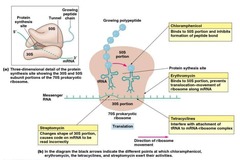
Which complex molecular machine reads the linear sequence of codons in mRNA to make proteins?
Ribosomes
Messenger RNA made in the nucleus is translated where?
In the cytosol/cytoplasm
What is the ribosomal process of making a protein?
Ribosome binds to mRNA to begin translation at start codon, moves down the mRNA reading the linear sequence of codons, receives the 20 amino acids required to make protein and links them together in the proper sequence, 'proofreads' to ensure the proper amino acid is added, stops protein synthesis at stop codon, allows new protein to exit the ribosome.

How many start codons are there?
One and its AUG
What is a codon?
A sequence of three consecutive nucleotides
How many codons code for the translation stop site?
Three
What sequence does the ribosome read from the messenger RNA to make a protein?
Sequence of codons
What codon informs ribosomes where to begin translating the transcript?
Start
What is the genetic code table?
A table that shows the definition/protein that each codon codes for.
What specialized RNA molecules deliver the amino acids to the ribosome during translation?
tRNA (transfer RNA)
All of the 20 amino acids have at least one type of __________ molecule that delivers it to the ribosome during translation.
tRNA
What enzyme attaches the proper amino acid to the proper tRNA?
Aminoacyl-tRNA Synthetases
tRNA delivers amino acids to ________ during translation.
Ribosomes
What is the first phase of translation?
The initiation phase
What happens during the initiation phase?
Assembles, aligns, and activates all the components required for the ribosome to begin translation at the start codon.

What complex is formed by the large subunit binding?
The Translation Initiation Complex
What modification is required for mRNA to interact with small ribosomal subunits in the cytosol?
5' G-Cap
What factors are required to form the initiation complex?
Initiation Factors
What fuels the translation initiation complex?
GTP
True or false: Translation is an energy-intensive process.
True
Each tRNA contains a sequence of three nucleotides called the _________.
Anticodon
The anticodon recognizes the ______ during translation.
Codon
What is the second part of the translation process and what happens?
The elongation cycle, during which the ribosome reads the linear sequence of codons in the mRNA to synthesize the protein.
What energy-rich molecule does the elongation cycle require?
GTP
Elongation factor ensures that _____ carrying the proper amino acid enters the ribosome.
tRNA
What RNA enzyme (Ribozyme) links the amino acids together during the elongation cycle?
Peptidyl Transferase
What is the final stage of translation and what happens?
The termination phase, where the ribosome meets the stop codon and interacts with release factors to release the protein.
What energy-rich molecule fuels the last step of translation?
GTP
The _____ codon is in contact with the ribosome to stop translation.
Stop
The release factor interacts with the ________ to release the new protein.
Stop codon
What is the product of translation?
A protein.
Where does the newly synthesized protein go after it is made?
Wherever it is needed inside or outside the cell.
What does the signal sequence do?
Acts as the zip code, to ensure the proper delivery of a protein.
The signal sequence for delivery to the mitochondrion was attached to a protein made in the cytosol, where will the protein be delivered?
The mitochondrion.
Which amino acid sequence enables the delivery of proteins to the ER?
The Signal peptide
Some antibiotics inhibit the activity of ribosomes which prevent _________.
Translation
What is heredity?
The transmission of traits from parents to offspring.
How do parents transmit genetic instructions to the offspring?
By combining sex cells called gametes from mom and dad.
What is the product of meiotic cell division?
Gametes that are haploid (1N).
Where does meiotic cell division occur in humans?
In gonads.
Where does meiotic cell division occur in plants?
In anther and ovule.
How many chromosomes are in a somatic cell?
46.
How many chromosomes are in a gamete?
23.
How many chromosomes do you have?
46.
True or false: each species has a specific number of chromosomes in the nucleus.
True.
After fertilization, a zygote has ______ chromosomes?
46.
Meiotic cell division ensures that ___________.
Each generation inherits 46 chromosomes.
How is genetic variation beneficial?
It increases the ability to adapt to new environmental conditions.
True or false: All multicellular organisms that reproduce sexually require both mitotic cell division and meiotic cell division to function properly.
True.
True or false: Meiotic cell division enables you to produce genetically-variable haploid gametes.
True.
How many haploid cells are produced from 1 germ-line cell undergoing meiotic cell division?
4.
How many times does a germ-line cell divide?
Twice.
True or false: DNA replication does not proceed before meiotic cell division.
False.
A homologous pair consisted of _____ gene from mom and _____ gene from dad.
One.
What are the stages of meiosis 1 and 2?
Prophase, Prometaphase, Metaphase, Anaphase, and Telophase.

When does crossing over occur between homologous chromosomes?
Prophase I of Meiosis I.

What are recombinant chromosomes?
Chromosomes that result from crossing over.
What is Prophase I of Meiosis I?
It produces recombinant chromosomes.
During which phase does the spindle separate 2 pairs of attached homologous chromosomes?
Meiosis I.
During which phase does the spindle separate each part of sister chromatids?
Anaphase II of Meiosis II.
What is independent assortment?
All the possible combos of chromosome arrangements.
True or false: Independent assortment and crossing over decrease genetic diversity.
False, they increase genetic diversity.
Do you have chromosomes from your four grandparents?
Yes.
What does nondisjunction cause?
Aneuploidy.

What results from spindle checkpoint failure?
Nondisjunction.
What is the risk of aneuploid zygotes?
Increased risk of birth defects, cancer, and aging.
Are meiotic errors common?
Yes.
What is a trait?
The black hair characteristic inherited from its mother.
What can traits be?
Anatomical, Behavioral, or Physiological.
What is the precise location on a chromosome for a specific trait called?
Locus.
What is a model system?
A species intentionally chosen to represent the characteristics of a specific biological system more effectively.
What model system did Gregor Mendel use?
The Pea.

Why did Gregor Mendel use the pea as a model system?
Because it was easier to use, cheaper, quicker, easy to control, and easy to replicate.
What do you call a cell with more than 3 sets of chromosomes?
Tetraploidy.

What are we in terms of chromosome sets?
Diploid, two sets of chromosomes.
What is an allele?
A different form of the same gene.

What does each allele of a gene contain?
A unique nucleotide sequence, different genetic information, formed by a mutation in an existing allele.

What is the source of new alleles in a population?
Mutation and migration.
What do alleles code for?
Proteins by using unique sequences of amino acids.
What is a genotype?
The actual two alleles that a diploid individual has for a gene.
What is the difference between homozygous and heterozygous?
Homozygous have two copies of the same allele, heterozygous have different alleles for the same gene.

What is a true breeding trait?
A trait that remains constant over generations when both parents are homozygous for the trait.
What are physical characteristics called?
Phenotype.
What forms phenotype?
The interaction between the individual's genotype and their environmental conditions.
Can womb conditions contribute to the phenotype of genetically identical individuals?
Yes.
When does your phenotype begin to develop?
In the womb.
What phenotype do heterozygous individuals show?
Dominant trait phenotype.
What is the gene not expressed in a heterozygote?
Recessive.
What genotype do you need to express a recessive trait?
Homozygous recessive.