AQA A Level Physics Capacitors
 Call Kai
 Learn
 Practice Test
 Spaced Repetition
 Match
 Flashcards
 Knowt Play
1/19

There's no tags or description
Looks like no tags are added yet.
20 Terms
Capacitance definition
charge stored per unit potential difference
FARADS or CV-1
Why is there a limit on the power rate a standard chemical battery releases energy at?
Because of high internal resistance + chemical —> electrical energy can’t happen instantly.
Constant charging current
Constant I achieved by constantly decreasing R
Capacitance graph
Q against V
Directly proportional
Capacitance = Gradient
Area under line = energy stored by capacitor

Capacitance graph
V against Q
Directly proportional
Capacitance = 1/Gradient
Area under line = energy stored by capacitor

Derivation of E=1/2QV
1. ∆W=V∆Q
-∆W moving charge Q across ∆V given by ∆W=Q∆V
-work done moving charge= energy stored on capacitor
- as more charge is transferred, pd across plates increases so more energy gained. Total energy does not equal QV as Q and V are changing
2. energy stored=total work done in charging= charge x average voltage
- if 'charged' from 0 to V, the average pd across plates = 1/2V, as pd increases linearly with charge
3. energy stored =work done= 1/2QV
-total energy gained when total charge Q is transferred, is therefore equal to total charge transferred x average pd
Energy stored / Voltage graphs
Energy = 1/2CV²
Energy α V²

Time constant definition
Discharging-
Time taken for the voltage (or charge or current) to fall to 1/e (0.6) of its initial value.
Charging
- time taken for charge or voltage (NOT CURRENT) to fall to 1- 1/e of max value
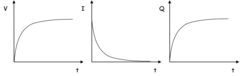
Graphical representations of charging a capacitor against time
v = Vo (1-e ^ -t/RC)
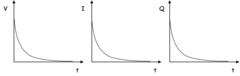
Graphical representations of discharging a capacitor against time
V = Voe ^ -t/RC
When does current stop?
Current stops once the p.d across the plates equals the battery voltage.
what is a capacitor?
A device for storing electrical charge. It is made of two || plates separated by an insulator.
What happens to current during charging?
As electrons move from one plate to the other, they become more similarly charged.
Electrostatic forces of repulsion causes current to decrease over time.
What happens to charge during charging?
Increases as more electrons move up to the plate
What happens to current when discharging?
No of electrons on the -ve plate decreases, repulsive force decreases. Current drops to 0.
What happens to charge during charging?
Charge decreases with every electron
Er =
E1 / E0
What does a dielectric do?
Increases the amount of charge stored by a || plate capacitor.
When no charge is applied,
No charge is stored so no electric field is generated.
So polar molecules move in random directions.
When a charge is applied,
an electric field is generated. the -ve endsd of the polar molecules are attracted to the +ve plate.
Causes the polar moleules to rotate- to align with the electric field.
As a result the molecules’ own electric fields oppose the applied electric field of the capacitor.
(the higher the permittivity, the larger the opposing field)
This decreases the overall electric field, so pd needed lower, so capacitance increases.