Quiz 4 - chapter 20 concept questions
 Call Kai
 Learn
 Practice Test
 Spaced Repetition
 Match
 Flashcards
 Knowt Play
1/20

There's no tags or description
Looks like no tags are added yet.
21 Terms
Ion regulation is a key feature of kidney function. What happens to the resting membrane potential of a neuron if extracellular K+ levels decrease?
It hyperpolarizes (becomes more negative).
What happens to the force of cardiac contraction if plasma Ca2+ levels decrease substantially?
Force of contraction decreases.
If net filtration out of glomerular capillaries occurs, then you know that capillary hydrostatic pressure must be (greater than/less than/equal to) capillary colloid osmotic pressure.
greater than
If net reabsorption into peritubular capillaries occurs, then capillary hydrostatic pressure must be (greater than/less than/equal to) the capillary colloid osmotic pressure.
less than

In which segments of the nephron do the following processes take place:
(a) filtration
(b) reabsorption
(c) secretion
(d) excretion
(a) Bowman’s capsule
(b) proximal tubule, loop of Henle, distal tubule, collecting duct
(c) proximal tubule, distal tubule, collecting duct
(d) collecting duct

Calculate the percentage of filtered volume that leaves
(a) the loop of Henle
(b) the collecting duct
(a) 18/180=10%
(b) 1.5/180=0.8%

A person filters 720 millimoles of K+ in a day and secretes 43 millimoles. She excretes 79 millimoles in her urine. What happened to the rest of the K+ and how much was it?
Using the equation and the values given, 684 mmol/day were reabsorbed.
This equation is a useful way to think about renal handling of solutes. Note, however, that not every substance in the plasma is filtered. And substances that are filtered may or may not be reabsorbed or secreted. In the following sections, we look in more detail at the important processes of filtration, reabsorption, secretion, and excretion.
Name one way in which filtration and secretion are alike. Name one way in which they differ.
Alike: both represent movement from ECF into the lumen. Filtration is only into Bowman’s space. Secretion takes place along the rest of the tubule.
A water molecule enters the renal corpuscle from the blood and ends up in the urine. Name all the anatomical structures that the molecule passes through on its trip to the outside world.
Glomerulus - Bowman’s space - proximal tubule - loop of Henle - distal tubule - collecting duct - renal pelvis - ureter - bladder - urethra
What would happen to plasma volume if filtration continued at a normal rate but reabsorption dropped to half that rate?
The body would run out of plasma in under an hour.

If 120 mL of plasma filter each minute, and the filtration fraction is 20%, what is the daily renal plasma flow?
172.8 L/day filter, which is 20% of plasma flow. So plasma flow is 864 L/day.

What happens to capillary blood pressure, GFR, and RBF when the afferent arteriole dilates?
Capillary blood pressure, GFR, and renal blood flow all increase.
Why is the colloid osmotic pressure of plasma in efferent arterioles higher than that in afferent arterioles?
Colloid osmotic pressure is higher in efferent arterioles due to same amount of protein in a smaller volume.
If a hypertensive person’s blood pressure is 143/107 mm Hg, and mean arterial pressure=diastolic pressure+1/3 the pulse pressure, what is this person’s mean arterial pressure? What is this person’s GFR according to Figure 20.6b?
Mean arterial pressure is 119 mm Hg and GFR is 180 L/day.
If systemic blood pressure remains constant but the afferent arteriole of a nephron constricts, what happens to renal blood flow and GFR in that nephron?
Renal blood flow and GFR decrease.
A person with cirrhosis of the liver has below-normal levels of plasma proteins and consequently a higher-than-normal GFR. Explain why a decrease in plasma protein concentration causes an increase in GFR.
With fewer plasma proteins, the plasma has lower-than-normal colloid osmotic pressure opposing GFR, so GFR increases.
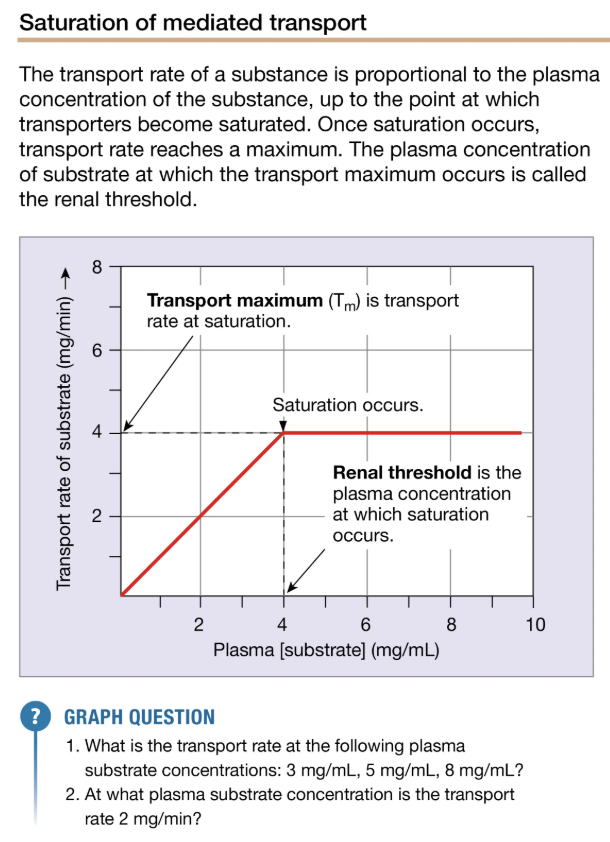
What is the transport rate at the following plasma substrate concentrations: 3 mg/mL, 5 mg/mL, 8 mg/mL?
The transport rate at 3 mg/mL is 3 mg/min; at 5 and 8 mg/mL, it is 4 mg/min.

At what plasma substrate concentration is the transport rate 2 mg/min?
The transport rate is 2 mg/min when plasma concentration is 2 mg/mL.

Why is the hydrostatic pressure so much lower in the peritubular capillaries than in the glomerulus?
Pressure is lower because blood leaving the glomerulus loses pressure as it moves into the peritubular capillaries.
If plasma creatinine=1.8 mg/100 mL plasma, urine creatinine=1.5 mg/mL urine, and urine volume is 1100 mL in 24 hours, what is the creatinine clearance? What is GFR?
Creatinine (Cr) clearance is excretion rate/plasma concentration. Excretion rate is 1.5 mg Cr/mL urine × 1100 mL urine/day, or 1650 mg Cr/day. Plasma concentration is 1.8 mg Cr/100 mL plasma. Cr clearance and GFR are 91.7 plasma/day.

Name the neurotransmitter and its receptor on the external sphincter muscle.
Acetylcholine on a nicotinic receptor