Group 2
 Call Kai
 Learn
 Practice Test
 Spaced Repetition
 Match
 Flashcards
 Knowt Play
1/25

There's no tags or description
Looks like no tags are added yet.
26 Terms
How can group 2 hydroxides be prepared by?
the reaction of the metal oxide and water


How would you describe the solubility of the group 2 hydroxides?
only slightly soluble in water
What happens when a group 2 hydroxide dissolves in water?
dissociates to release the metal cation and the hydrodxide ions e.g.

The solubility of the hydroxides ... down the group. Therefore the formed solution contains ... OH- ions and is ... alkaline
1) increases
2) more
3) more
If a solution is becoming more alkaline, is pH increasing or decreasing?
increasing
What is the use of Ca(OH)2 and why do we use it?
used in agriculture, to neutralise acidic soils
What is the use of Mg(OH)2 and CaCO3 and why do we use them?
as ‘antacids’ in treating indigestion.
Which compounds are used as antacids to neutralise excess stomach acid?
Mg(OH)₂ and CaCO₃
Which compound is used in agriculture to neutralise acidic soils?
Ca(OH)₂
Do group 2 metals have high or low bp/mp and explain why
have high mp/bp due to strong metallic bonds in their giant metallic lattice structures
Can group 2 metals conduct electricity? Explain your answer
yes they can conduct electricity in both solid and liquid form (molten) due to the mobile delocalised electrons
Why are group 2 metals considered s-block elements?
highest energy electron is found in an s subshell / orbital
Write an equation that represents the 2nd ionisation energy of Mg



In the reaction, (picture) what would you expect to observe as this reaction takes place?
fizzing
solid dissolves

State and explain what would be different about the resulting solution if you were to replace calcium with barium
solution has lower pH, calcium hydroxide is less soluble in water than barium hydroxide
less OH- ions dissociated into the solution
Is the reaction of magnesium with water slow or fast?
very slow
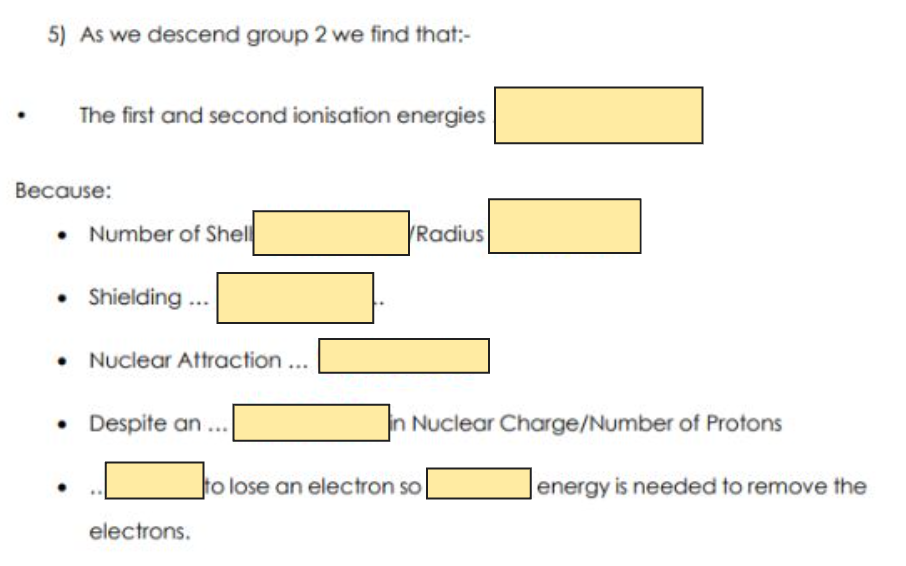
State and explain the trend in reactivity of the group 2 metals with dilute HNO3
reactivity with nitric acid increases down the group
because number of electron shells/ atomic radius increases
shielding increases
nuclear attraction decreases despite nuclear charge increasing
ionisation energy decrease so it is easier to lose electrons
How do Group 2 elements form 2+ ions in redox reactions in terms of electron configuration?
Group 2 elements have an outer-shell electron configuration of Xs². They lose both outer-shell electrons (oxidation) to form 2+ ions
How do Group 2 elements (Mg → Ba) react with oxygen?
React with oxygen to form metal oxides.
Reactivity increases down the group.
General equation: 2M + O₂ → 2MO
How do Group 2 elements (Mg → Ba) react with water?
React with water to form metal hydroxides + hydrogen gas.
Reactivity increases down the group.
General equation: M + 2H₂O → M(OH)₂ + H₂
Mg reacts very slowly with cold water, whereas Ba reacts rapidly.
How do Group 2 elements (Mg → Ba) react with dilute acids?
React with dilute acids to form a salt + hydrogen gas.
Reactivity increases down the group.
Example: Mg + 2HCl → MgCl₂ + H₂
Explain the trend in reactivity of Group 2 elements down the group in terms of first and second ionisation energies.
First and second ionisation energies decrease down the group.
Atomic radius and electron shielding increase, weakening the attraction between the nucleus and outer electrons.
Therefore, both outer electrons are lost more easily to form 2+ ions, so reactivity increases.
How do Group 2 oxides react with water, and what is the trend in alkalinity down the group?
Group 2 oxides react with water to form metal hydroxides, producing alkaline solutions.
General equation: MO + H₂O → M(OH)₂
Alkalinity increases down the group (approximately pH 9–13) because the hydroxides become more soluble, releasing more OH⁻ ions.
MgO reacts slowly, while BaO reacts readily.