Math Test
 Call Kai
 Learn
 Practice Test
 Spaced Repetition
 Match
 Flashcards
 Knowt Play
1/18

There's no tags or description
Looks like no tags are added yet.
19 Terms
i

B, D, E

ii
A, D, E
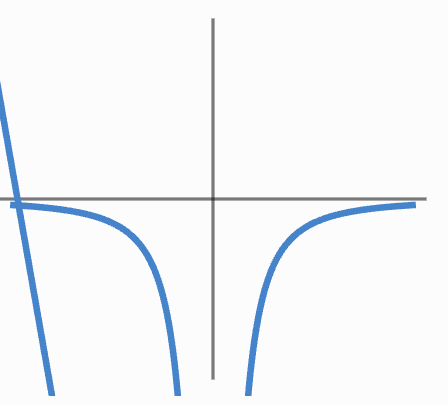
iii
B, C, F
iv
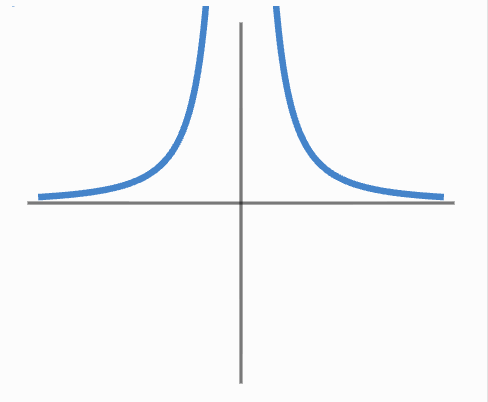
B, C, E
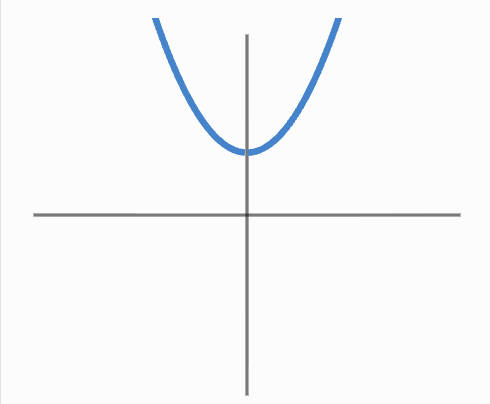
v
G
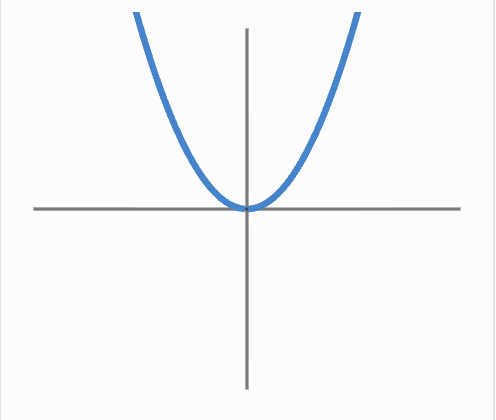
vi
A, C, E
vii

A, D, F
viii
B, D, F

ix
A, C, F
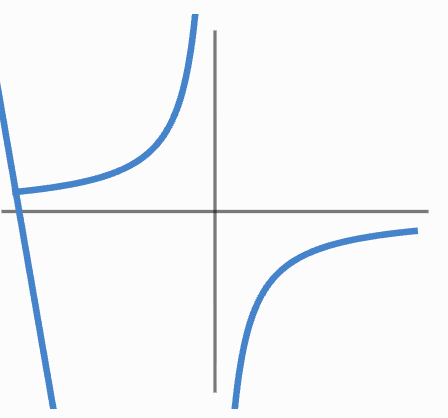
2a. Determine the relationship and justify.
Direct variation because y is always -2 time x, so y/x = -2 for every nonzero x.
2b. Find the equation.
Work: y = kx -2 = k(1) k = -2 Answer y = -2x
3a. Given: y varies inversely with x, and when x=3, y=20. Find an equation.
Work: y = k/x 20 = k/3 k = 60 Answer: y = 60/x
3b. Find x when y=10.
10 = 60/x 10x = 60 x = 6
Given: k=4
Find equation
Formula: y=kx^n
Since it varies directly with the cube of x, n=3
Substitute/answer: y=4x^3
Given: k=-5
Formula: y = k/x^n
Since it varies inversely with the square of x, n=2
Substitute: y = -5/x^2
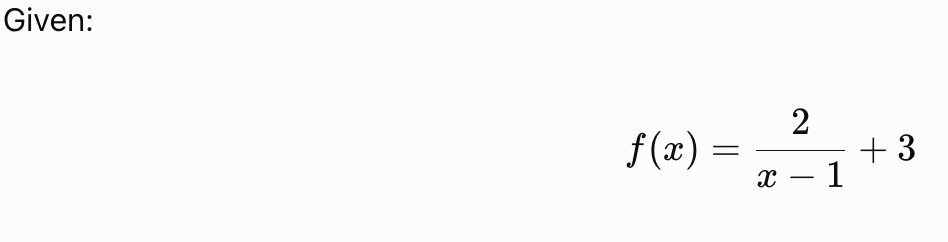
6a. Find Domain and range
Work domain : x-1 cant equal 0, so x cant equal 1 Answer: X is an element of real numbers, x cant equal 1
Work range: fraction can never equal zero, so y can never equal 3 Answer: y is an element of real numbers, y cant equal 3
6b.
Vertical asymptote: Set the denominator equal to zero: x-1=0 Answer: x=1
Horizontal asymptote: Use the number added outside the fraction Answer: y=3
6c. Sketch the asymptotes
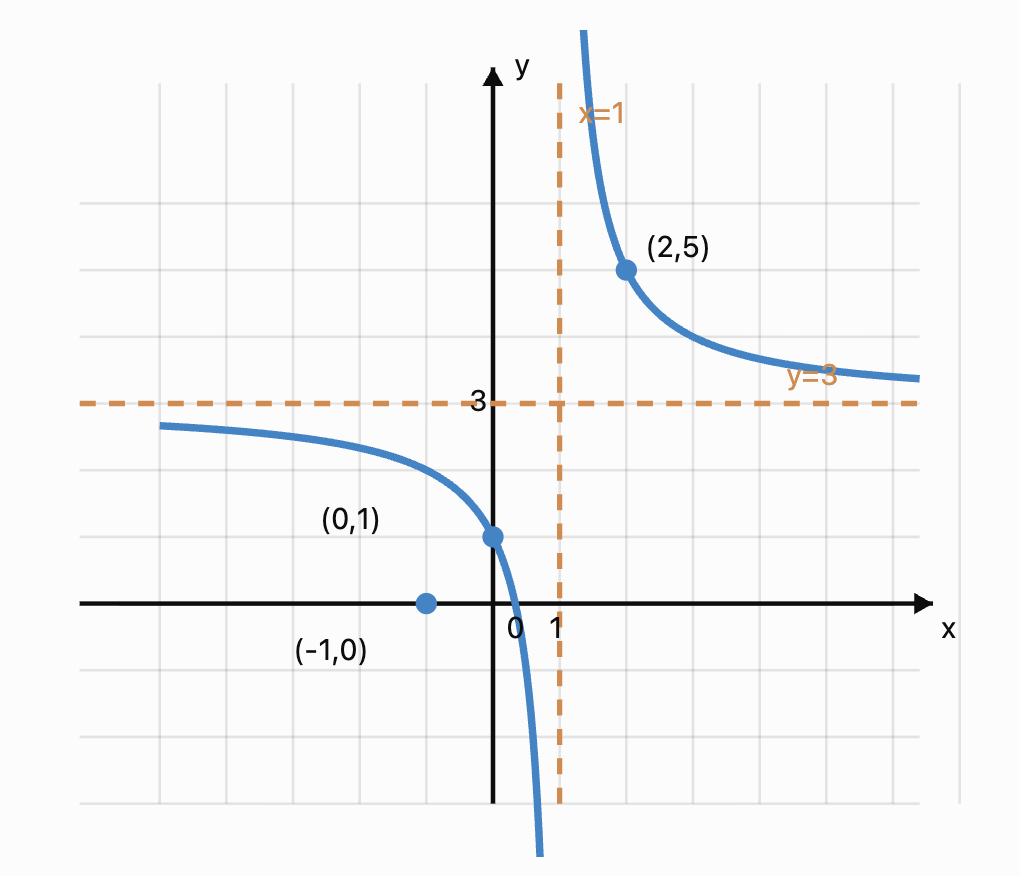
Find the y-intercept by substituting x=0: (0,1)
Find the x-intercept by setting y=0: (1/3,0)
Another useful point: (2,5)
Given the parent function \(y=\frac{1}{x}\), write the equation after the following transformations:
Reflected over the x-axis
Vertical dilation by a factor of 2
Shifted right 4 units
Shifted up 7 units
Parent function: y = 1/x
Final Answer: y= (-2/x-4) +7