Cell Physiology + Basics
 Call Kai
 Learn
 Practice Test
 Spaced Repetition
 Match
 Flashcards
 Knowt Play
1/176

There's no tags or description
Looks like no tags are added yet.
177 Terms
Physiology is…
The biological study of the functions of living organisms and their parts (IBP)
The study of how living organisms function (Vander’s)
The foundation of medical practice (Costanzo)
Physiology is Integrative, works together as a whole
Physiology connects processes from molecules to the whole body.
Biochemistry, molecular biology, cell biology, neuroscience, immunology, pathology, pharmacology, and more.

Physiology; From molecules to organism - How is the body organized?
Chemical Level (H2O) → Cellular Level → Tissue Level → Organ Level → Organ System Level → Organism Level
Molecules → cells → tissues → organs → organ systems → organism.
What is in vitro?
A process studied outside the organism, such as in a test tube or cell culture.
What is in silico?
A process studied using computer modeling/simulation.
What is a feedback loop?
A physiological mechanism that regulates a variable.
Ex vivo
Taking something out of a living organism and studying it outside the body.
Example:
Take a piece of tissue from an animal.
Put the tissue in a dish and keep it alive.
In vivo
A process studied in a living organism.

What is a feedback loop?
A physiological mechanism that regulates a variable and is used to maintain homeostasis
What are the 7 parts of a feedback system?
Stimulus → receptor → input pathway → control center → output pathway → effector → response.

Negative Feedback Loop
A physiological process that detects a change in the body's internal environment and reverses it to restore stability

Positive Feedback Loop
A physiological process where the body amplifies an initial change or stimulus rather than reversing it,

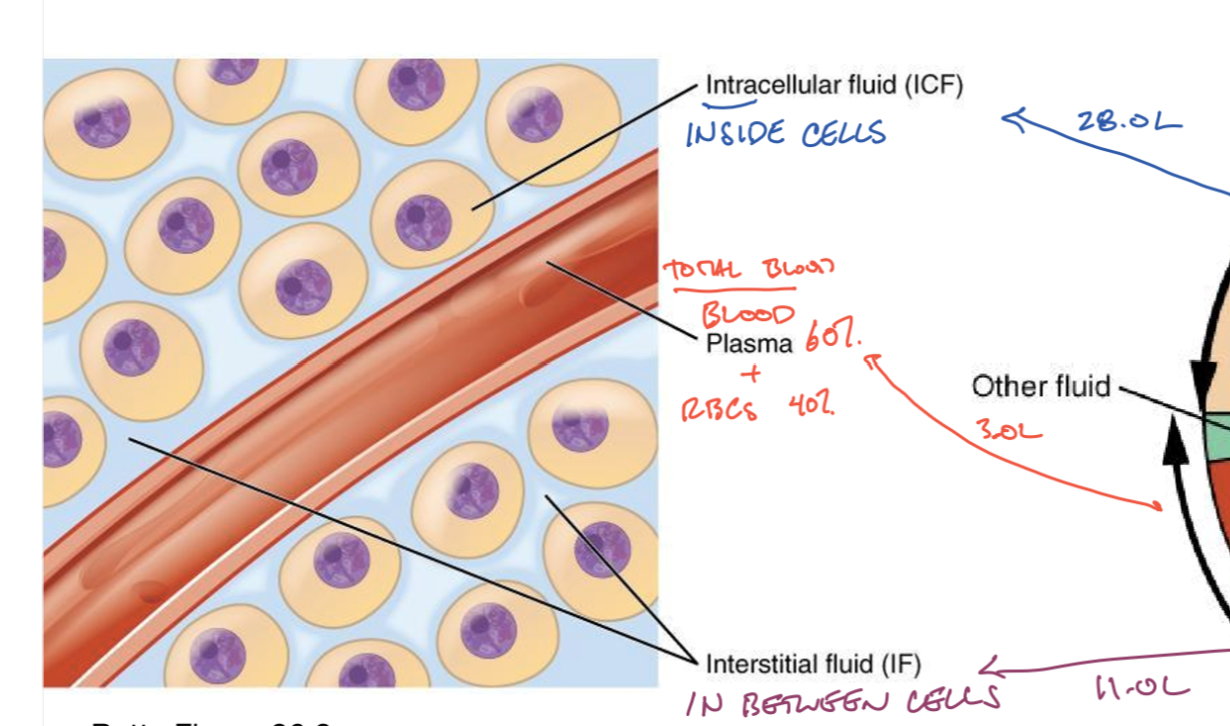
Body fluids are organized into compartments
Intracellular Fluid (28.0 L): Inside cells
Extracellular Fluid (14.0 L): Outside cells
Interstitial Fluid (11.0 L): In between cells
Plasma (3.0 L): Blood
Other fluid
Total = 42.0 L
Homeostasis
The self-regulating process by which biological systems maintain a constant, stable internal environment despite changes in external conditions.
Dynamic Process: Give and take, body is constantly adjusting
What variables are regulated by homeostasis?
pH, electrolytes, O₂, CO₂, blood pressure, temperature, glucose, and osmolarity.
Who is associated with “milieu intérieur”?
Claude Bernard.
Who coined the term “homeostasis”?
Walter B. Cannon
Is homeostasis equilibrium or steady state?
Homeostasis is a dynamic steady state, not equilibrium.
What is something that helps maintain homeostasis
Exchange between internal and external environments
How can you tell if something is regulated by homeostasis?
It is in the internal environment, kept fairly constant, and monitored by a receptor.
Main idea: Homeostasis keeps the extracellular fluid stable because it is the internal environment in which our cells live.
Body systems
↓
regulate the ECF
↓
ECF surrounds cells
↓
cells get what they need + wastes are removed
↓
cells can function normally
Cells need things like:
O₂ → for cellular respiration/energy
Glucose → energy source
Water
Ions → Na⁺, K⁺, Ca²⁺, etc.
Proper pH
Proper temperature
from ECF
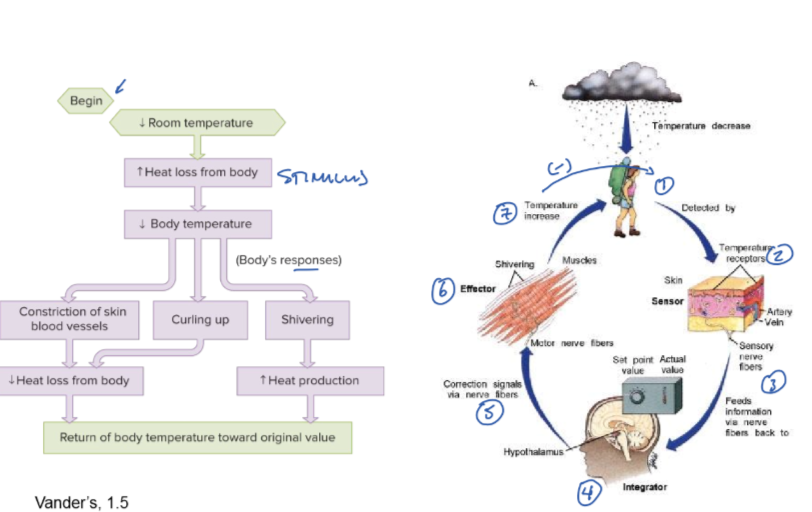
Applying Feedback Mechanisms to Homeostasis
Example: You get cold
Stimulus: Body temperature drops
↓
Receptor: Detects the temperature change
↓
Integrator/control center: Brain decides what to do
↓
Effectors: Muscles/body respond → shivering + constricting blood vessels
↓
Response: Body temperature rises back toward the set point
Homeostasis maintained as the temperature rises back towards the set point
What is the afferent (input) pathway?
Carriers information from the receptor/sensor to the control center.
What is the efferent (output) pathway?
Carries information from the control center to the effector.
What does the control center/integrating center do?
Processes the information from the receptor and determines the appropriate response.
What does the effector do?
Generates the response directed by the control center
What is the purpose of a negative feedback system?
To oppose/reverse the initial stimulus and bring the variable back toward its normal range.
What is the purpose of a positive feedback system?
To reinforce/amplify the initial stimulus.
What is an example of positive feedback in the human body?
Childbirth: contractions increase the stimulus for more contractions.
What is an example of negative feedback in the human body?
Body temperature regulation: responses oppose the temperature change.
What are the two forces involved in maintaining homeostasis?
Internal and external environments exchange substances to help maintain homeostasis.
What is the internal environment of the body?
The extracellular fluid (ECF) surrounding the cells.
Why must the internal environment be regulated?
Cells need a stable environment to function properly.
What does homeostasis require the body to constantly do?
Monitor → evaluate → change → re-monitor → re-evaluate.
What happens when a set point is reset?
The target value/range maintained by homeostasis changes.
What does a chemoreceptor detect?
Chemical changes.
What does a baroreceptor detect?
Pressure changes.
What does a mechanoreceptor detect?
Stretch or mechanical changes.
What does a thermoreceptor detect?
Temperature changes.
What are the main components of a plasma membrane?
Phospholipids, membrane proteins, and cholesterol.
What are the two main types of membrane proteins?
Transmembrane and peripheral proteins.
What are transmembrane proteins?
Proteins that span the plasma membrane.
What are peripheral proteins?
Proteins associated with one side of the membrane
What are glycoproteins?
Proteins with carbohydrate groups attached.
What does cholesterol do in the membrane?
It affects membrane fluidity.
What does amphipathic mean?
Having both hydrophilic and hydrophobic regions.
Why are phospholipids amphipathic?
They have a hydrophilic head and hydrophobic fatty-acid tails.
What are the 3 main functions of the plasma membrane?
Selective barrier, intracellular communication, and structural support.
What does the plasma membrane's selective barrier do?
Controls what enters and leaves the cell.
What molecules can easily cross the lipid bilayer?
Small nonpolar molecules such as O₂ and CO₂.
Why can't ions easily cross the lipid bilayer?
They are charged and need specific transport proteins.
Why do polar molecules need transporters?
They do not easily cross the hydrophobic lipid interior.
How does the membrane participate in cell communication?
Signaling molecules bind membrane receptors and start intracellular signaling cascades.
What is a ligand?
A signaling molecule that binds to a receptor.
What happens when a ligand binds its receptor?
It can trigger an intracellular signaling cascade.
How does the membrane provide structural support?
Membrane proteins form contacts with neighboring cells.
What are tight junctions?
Cell connections that restrict movement between cells.
What are gap junctions?
Connections that allow small molecules/ions to pass between cells.
What are desmosomes?
Cell connections that anchor cells together and transfer force.
What is diffusion?
Movement of molecules from high concentration to low concentration.
What drives simple diffusion?
A concentration gradient.
Over what distance is diffusion effective?
Short distances, generally less than about 7 nm.
Why does the body need a circulatory system?
Diffusion is too slow over long distances.
What does a membrane do to diffusion?
It acts as a barrier and slows diffusion.
What is net flux?
The difference between movement in opposite directions.
What direction does net diffusion occur?
From high concentration to low concentration.
What is Fick's First Law?
J = PA(Co − Ci)
What does J represent in Fick's law?
Rate of diffusion or magnitude of flux.
What does P represent?
Membrane permeability.
What does A represent?
Membrane surface area.
What does Co represent?
Concentration outside the cell.
What does Ci represent?
Concentration inside the cell.
What increases diffusion rate according to Fick's law?
Greater surface area, permeability, or concentration difference.
What is facilitated diffusion?
Passive movement through membrane transport proteins.
Does facilitated diffusion require energy?
No
What are ion channels?
Membrane proteins that allow specific ions to cross
What is channel gating?
Opening and closing of ion channels.
What are the 3 types of ion channels?
Ligand-gated, voltage-gated, and mechanically-gated
What are ligand-gated channels opened by?
Binding of a ligand
What are voltage-gated channels opened by?
Changes in membrane voltage
What are mechanically-gated channels opened by?
Mechanical forces such as stretch
What 4 factors determine mediated transport flux?
Solute concentration, transporter affinity, transporter number, and conformational-change rate.
What is transporter specificity/selectivity?
A transporter preferentially transports certain substances.
What is transporter saturation?
Transport reaches a maximum because available transporters are occupied.
What is active transport?
Movement against a concentration gradient using energy
What are ICF and ECF concentrations
ICF:
Na+ = 15 mm (More outside)
K+ = 150 mm (More inside)
Cl- = 7 mm (More outside)
ECF
Na+ = 145 mm (More outside)
K+ = 5 mm (More inside)
Cl- = 100 mm (More outside)
What is the Na⁺/K⁺ ATPase?
A primary active transporter that uses ATP to move Na⁺ and K⁺.
What does the Na⁺/K⁺ ATPase pump do?
Pumps 3 Na⁺ out and 2 K⁺ into the cell.
(Because there is already such a high concentration inside the cell, it takes energy to pump more K in) ( PUMP K IN)
What is secondary active transport?
Transport powered indirectly by an ion's electrochemical gradient.
What ion gradient commonly powers secondary active transport?
The Na⁺ gradient.
What creates the Na⁺ gradient used in secondary transport?
The Na⁺/K⁺ ATPase.
What is cotransport?
Two substances move in the same direction.
What is countertransport?
Two substances move in opposite directions.
What is GLUT?
A glucose transporter, used in passive transport ( facilitated diffusion)
What is osmosis?
Movement of water across a membrane
What determines membrane permeability to water?
Number/type of aquaporins and tissue type
What are aquaporins?
Membrane channels that allow water to cross
What is osmolarity?
The total concentration of solute particles in a solution.
What happens to water concentration when solute concentration increases?
Water concentration decreases.
What determines osmotic effects of a solute?
The number of solute particles present