Science ASVAB
 Call Kai
 Learn
 Practice Test
 Spaced Repetition
 Match
 Flashcards
 Knowt Play
1/117

There's no tags or description
Looks like no tags are added yet.
Name | Mastery | Learn | Test | Matching | Spaced | Call with Kai | Chat |
|---|
No analytics yet
Send a link to your students to track their progress
118 Terms
crust, mantle, core
What are Earth's 3 main layers?
crust
rocky outer layer & thinnest
mantle
a thick layer of hot but solid rock beneath Earth's crust
core
a large sphere of metal that occupies Earth's center
Plate Tectonics
pieces of crust's outermost layer (plates) move slowly (1.4 inches in a year) oceanic & continental plates "float" on top of denser material. As plates move, continents drift slowly
divergent plate boundaries
occur when plates move APART; magma from mantle rises to earth's surface & forms new rock- results in seafloor spread
convergent plate boundaries
Plates move toward each other, and collide making mountains or volcanoes
Transform Fault Boundaries
Plates move sideways past each other.
igneous, sedimentary, metamorphic
3 types of rocks
igneous rock
forms when magma from inside earth cools and solidifies-- granite, obsidian, basalt
metamorphic rock
forms when a rock is transformed by heat, pressure, or chemical reaction-- marble, slate
sedimentary rock
forms over time as sediment is layered, squeezed, and solidified- limestone, coal, shale
water makes up...
71% of earth's surface- glaciers, oceans, lakes, rivers
what form is most fresh water in?
ground water
water cycle
The continuous process by which water moves from Earth's surface to the atmosphere and back
evaportation
energy from sun causes water on surface to convert to liquid- gas. warm water vapor rises from surface into atmosphere
transpiration
water evaporates from plants
Condensation
when vapor rises into sky and cools
Precipitation
water particles fall from clouds and reach ground - rain, snow, hail
water freezes
32 F and 0 C
water boils
212 F and 100 C
how much saltwater is there?
Fresh water?
Ice?
97% Saltwater
3% Freshwater
2/3% Ice
Earth's atmosphere
78% nitrogen, 21% oxygen, 1% argon
5 layers of atmosphere
troposphere, stratosphere, mesosphere, thermosphere, exosphere
Troposphere
1st layer, where humans live & weather takes place
Stratosphere
2nd layer of atmosphere; extends from 10 to 30 miles up; location of OZONE LAYER; absorbs 95% of Ultraviolet radiation; temperature increases with altitude increase.
Mesosphere
3rd layer of atmosphere, coldest layer, where meteors burn up
Thermosphere
The uppermost layer of the atmosphere (4th), in which temperature increases as altitude increases, International Space Station Orbits
Exosphere
The outer layer of the thermosphere, extending outward into space, contains most satellites orbiting earth
Planets
Mercury, Venus, Earth, Mars, Jupiter, Saturn, Uranus, Neptune
inner planets
Small, rocky planets that orbit closest to the sun including Mercury, Venus, Earth, & Mars, small, dense, and rocky- terrestrial
outer planets
Jupiter, Saturn, Uranus, & Neptune, colder, larger, massive
Mercury
smallest, dense, large iron core, 88 days = 1 year (fastest)
Venus
brightest planet in sky, 243 days to rotate- 1 day=1 year
Earth
suitable atmosphere & temperature for H20= support life
Mars
Iron rich rocks, red, once had liquid surface H20
asteroid belt
the region of interplanetary space between Mars and Jupiter where most asteroids are found
Jupiter
largest, 95 moons, Hydrogen(H), Helium (He), gas giant
Saturn
2nd largest, known for rings, 146 moons, gas giants
Uranus
axis tilt is more than 90 degrees, ice giant
Neptune
blueish color from methane, ice giant
Kuiper Belt
a region of the solar system beyond the orbit of Neptune, believed to contain many comets, asteroids, and other small bodies made largely of ice.
Comets
balls of ice, rock, and dust in space with a tail
Energy
living things need this to survive!
Producer
organisms able to produce their own energy (food) i.e plant
Consumers (heterotrophs)
eat other organisms for energy & don't make their own
Herbivores (primary consumers)
eat plants i.e deer, grasshoppers, pandas
Carnivores (secondary and tertiary consumers)
feed on other animals i.e lion, coyote
Omnivores (primary and secondary consumers)
eat both plants and animals i.e humans, bears, racoons
Scavengers and decomposers
Organisms that get their energy by eating dead things. They are nature's recyclers. i.e vultures, earthworms
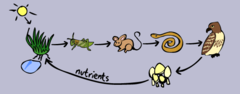
Food chain
A linear series of steps in which organisms transfer energy by eating and being eaten

Food Web
network of complex interactions formed by the feeding relationships among the various organisms in an ecosystem
muscular system
all muscles that move bones and connective tissue
respiratory system
nose, pharynx, larynx, trachea, bronchi, & lungs, breathing- process of oxygen obtained & CO2 released
circulatory system
transports materials to & from cells, consists of blood cells & platelets, heart, blood vessels (arteries , vein)
digestive system
series of organs joined to work so we can use food for energy: mouth, throat, esophagus, stomach, small & large intestine, rectum, anus. glands that help us process: liver
nervous system
gathers & interprets info from body internal/external environment & responds to info. allows people to speak, smell, taste, hear, see, move, think & have emotions: brain nerves, spinal cord
reproductive system
Allows organisms to produce offspring
gregor mendel
The father of genetics - Experimented with pea plants, discovered each plant contains 2 sets of instructions for each characteristics. each parent donates one set
Allele
Different forms of a gene- dominant or recessive
dominant allele
will show up even if there are less i.e brown dominates blue
recessive allele
show only if a person has 2 copies of allele i.e 2 blue eyes
homozygous
An organism that has two identical alleles for a trait i.e rr or RR
homozygous dominant
Both alleles (factors) for a trait are the same and dominant (AA)
homozygous recessive
Both alleles (factors) for a trait are the same and recessive (aa)

Punnet Square
A chart that shows all the possible combinations of alleles that can result from a genetic cross
Farenheit
tempurature scale on which water freezes at 32 degrees and boils at 212 degrees
Celcius
Metric temperature scale on which water freezes at 0 degrees and boils at 100 degrees

Kelvin
The SI base unit of temperature (absolute zero:0K-373K boiling)
Newton's Laws of Motion
Inertia, Acceleration, and Reaction
Newton's 1st Law
(Law of Inertia) an object in motion tends to stay in motion & an object at rest stays at rest unless acted upon by an outside force.
Newton's 2nd Law
Force = mass x acceleration
Newton's 3rd Law
For every action there is an equal and opposite reaction
Newton's Law of Gravitational Force
The gravitational force between two objects is directly proportional to the product of their masses & inversely proportional to square of distance between them
Speed of light
300,000 kilometers per second/ 186,000 miles per second
Speed of sound
343 meters per second (in air), or 4.7 seconds to travel 1 mile. 4.3X faster Traveling through water
Albert Einstein: Theory of Special Relativity
how time and space change depending on how fast your moving (motion is compared to something else)
kinetic energy
the energy an object has due to its motion i.e throwing a baseball, flying airplane, flowing river
potential energy
stored energy that results from the position or shape of an object i.e compressed spring, lifted weight
mechanical energy
energy stored in objects by tension
chemical energy
energy stored within chemical bonds of atoms
nuclear energy
potential energy of particles inside an atomic nucleus
gravitational force
an attractive force that acts between any two objects
forms of potential energy
mechanical, chemical, nuclear, gravitational
Forms of Kinetic Energy
thermal, electrical, radiant, sound, motion/mechanical
thermal energy
The total energy of motion in the particles of a substance
electrical energy
Energy caused by the movement of electrons. i.e lightning or electrical eels
radiant energy
energy carried by light or radiation i.e sunshine or xray
sound energy
Energy caused by an object's vibrations i.e drums or thunder
motion/mechanical energy
stored in movements of objects i.e wind
atoms
smallest unit of matter (protons, neutrons, electrons)
Elements
A molecule composed of one kind of atom; cannot be broken into simpler units by chemical reactions.
molecules
particle made up of two or more atoms chemically bonded together
compounds
molecules made up of two or more elements
3 States of matter
solid, liquid, gas
freezing
liquid to solid
melting
solid to liquid
condensation
Gas to liquid
Vaporization
Liquid to gas
sublimination
solid to gas