Organic Chem 2 Test 3
 Call Kai
 Learn
 Practice Test
 Spaced Repetition
 Match
 Flashcards
 Knowt Play
1/173

There's no tags or description
Looks like no tags are added yet.
174 Terms
carboxylic acid derivatives
acyl chloride, acid anhydride, ester, nitrile, amide
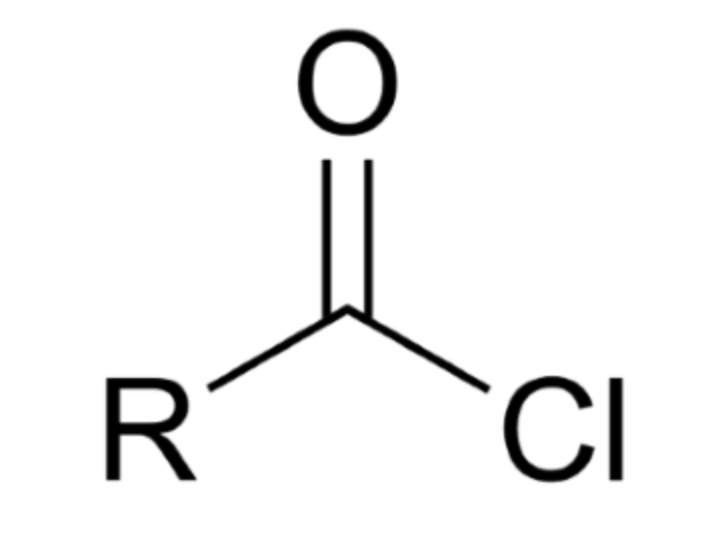
acyl chloride
A type of carboxylic acid derivative where the hydroxyl group is replaced by a chlorine atom
acid anhydride
A carboxylic acid derivative formed by the removal of water from two carboxylic acid molecules.

ester
A carboxylic acid derivative formed from the reaction between a carboxylic acid and an alcohol, in which the hydroxyl group is replaced by an alkoxy group (OR).

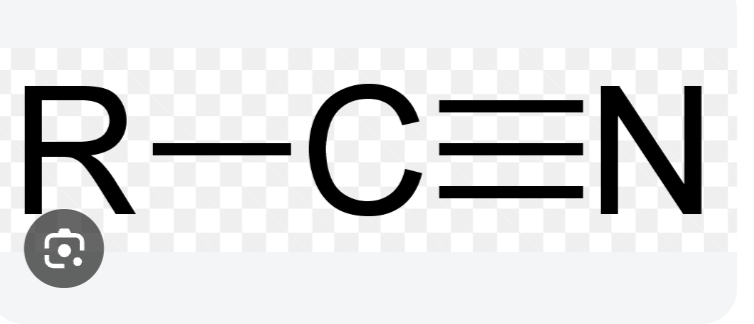
nitrile
A functional group containing a carbon triple-bonded to a nitrogen atom, represented as R-C≡N
amide
A carboxylic acid derivative formed from the reaction between a carboxylic acid and an amine, where the hydroxyl group is replaced by an amino group (NH2).

What happens when a carboxylic acid is attached to a ring in terms of nomenclature?
it is named as an alkane carboxylic acid; ex. benzoic acid
how are alkanes with two carboxylic acids named?
They are named as diacids, with the suffix "dioic acid"; for example, oxalic acid (ethanedioic acid).
geometry of carboxylic acids
trigonal planar, 120 degree bond angles, carbonyl C is sp2 hybridized
are carboxylic acids polar or nonpolar?
polar
carboxylic acids with 1-9 C atoms have a
sharp and strong odor; acids with larger saturated alkyl groups are waxy, odorless solids
carboxylic acids with up to 4 carbons are
miscible with water in all proportions; water solubility decreases as the size of the alkyl group increases
what kind of melting and boiling points do carboxylic acids have?
high melting and boiling points
what is a carboxylic acid dimer?
two carboxylic acid molecules held together by 2 hydrogen bonds; so carboxylic acids have higher boiling points
are carboxylic acids strong or weak acids?
weak acids
what can carboxylic acids donate to bases?
a proton (H+)
what type of reaction occurs between carboxylic acids and bases?
neutralization reaction, which creates a carboxylate salt and water; strong bases (NaOH) will react 100% with water
how do you convert a carboxylic acid salt back to a carboxylic acid?
treat it with a strong acid (HCl)
what suffix do carboxylate ions (carboxylate salts) end with?
“ate”
Which is more water soluble: a carboxylic acid or its carboxylate salt?
the carboxylate salt
in water, which side does the carboxylic acid equilibrium favor?
the acid (protonated) form
what is the typical pKa of carboxylic acids?
between 4 and 5
low pKa means
the acid is stronger
what two components make up a carboxylic acid buffer?
a carboxylic acid and its conjugate base (carboxylate salt)
what equation is used to calculate buffer pH?
Henderson Hasselbach equation; pH= pKa + log [conjugate base]/[acid]
how do electron withdrawing groups affect acidity?
increase acidity and lower pKa
how does distance from an electron-withdrawing group affect acidity?
Closer to COOH = stronger acid
Oxidative cleavage of alkenes
is a reaction that breaks carbon-carbon double bonds to form carbonyl compounds such as aldehydes or ketones, often using reagents like hot KMNO4
when does oxidative cleavage of an alkene produce a carboxylic acid?
when an alkene carbon has at least one hydrogen
What does oxidation of a primary alcohol create?
A carboxylic acid using Na2Cr2O7, H2SO4, H2O
What does oxidation of an alkylbenzene produce?
Benzoic acid if at least one benzylic H is present
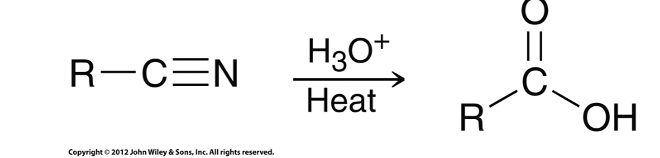
How do you convert a nitrile into a carboxylic acid?
H3O+ and heat (acidic hydrolysis)
How do you convert an alkyl halide to a carboxylic acid?
1) CN to make benzoic nitrile 2) H3O+ and heat to make benzoic acid
How do Grignard reagents form carboxylic acid?
CO2 then H3O+
what is a Grignard reagent?
A Grignard reagent is an organomagnesium compound, typically of the form R-MgX, where R is an organic group and X is a halogen. They are highly reactive and used to form carbon-carbon bonds in organic synthesis.
What does LiAlH4 do to carboxylic acids?
reduces them to primary alcohols.
How does BH3 THF differ from LiAlH4 in reducing carboxylic acids?
BH3 THF selectively reduced COOH; LiAlH4 would reduce any other carbonyls present as well
why are nitriles also classified as carboxylic acid derivatives?
they have the same carbon oxidation state despite lacking a carbonyl
which carboxylic acid derivatives are common in proteins?
amides (peptide bonds)
how do you name an acid halide?
replace -ic acid with -yl halide
how do you name an acid halide attached to a ring?
replace carboxylic acid with carbonyl halide
how are acid anhydrides named
replace acid with anhydride

how are asymmetric acid anhydrides named?
list both parent acids alphabetically, followed by anhydride
how are esters named?
name the alkyl group attached to the oxygen followed by the carboxylic acid’s name with the suffix ate
how are amides named?
name the parent carboxylic acid, replacing "ic acid" with "amide" for substituents.
How are any alkyl groups attached to the N atom in an amide named?
Use N or N,N before substituent names
How are amides attached to rings named?
Name the cyclic compound followed by "carboxamide" if it is derived from a carboxylic acid.
how are nitriles named?
replacing “ic acid” with “onitrile” ; ex. benzoic acid to benzonitrile
what is the reactivity order of carboxylic acid derivatives?
alkyl haklides> anhydrides> esters> amides
what factors affect carboxylic acid derivative reactivity?
induction, resonance, sterics and leaving-group ability
why are acid chlorides highly reactive?
Cl withdraws electrons and is a good leaving group
why are amides the least reactive acid derivatives?
strong nitrogen resonance donation stabilizes the carbonyl
why do aldehydes and ketones not undergo nucleophilic acyl substitution?
they lack a suitable leaving group
what are the two main steps of nucleophilic acyl subsitution?
1) nucleophilic attack 2) loss of leaving group
Does nucleophilic acyl substitution follow an SN2 mechanism?
No. It proceeds through a tetrahedral intermediate
what reagent converts carboxylic acids into acid chlorides?
SOCl2 (thionyl chloride); pyridine can be added
what happens when an acid chloride reacts with water?
hydrolysis forms a carboxylic acid and HCl
What happens if an acid chloride reacts with alcohol?
forms an ester; often uses pyridine
What happens when an acid chloride reacts with NH3 or an amine?
Forms an amide; 2 equivalents neutralize the HCl formed (1 for product, 1 to neutralize HCl formed)
What does excess LiAlH4 (LAH) do to acid chlorides?
reduces them to primary alcohols
how can an acid chloride be reduced to an aldehyde?
1) LiAl(OR)3H (bulky reducing agent) 2) H2O
What does an excess Grignard reagent do to an acid chloride?
forms a tertiary alcohol after aqueous workup
what reagent converts an acid chloride into a ketone?
Gilman reagent (R2CuLi)
how are acid anhydrides prepared from acid chloride?
react an acid chloride with a carboxylate ion
what reactions do acid anhydrides go?
similar to acid chlorides: hydrolysis, alcoholysis, aminolysis and reduction
what does acetic anyhydrides form with alcohol vs amines?
alcohol + anhydride = ester
amine + anhydride = amide
how can esters be prepared using an SN2 reaction?
carboxylate + primary alkyl halide = ester
What is Fisher esterification and how is it driven forward?
carboxylic acid + alcohol + acid catalyst = ester + water; use excess alcohol or remove water
what is the role of pyridine in acid chloride + alcohol reactions?
Neutralizes HCl formed during ester formation
what does acidic hydrolysis of an ester produce?
carboxylic acid and alcohol.
What is saponification?
base hydrolysis of an ester to become carboxylate salt and alcohol
how do you obtain a carboxylic acid after saponification?
Add H3O+ (acid workup)?
what happens when an ester reacts with NH3 or amines?
forms amides; the reaction is relatively slow
what does excess LAH do to an ester?
produces two alcohols after aqueous workup
how do you reduce an ester to an aldehyde without over-reduction?
Use DIBAH followed by H2O
what happens when an ester reacts with excess Grignard reagents?
forms tertiary alcohols after aqueous workup (2 additions)
what is the best carboxylic acid derivative for preparing amides?
acid chlorides, because they are the most reactive
what monomers form nylon 6,6?
A diacid chloride and a diamine, forming a polyamide
what does acidic hydrolysis vs basic hydrolysis of an amide produce?
acidic: carboxylic acid + ammonium salt
basic: carboxylate salt + amine
What does LAH do to amides?
reduces them to amines, removing the carbonyl oxygen
what are the two ways to prepare nitriles?
CN⁻ + 1°/2° alkyl halide (SN2), or amide dehydration with SOCl₂.
what does nitrile hydrolysis produce?
A carboxylic acid using H₃O⁺, or NaOH/H₂O followed by H₃O⁺.
what happens when a nitrile reacts with a Grignard reagent?
Forms a ketone after acidic hydrolysis
what does LAH do to nitriles?
reduces them to primary amines
what two things should you check when planning a synthesis?
changes to the carbon skeleton and changes to the functional group
What are the key IR peaks for carboxylic acids and nitriles?
Acid O–H: 2500–3300 cm⁻¹ (broad); nitrile C≡N: ~2200 cm⁻¹
what causes surface tension?
cohesion between surface molecules due to attractive forces acting sideways or downward
what is a detergent?
a substance that cleans, especially by removing grease or dirt
what is soap chemically?
the sodium or potassium salt of a long-chain carboxylic acid
how many carbon atoms are typically found in soap’s fatty acid chains?
10-18 carbons
what are the two parts of a soap molecule?
A hydrophilic head and a hydrophobic tail
what is a surfactant?
a substance that accumulates at surfaces and changes their properties
what is a micelle?
A spherical arrangement of soap molecules in which hydrophobic tails are inward and hydrophilic heads are outward, forming a structure that can trap oils and dirt.
why do micelles form?
soap molecules cluster to shield their hydrophobic tails from water
how do soaps clean?
lower surface tension, trap grease in micelles, and keep dirt suspended in water
why do soap micelles stay suspended in water?
their negatively charged surfaces repel one another
what is saponification?
heating triglycerides (fats or oils) with a base such as NaOH to make soap
what intermediates are involved in alpha carbon reactions?
enols and enolates
what are enols?
a compound with an OH group directly attached to a C=C double bond
what are keto-enol tautomers?
constitutional isomers that interconvert by moving a proton and a double bond