6) memory
 Call Kai
 Learn
 Practice Test
 Spaced Repetition
 Match
 Flashcards
 Knowt Play
1/118

There's no tags or description
Looks like no tags are added yet.
119 Terms
what are the components of the working memory model?
The central executive, the visuo-spatial sketchpad, the phonological loop and the episodic buffer
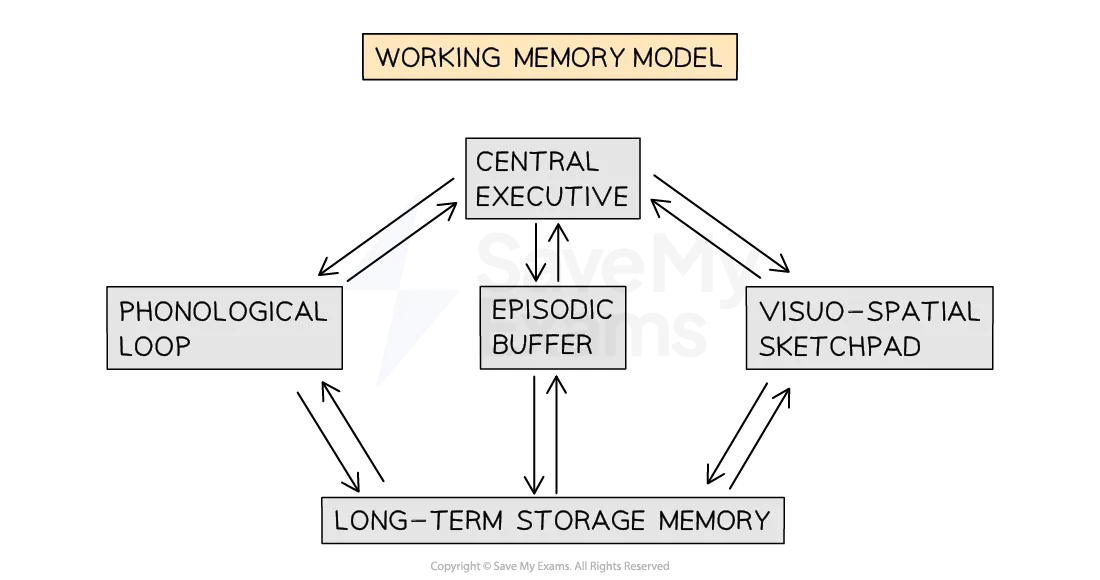
The working memory model
What is the central executive?
The attentional profess that monitors incoming data, makes decisions and allocates slave systems to tasks.
What is the phonological loop?
The slave system that deals with auditory information and preserves the order in which information arrives
What’s the phonological loop subdivided into?
The phonological store and articulatory process
What does the phonological store do?
Stores the word you hear
What does the articulatory process do?
It allows maintenance rehearsal
What’s the visuo spatial sketch pad divided into?
The visual cache and inner scribe
What does the visuo spatial sketchpad store?
It stores visual and spatial information
What is the episodic buffer?
A temporary store for information which integrates the visual, spatial and verbal information processes by the other stores. It also links the working memory to the LTM
What was the aim of Baddeley et al (1975a) experiment?
To investigate the existence of a phonological loop in STM
What was the procedure of Baddeley et al (1975a) experiment?
Participants saw everyday words displayed very quickly, they were then asked to write the words seen in serial order. Condition 1 contained 5 one syllable word and condition 2 contained 5 polysyllabic words
What were the findings of Baddeley et al (1975a) experiment?
Participants recalled the shorter one syllable words much better than the polysyllabic words which he called the word length effect
What were the conclusion of Baddeley et al (1975a) experiment?
The phonological loop had a role in the capacity of STM; it is determined by the length of time it takes to say the words
How much information does the phonological loop hold?
The amount of information that you can say in 2 seconds
Strength: what’s clinical evidence that supports the working memory model?
The case study with KF, he had poor STM ability for verbal information but could process visual information normally. His STM for digits was poor when read out to him but his recall was better when he was able to read the digits himself
Why in Baddeley (1975) studies of dual task performance did participants struggle completing two visual tasks as opposed than doing a visual and verbal task?
Two visuals tasks compete for the same slave system, whereas visual and verbal talk use different slave systems so there is no competition
Why is Baddeley’s lack of clarity over the central executive a weakness?
It makes it difficult to test scientifically or understand exactly how it works
who is Clive wearing?
Clive wearing was a highly educated talent musician and broadcaster who contracted a viral infection in his brain which left him with extensive brain damage
What was the case of clive wearing?
after his brain damage, Wearing was able to maintain most of his skills like reading but his memory for past events were fuzzy, his visual memory was impaired. He’s unable to make new memories.
Who introduced the multi store model of memory?
Atkinson and Shiffrin (1968)
What are the three stores of the multi store model?
Sensory memory, short then memory, long term memory
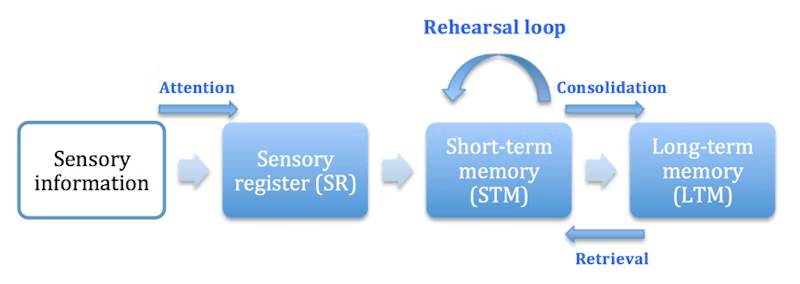
The multi store model of memory
What’s the sensory register?
the store that detects stimulus from the environment.
How many stores are in the sensory register?
five, one for each sense
What’s the coding in the sensory register ?
Morality specific (depends on the sense)
What’s the duration in the sensory register?
Half a second
That’s the capacity in the sensory register?
very high
How is information transferred from the sensory register to the short term memory?
If attention is paid to it
What’s the coding in the short term memory store?
Acoustic, according to the way it sounds
What’s the coding in long term memory?
Semantic, according to its meaning
What was the aim of Baddeley (1966) experiment?
To identify whether accounting coding is used in STM and semantic coding is used in LTM
What was the procedure of Baddeley (1966) experiment?
There were four types of word list, acoustically similar, semantically similar, acoustically dissimilar and semantically dissimilar. Participants eeee asked to recall the words in the same order as they were presented, either immediately or after times delay
What was the experimental design/condition of Baddeley (1966) experiment?
Laboratory experiment with independent measure design
What was the independent and dependent variable in Baddeley (1966) experiment?
IV- the type of worst list
DV- the number of substitution error made
What’s were the findings of Baddeley (1966) experiment?
With immediate recall there was more substitution error on acoustically similar lists than on the acoustically dissimilar list. With delayed recall substitution error did not differ between acoustically similar and dissimilar words however semantically similar lists words were confused more than semantically dissimilar.
What conclusion were drawn in Baddeley (1966) experiment?
That STM coding is acoustic and LTM coding is semantic
What was Bahrick et al (1975) procedure?
University graduates were shown photos from their high school yearbook. For each photo, participants were asked to select the name that matched
What was the sample of Bahrick et al (1975) experiment?
394 American university graduates
What were the findings of Bahrick (1975) experiment?
90% of the participants were able to correctly match the names to faces 14 years after graduating and 60% of participants were able to correctly match the names and faces 47 years after
What was Bahrick et al (1975) conclusion?
People could remember certain types of information such as names and faces for almost a lifetime
What was the procedure or Peterson and Peterson (1959) experiment?
Participants were briefly shown a consonant Triagram and then were asked to count backwards in three from a specified number. After intervals of 3, 6, 9, 12, 15 or 18 participants were asked to recall the original trigram, procedure was repeated using diffrent trigrams
What were the findings of Peterson and Peterson (1959) experiment?
The longer the interval the less accurate the recall, at 3 seconds, 80% was correctly recalled and at 18 seconds only 10 were recalled
What’s the duration of the STM?
About 18 seconds
What was the aim of Peterson and Peterson (1959) experiment ?
To investigate the duration of S when rehearsal is prevented
What was the conclusion from Peterson and Peterson (1959) experiment?
That the STM has a limited duration of 18 seconds. Also, if we are unable to rehearse information, it will not be passed to LTM, supporting the MSM on the idea of decay for forgetting in STM
What was Jacob’s (1887) procedure?
Participants were asked to recall an increasing number of digits in the correct order until they can no longer recall correctly
What were the findings of Jacobs (1887) experiment?
The mean span for digits was 9.5 and for letters it was 7.3
What did Miller (1956) come up with?
the magic number 7±2.
He also suggested that it can be increased through chunking, grouping sets of digits/letters
What’s the capacity of LTM?
Unlimited
What was standing et al (1970) procedure and finding?
He tested people’s memories for 2560 pictures, after a number of days about 90% was still recalled correctly in memory tests
How is information transferred from STM to LTM
Rehearsed or repeated
How is information lost in the sensory register?
Via decay
How is memory lost in STM?
Decay or displacement
How is memory lost in LTM?
Interference or retrieval failure
What’s the MSM being criticised for?
It’s simplicity and inability to fully explain all aspects of memory
Why is the research to support the MSM be seen as a weakness?
The research does not use everyday information like names and faces but instead digits and letters
What were Shallice and Warrington (1970 procedure?
They invested a patient with amnesia known as KF, when digits were presented to him visually rather than reading them out loud, his digits span was much better and closer to normal
What does Shallice and Warrington (1970) case study show?
That there is two types of STM, one to profess visual information and one to profess auditory information
What is elaborative rehearsal?
When a person links new information to existing knowledge or thinks about its meaning
What did Craik and Watkins (1973) argue?
That there are two types of rehearsal called maintenance and elaborative. Elaborative maintenance is needed for LTM
When does interference occur?
When two pieces of information conflict with each other resulting in forgetting of one, both or some cases, distortion of memory.
What is interfere?
An explanation of forgetting in LTM
What’s retroactive interference?
When a newer memory interferes with an older one
What was Baddeley and Hitch (1977) aim?
To investigate weather interference was a better explanation than decay
What was the procedure of Baddeley and Hitch (1977) experiment?
They asked rugby players to remember games of the team they had played so far in the season. As players had missed game, for some, the ‘last team’ they played could have been many weeks ego
What were the findings of Baddeley and Hitch (1977) experiment?
Accurate recall did not depend on how long ago the matches took place. More important was the number of games they played in the meantime
What’s proactive interference?
When an older memory interferes with a newer one
What was the conclusion from Underwood (1957) experiment?
Participants could recall earlier information a lot more accurately than new information. Memory was weakened the more they had to try and recall
What were the results of Underwood (1957) experiment?
Participants would remember over 70% after just one list but after 10 or more lists this dropped to below 20%
What’s the effect of similarity in interference?
Interference is worse when memories are similar
What’s retrieval failure?
Forgetting due to insufficient cues
What did Tulving (1973) propose?
The cue that help us recall information, it has to be present at encoding and at retrieval, otherwise if it’s unavailable, forgetting occurs
What were the four conditions in Godden and Baddeley (2975) experiment?
Learn on land- recall on land
Learn on land- recall underwater
Learn underwater- recall underwater
Learn underwater - recall on land
What were the findings of Godden and Baddeley (1975) experiment?
Accurate recall was 40% lower in the non-matching conditions
What is state dependent forgetting?
when recall is worse because a person’s internal state at recall is different from their internal state during learning.
What was the procedure of Carter and Cassaday (1998) experiment?
Gave participants antihistamine drugs, making them slightly drowsy. Participants learned and recalled word lists in 4 conditions: learn on drugs, recall on drugs or recall not on drugs. Learn not on drugs, recall on drugs or recall not on drug.
What were the findings of Cater and Cassaday (1998) experiment?
In mismatched conditions, memory performance was significantly worse
Why is it a weakness that Baddeley (1997) argues that context effects are actually not very strong?
It brings to question how valid it is in everyday memory
Why is it a weakness that encoding specify principle is not testable?
Retrieval failure is built on the bases of encoding specificity principle, therefore we cannot scientifically test it
What was Schmit et al (2000) study?
participants aged 11–79 were shown a map of their childhood neighbourhood with street names replaced by numbers. They had to recall the original street names. Researchers also recorded how often they had moved house.
What were the findings of Schmit (2000) experiment?
Participants who had moved house more frequently generally recalled fewer childhood street names, suggesting that new learning interfered with old memories (retroactive interference).
What was Schmit investigating?
Retroactive interference
What does eyewitness testimony refer to?
The ability to recall events that one has seen or experienced
What are leading questions?
questions that suggest or encourage a particular answer
What’ the response bias explanation for leading questions?
Questions influence how we decide to answer
What’s memory substitution explanation for leading questions?
The question actually changes the memory
What’s was the procedure of Loftus and Palmer (1974)?
45 American students were shown 7 films of traffic accidents, a critical question was asked “how fast were the cards going when they _ each other?”
What were the experimental design/method of Loftus and Palmer (1974) experiment?
Independent design group with five conditions
What was the IV in Loftus and Palmer (1974) experiment?
A critical question that was phrased differently for different conditions
What were the verbs used in Loftus and Palmer (1974) for the critical question?
Smashed/collided/bumped/hit/contacted
What conclusion was drawn in Loftus and Palmer (1974) experiment?
When the verb used was more ‘violent’ the faster they think the car went
What is memory conformity?
When co-witnesses go along with each other, either to win social approval or because they believe the other witnesses are right and they are wrong
How can memories of event be altered/contaminated?
Discussing the events with others (post event discussion)
How does memory contamination occur?
During discussion when witnesses may combine (mis)information from other witnesses with their own memory
What was Gebbert (2003) procedure?
Participants were put into pairs where each partner watch a video of the same crime but filmed from different pov. In one condition, pairs then discussed the event before each completing a test to recall the events they had just watched
What were the findings of Gabbert (2003) experiment?
71% of participants who had discussed event with their partners, mistakenly recalled items discussed by the other partner which they did not see in the video, whilst in a control group, the corresponding figure was 0%
What did Gabbert (2003) concluded in his experiment
That witness displayed memory conformity
Why is it a disadvantage that research into leading questions and post event discussion use artificial tasks?
They lack mundane realism which brings internal validity into questions
What are the contradictory findings of the effect of leading questions and post when discussion on eye witness testimony?
Yuille and Cutshall (1986) found that witnesses had very accurate memories of highly stressful event and were resistant to the effects of misleading questions