Lecture 16 - DNA Sequencing Genes and Genomes
 Call Kai
 Learn
 Practice Test
 Spaced Repetition
 Match
 Flashcards
 Knowt Play
1/27

There's no tags or description
Looks like no tags are added yet.
28 Terms
DNA sequencing
Sequencing is used to determine the nucleotide sequence of an unknown stretch of DNA, nucleotide by nucleotide
Sanger Sequencing
most widely used method of DNA sequencing
relies on dideoxynucleotides or ddNTPs, i.e, ddATP, ddTTP, ddGTP, and ddCTP
reaction mix: template DNA, primer, DNA polymerase, dNTPs, labelled dideoxynucleotides (ddNTPs)
Deoxynucleotides vs Dideoxynucleotides
A deoxynucleotide has a hydroxyl group on the 3’ carbon, allowing this end to be elongated
A dideoxynucleotides lacks the 3’ hydroxyl group, and it cannot be elongated by DNA polymerase (each nucleotide is labeled with different fluorescent dye)
Dideoxy DNA sequencing
Similar to PCR, we heat and cool the reaction mix with template and the primer to allow the primer to anneal (just once though)
After that, DNA polymerase is added and a SINGLE round of DNA synthesis takes place
Dideoxy DNA sequencing Steps
In each subsequent step, synthesis will be terminated on some strands (ddNTP is added), and synthesis will be continued on others (dNTP is added)
Dideoxy DNA Sequencing end result
synthesis of DNA chains with a range of sizes, each labeled with a fluorescent dye
Products of a DNA sequencing reaction
Since the dNTPs do not have a label, we cannot see them
We can see the ddNTPs though
How are the sequency products separated during Dideoxy DNA sequencing?
by size
insert graph later
Sequencing whole genomes
A single sequence reaction will yield a few hundred to a few thousand bp (base pairs) of sequence
Shotgun Sequencing
cut genome into small fragments (use of restriction enzymes)
sequence each fragment (illumina sequencing)
assemble sequence
Illumina sequencing
allows us to sequence millions of DNA fragments on a microscopic slide
uses reversibly terminating nucleotides in the sequencing reaction
with the terminating chemical block, it cannot be elongated
once the chemical block is removed, it can be elongated
How are the sequences assembled during shotgun sequencing?`
sequence overlaps to assemble whole genome sequence — requires heavy computing!
What are genes and genomes?
Gene: a specific segment of DNA that provides instructions to make proteins
Genome:the complete set of genetic material or DNA in an organism
Nucleoid
loops of supercoiled DNA attached to a protein core
Genome organization in eukaryotes
DNA binding proteins package DNA into chromatin
Genome annotation
identifying various sequence features (genes, promoters, etc) and their locations in the genome
requires computational, mathematical and statistical methods
How do we find protein coding genes?
computer programs are used to search a genome sequence to identify open reading frames (ORFs)
What is a reading frame?
a way of dividing a sequence of nucleotides (DNA or RNA) into consecutive codons
What is an ORF
ORF = AUG - (codon-codon-codon)n-STOP
n = number of codons in the protein (a few dozen to several hundred)
Bacteria and Archaea
no introns
genes can be identified by highly conserved promoter sequences associated with a distinct ORF
EU
Eukaryotic Organisms
genes contain introns
identification of ORFs is more difficult
One strategy is to use cDNA sequences and then locate the gene in the genome sequence
G-value paradox
the number of genes in an organism is not a good predictor of biological complexity
Explanation: different proteins can be made from a single gene, depending upon how the RNA transcript is spliced together
Another explanation: more functions for each protein
C-value paradox
no relationship between genome size and biological complexity
explanation #1: polyploidy - having more copies of the same gene
explanation #2: noncoding DNA - not al DNA codes for protein
Genes vs Genomes
Protein-coding sequences constitute about 2.5% of the human genome, and repeated sequences make up more than 50%
in prokaryotic cells, usually 90% of the DNA sequences code for a product used by the cell

Repetitive Sequences in Eukaryotes
transposable elements (~45% of the genome)
short tandem repeats (~3% of the genome)
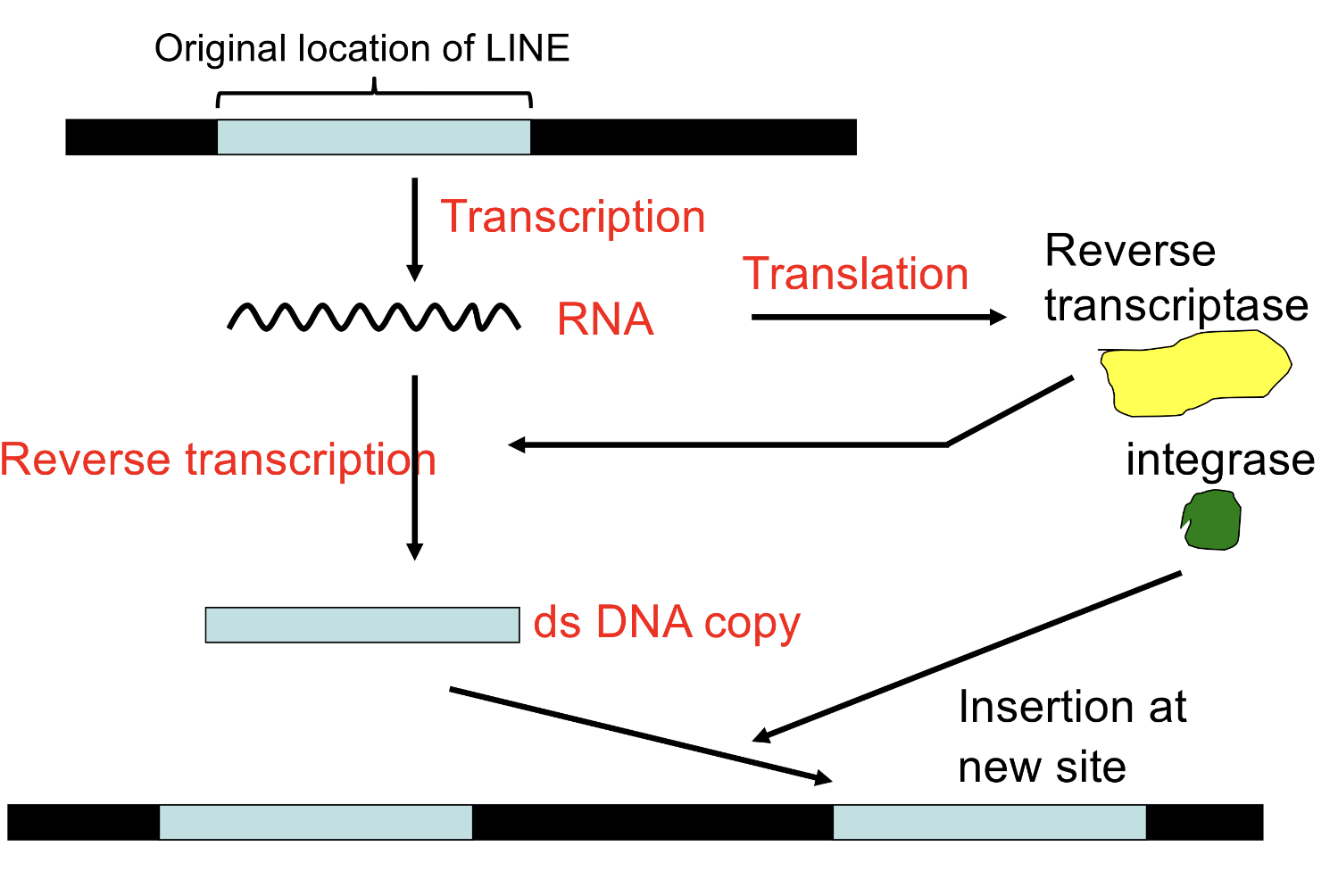
Transposable Elements
parasitic segments of DNA able to move from one location in a genome to another
Short Tandem Repeats
microsatellites, or simple sequence repeats, are repeating sequences of 1 - 5 bases
minisatellites, or variable number terminal repeats (VNTRs), are repeating sequences of 6 - 500 bases
Repeat sequences vary among individuals, each individual has a unique set
Repeat sequences can be used in DNA fingerprinting by analyzing repeat length
Humans and Chimpanzees
The base sequences of human beings and chimpanzees are 98.8% identical
the leading hypothesis focuses on the importance of regulation of gene expression