Bio 2 exam 3
 Call Kai
 Learn
 Practice Test
 Spaced Repetition
 Match
 Flashcards
 Knowt Play
1/217

There's no tags or description
Looks like no tags are added yet.
218 Terms
Smaller endothermic animals have a higher basal metabolic rate, per body weight, than a larger endothermic animal because:
Smaller animals have a lower surface area to volume ratio and lose heat slower than larger animals.
Smaller animals have a greater surface area to volume ratio and lose heat faster than larger animals.
Smaller animals cannot cover as much distance and are slower than larger animals when they move.
Smaller animals have less fur than larger animals so they lose heat faster than larger animals.
Smaller animals have a greater surface area to volume ratio and lose heat faster than larger animals.
Which of the following is NOT an example of positive feedback?
After eating a large meal, a person feels full and does not want more food.
When a blood vessel is damaged, platelets adhere to the wound site and release chemical signals that attract more platelets. This process rapidly forms a blood clot to stop bleeding.
In childbirth, the hormone oxytocin stimulates contractions of the uterus until the baby is born.
Ripening fruit produces ethylene gas, which promote ripening in nearby fruit.
After eating a large meal, a person feels full and does not want more food.
When faced with a sudden drop in environmental temperature, an endothermic animal would most likely:
experience a drop in its body temperature
rapidly add fur or fat to increase insulation
increase muscle activity to generate heat
wait to see if it goes lower
increase muscle activity to generate heat (ie. shivering)
Diffusion of nutrients into the interior of the cell will be more efficient in a cell with a ______ surface-area to volume ratio.
high
(none of these; depends on the cell)
intermediate
low
high
The function of negative feedback is to:
Make sure no levels of substances in the body can change.
Increase the levels of a stimulus to bring a process to completion.
Change the direction of a stimulus to bring levels back to the set point.
Indicate that something in the body is not working correctly.
Change the direction of a stimulus to bring levels back to the set point.
After a hemoglobin molecule binds its first oxygen, why is it easier for the second and third oxygens to bind?
The binding of one oxygen to hemoglobin increases body temperature.
Each bound oxygen gravitationally attracts further oxygens.
It is easier for oxygen to bind to heme groups on the beta chains of hemoglobin than the alpha chains.
The hemoglobin molecule changes shape, making binding more favorable.
The hemoglobin molecule changes shape, making binding more favorable.
Which of the following conditions would lead to O2 (oxygen) dissociating from hemoglobin and push the oxygen-dissociation curve to the right?
Lower body temperature
Higher CO2 levels
Higher pH
Lower CO2 levels
Higher CO2 levels
Which type of blood vessel is the site of exchange for nutrients, oxygen and wastes?
Capillaries
Veins
Venules
Arterioles
Capillaries
For animals that use diffusion through their body surface as their only means of obtaining oxygen:
They must have a thick cell membrane.
They must be very small or very flat.
They must be round.
They must speed up the rate of diffusion.
They must be very small or very flat.
Which adaptation allows gills to effectively transfer oxygen from water to the blood of a fish?
Thick gill tissues
Special protein channels that actively transport oxygen into the capillaries
Large distance between capillaries and gill membranes
Large surface area
Large surface area
What are two factors SA:V ratio affects and how
the rate of diffusion (based on the organism’s shape and whether they have a high SA:V ratio or not)
heat exchange with the environment (the higher the ratio, the more heat is exchanged - ie it is easier to gain and lose heat)
In cold climates: Small animals lose heat rapidly, requiring a much higher metabolic rate (eating constantly) to stay warm
In hot climates: High SA:V helps them dump excess body heat quickly
Large animals retain heat much longer because internal volume generates/holds a lot of heat while the outer skin offers limited escape routes
In cold climates: A low SA:V is a huge advantage for staying warm without burning massive amounts of energy
In hot climates: Low SA:V can cause dangerous overheating, which is why large animals rely on specialized adaptations like large, thin ears or wrinkly skin to artificially boost surface area for cooling
How does SA:V ratio change with size?
the bigger you get, the smaller your SA:V ratio gets (ie. only applicable if comparing the same shape of different sizes)
Which of these organs has the greatest SA:V ratio?
Skin
Liver
Small intestine
Small intestine - has lots of folds so it will get a lot of SA but not V
Why are cells small?
Large cells have a small SA:V, whereas a bunch of smaller cells taking up the same volume have a much higher SA:V —> more efficient solute transport. Another way to increase this ratio is to add villi
Do tropical plants have high or low SA:V ratios and why?
They have high SA:V ratios to maximize gas exchange (they don’t care to have low SA:V ratios to maintain heat since it is already warm there)
Do cacti have high or low SA:V ratios and why?
They have low SA:V ratios. They use their trunk (low SA:V) for gas exchange to minimize water loss. While this gas exchange will be less efficient, they have to avoid dehydration since water conservation is more important in such an arid environment.
What affects the rate of diffusion?
The time it takes to reach equilibrium depends on the size/mass of the molecule, the temperature of the system, the density of the solution, the steepness of the concentration gradient (as it diffuses from high to low)
Where and how does gas exchange occur?
by diffusion across cell membranes (no energy required)
Why is it important to maintain homeostasis?
Organisms can only survive within a certain set of physiological parameters, even though their internal and external environments are always changing. One reason this is important is because enzymes only function well under a narrow range of temperatures (too low and it will work slow, too high and it will denature)
What is positive feedback?
Reinforces a change to the physiological state to accelerate that change
What is negative feedback?
Returns physiological state back to a set point after it changes

What kind of feedback loop is this? explain it.
Negative feedback loop to control body temperature. The hypothalamus of the brain receives sensory information from the body to determine what the current temperature is, with respect to the desired “set point.” The set point is adjustable; when the skin is warm, the set point is lowered, and it is raised when the skin is cold. When the body is too warm, the body will undertake actions to lose heat and return to the optimal temperature, vice versa when cold.

What kind of feedback loop is this? explain it
When the blood vessel wall is injured, it releases signaling molecules that get platelets to the injury site. The platelets stick to the site and release their own signals to bring in more platelets to the site. Only once the clot has sealed the injury is the loop broken through negative feedback
How can positive feedback loops end?
Through a negative feedback loop, or just when the natural stopping point is reached (childbirth - once the baby is out, there is no more need for uterine contractions)

What type of feedback loop is this?
Positive

What type of feedback loop is this?
Negative (regulation of blood sugar levels)
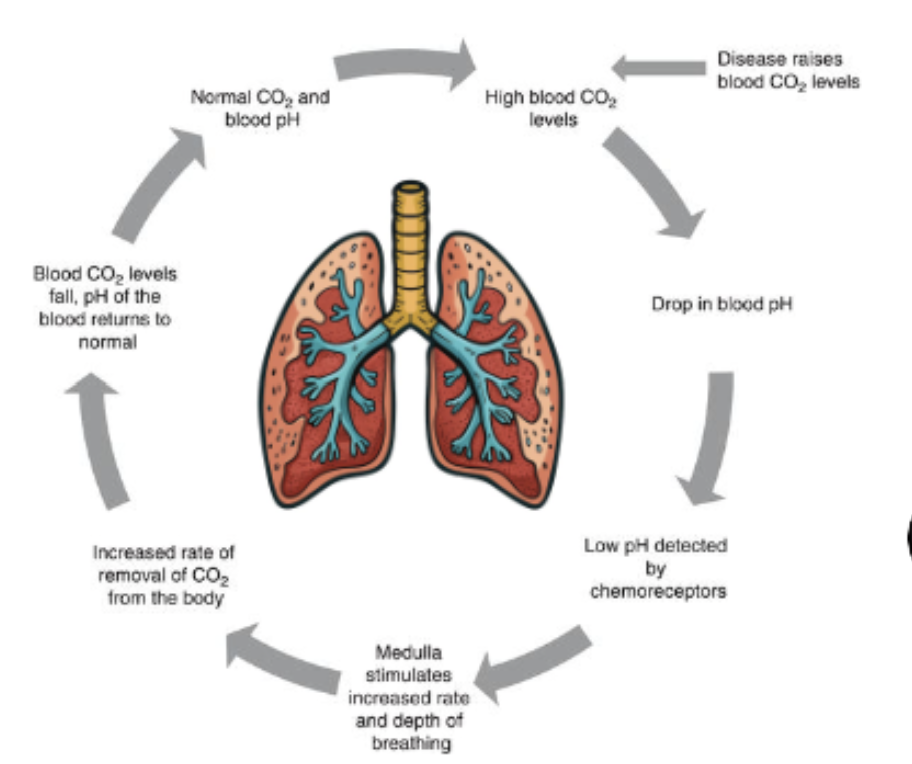
What type of feedback loop is this?
Negative (regulation of respiratory rate)
What is one pro and one con of higher temperatures on biological processes?
Reaction rate and membrane fluidity increases at higher temperatures, but too high and enzymes denature
What are the three main strategies for regulating temperature
Endothermy, ectothermy, heterothermy
What is endothermy?
birds and mammals, like this red panda
the production and regulation of metabolic heat allows endotherms to maintain a constant internal temperature (Metabolic rate keeps them at the same-ish internal temperature)
Can survive in a wider range of temperatures/environments provided that they have enough food to sustain their internal heat production
Can remain active, hunt, and reproduce in drastically changing climates
Require a high and continuous intake of food and energy to maintain the metabolic rate that keeps them at the same internal temperature
“warm blooded”
What is ecothermy?
bearded dragon, turtles, as well as other reptiles, fish, invertebrates, etc.,
cannot effectively regulate body temperature and instead require external sources of heat to achieve their set point
Survive in a narrower range of temperatures than endotherms, but their core temperatures can exceed the range of an endotherms core temperatures
Use much less energy and can survive for long periods of time without food, which makes them successful in stable, warm, or seasonal environments
“cold blooded”
What is heterothermy
groundhog
have endo and ectothermic regulation strategies at different times (ex, ectothermy only during hibernation or torpor);
common across animals
An ectotherm and endotherm have been sitting in the sun, who is warmer?
the ectotherm (higher range of core temperatures, has similar temperature to environment usually)
How does temperature affect metabolic rate in ectotherms and endotherms
ectotherms (blue) metabolic rate increases as temp increases. endotherms (red) metabolic rate decreases as temperature increases, until it reaches a thermoneutral zone. After this point, the metabolic rate begins increasing with temp. at all temperatures, the endotherm has a higher metabolic rate than the ectotherm. They need to exert a lot more energy, especially when it is cold since they have to bring their body temp up so that metabolic processes can take place

what does metabolic rate mean?
the amount of energy that an organism is currently spending (or equivalently, the amount of O2 being consumed

explain a trend seen in this graph
energy expenditure at low temperatures is (generally)
proportional to the difference between body temperature and
environmental temperature
What is the thermoneutral zone?
least amount of metabolism that you need to be performing in order to survive - very narrow, with an upper limit defined by denaturation, and a lower limit defined by excess metabolic energy to stay warm
Upper limit (upper critical temperature) defined by what temperature they can survive at without denaturing proteins and destabilizing lipid membranes
Note that this zone occurs right before the point where the organism can no longer survive (so there is a buffer if u go below it, but no buffer if u go above it)

What is true about the thermoneutral zone?
Both endoterms and ectotherms have a TNZ in their metabolic rate curve
Endothermic metabolic activity is minimized within the TNZ
When the environmental temperature is within the TNZ, endotherms and ectotherms have similar metabolic rates
Body temperature is lowest within the TNZ
Endothermic metabolic activity is minimized within the TNZ
Explain how countercurrent exchange manages temperature
Since it is inefficient to use energy to heat up all body parts, some organisms use regional heterothermy, where their core temp is maintained and their extremeties can cool to near-freezing
Warm blood from the artery is cooled as it goes to the extremities. As this blood goes back up the veins, it gets warmed up via heat transfer from the artery/core warm blood. It does not require lots of energy

Explain how an endotherm might adjust to hot and cold temperatures
Cold
The hypothalamus detects cold and uses physiological and behavioral mechanisms to increase heat production and decrease heat loss
Primary physiological mechanisms
Physiological: shivering, peripheral vasoconstriction, increased metabolic rate
Behavioral: burrowing, huddling
negative feedback look
Hot
The hypothalamus detects cold and uses physiological and behavioral mechanisms to decrease heat production and increase heat loss
Primary physiological mechanisms
Physiological: panting, peripheral vasodilation, decreased metabolic rate
Behavioral: seeking shade, licking forelimbs
negative feedback look

Explain how an ectotherm might adjust to hot and cold temperatures
Cold
retreat for burrows to maintain a constant, intermediate temperature
hypothalamus detects that it is cold
at night, can only burrow (behavioral) to prevent heat loss
during day, can use peripheral vasodilation to gain heat from sun (physiological) and can increase sun exposure, lay on hot surfaces, and increase activity (behavioral) all to increase heat gain
negative feedback look
Hot
behavioral (seeking shade, lying on cool ground, decreasing activity)
hypothalamus detection
negative feedback look

Are environmental temperatures a selective pressure?
yes - we see animals of the same species with different phenotypes depending on where they live (artic foxes have much more fur than desert foxes)
What is Fick’s law and what does each variable indicate?

How would Q change if we decreased the cross-sectional surface area (A)
Q would increase
Q would decrease
Q would stay the same
Q would decrease
How would Q change if we increased the diffusion path length (L)
Q would increase
Q would decrease
Q would stay the same
Q would decrease
What is one thing that could change D (Fick’s Law)?
Temperature
Which medium is harder to breathe in, water or air?
Water - Much less oxygen + higher density and viscosity (harder to move around)
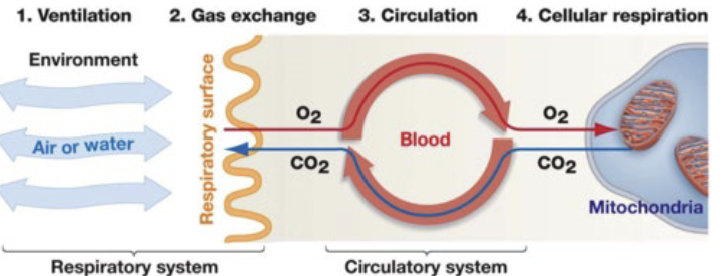
What are the ways in which biological systems optimize the diffusion rate?
Maintain a steep partial pressure gradient (P1-P2) through:
ventilation - moves respiratory medium (air/water) over the gas exchange surfaces
perfusion - circulation of blood into, over, and away from thegas exchange surfaces
Reduce diffusion path length (L) - Gases moving through the respiratory and circulatory systems are carried close to their targets and never have to diffuse very far
What variable in Fick’s law changes the most in people with emphysema (rank)
diffusion coefficient
cross sectional SA
partial pressure difference
diffusion path length
Diffusion coefficient (3)
Cross sectional surface area (1)
Partial pressure difference (4)
Can still get air into the lungs, you just can’t use it as well
Diffusion path length (2)
Emphysema does affect the tissue structure, and what the cell membrane and extracellular matrix look like
What is similar and different about water and air?
they have the same O2 partial pressure, but different O2 concentration, density, and viscosity

How do fish use their gills for gas exchange?
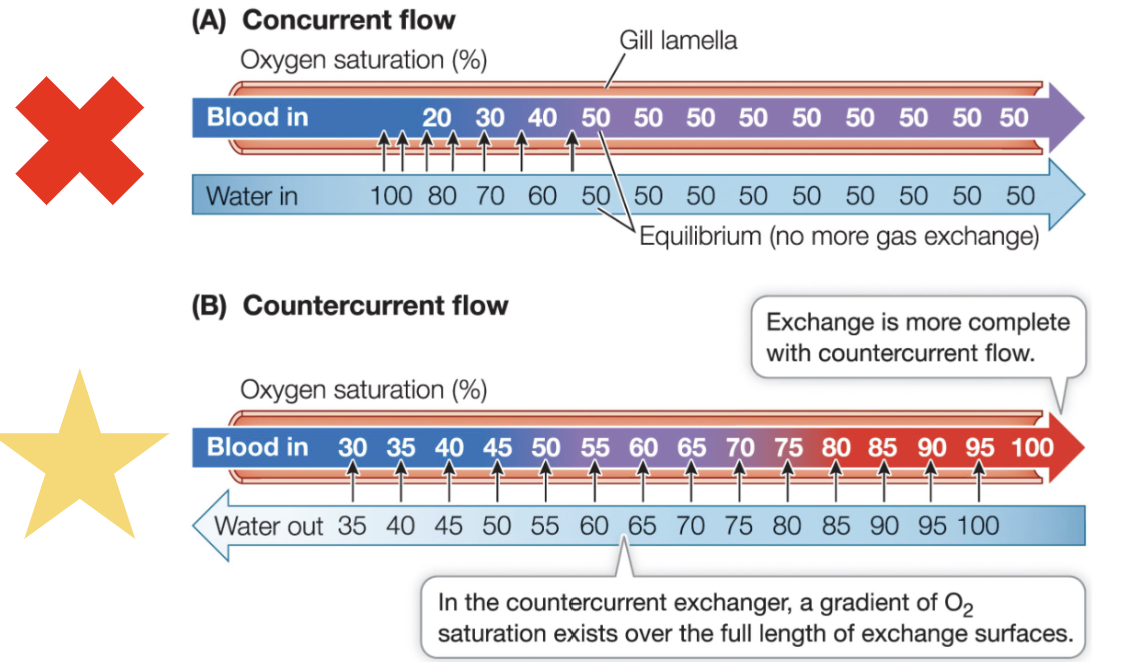
When the fish opens its mouth, it pumps that oxygenated water (ventilation) unidirectionally into its mouth and out through the gills. The gills have arches, and those arches have blood vessels that bring in deoxygenated blood and send out oxygenated blood to the rest of the body (perfusion). Each arch has filaments, and each filament has a bunch of lamellae (gives lots of surface area for gas exchange + very thin to minimize L). Through the lamella, countercurrent flow is performed. The blood and water flow unidirectionally in opposite directions.

Why is countercurrent flow important? Why is it more efficient than concurrent flow?
Countercurrent flow allows for complete oxygen saturation of blood
Concurrent flow, because they are moving in the same direction, equilibrium is reached and oxygen saturation only reaches 50%
Explain how lungs perform gas exchange
Inhaled air travels into the trachea, then bronchi and bronchioles before finally reaching the alveoli, where gas exchange occurs
In the alveolus, the air is very close to the blood flowing through capillaries (the wall between them is thin which reduces the distant that O2 needs to diffuse)
While we do not have countercurrent exchange, O2 diffusion down its pressure gradient is maximized by having a thin membrane over a very large surface area

What is the purpose of mucus and surfactant
Mucus trap microbes and debris and prevent them from multiplying or getting in the way of your gas exchange system
Surfactant helps keep your lungs stretchy and elastic to reduce the work of breathing (reduces surface tension)
How does emphysema impact the alveoli?
it breaks down the alveoli, decreasing the SA:V ratio which minimizes gas exchange efficiency
what is the ideal V/Q ratio? what happens if you are too low or too high?

Explain loading and unloading of O2 and CO2
In the lungs, O2 is loaded and CO2 is unloaded. In body tissue, O2 is unloaded and CO2 is loaded. both processes happen via diffusion
Explain the structure of RBCs
each RBC has millions of hemoglobin complexes. each hemoglobin has 4 heme groups (tetramer), which can store 1 O2 each (so 4 O2’s per hemoglobin)
Explain the loading and unloading of CO2 in the blood
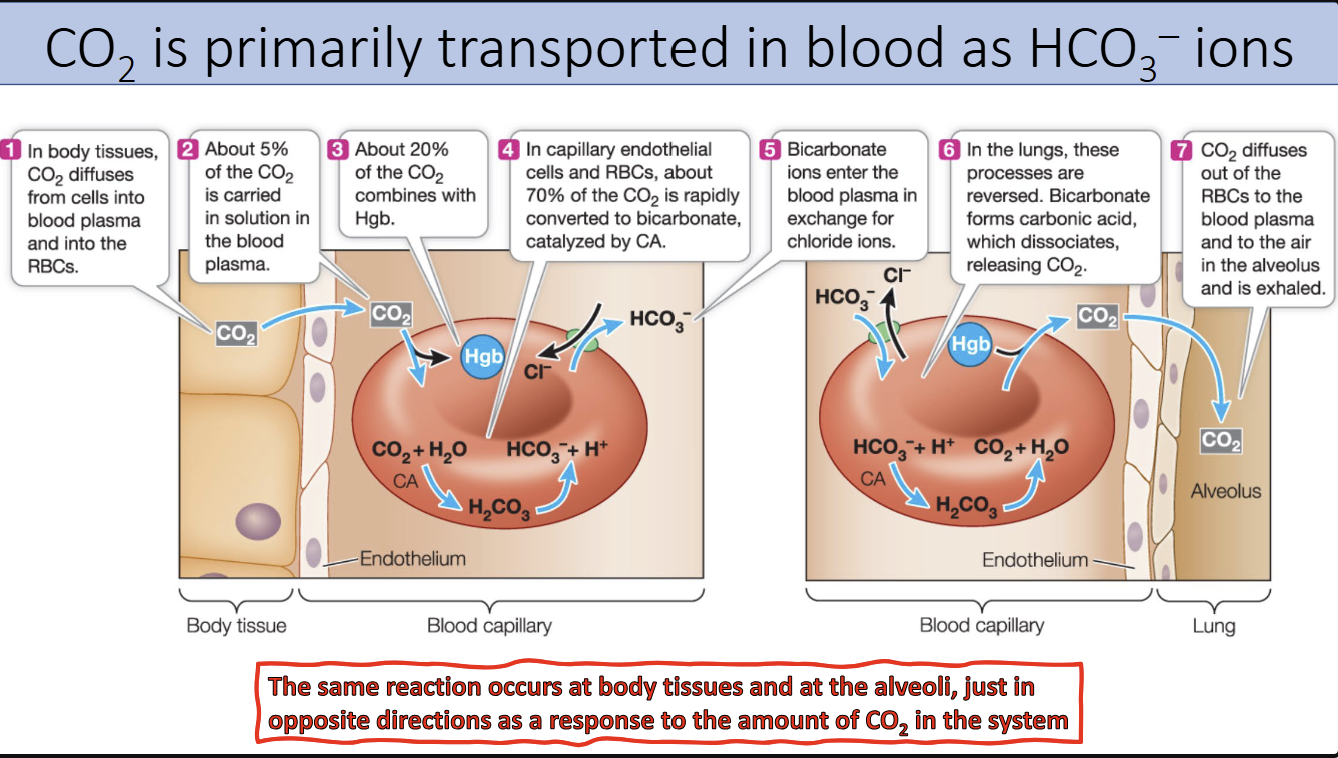
Explain the binding of hemoglobin to O2
each hemoglobin can bind 4 O2s
reversible process (otherwise we would never get gas exchange)
Once one oxygen is already bound to a tetramer, it is really easy to bind oxygen to the other heme groups - which is why we see that steep slope - binding the last one is less favorable than binding subunits 2 and 3 just because it is less likely it will collide with an oxygen
At 75%, most hemoglobin’s have 3-4 oxygens bound

What is positive cooperativity:
With each of four O2 binding events, the shape of the Hb complex
changes; the second and third events are very favorable (fourth less so due to probability)
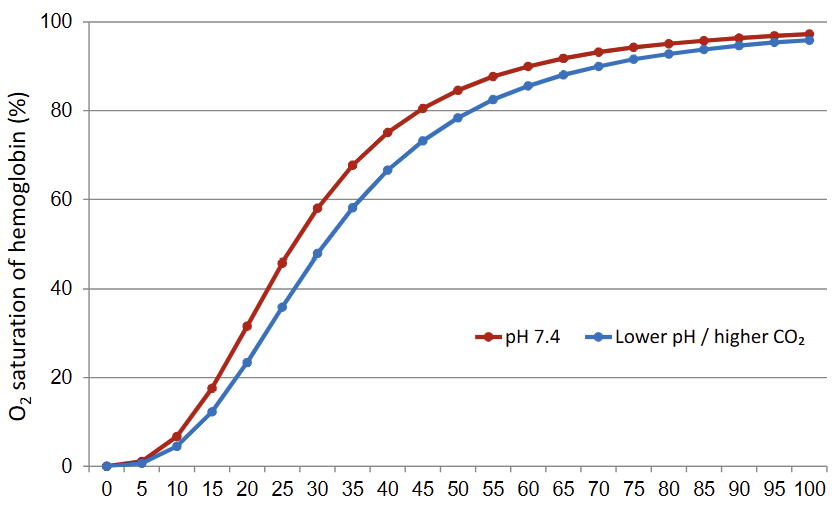
What is the Bohr effect?
reflects the shift in Hb’s affinity for O2 at low pH (high CO2)
high CO2/low pH can happen when respiration rate is high
the affinity decreases to allow O2 to be unloaded to oxygen-starved tissues
Rank the hemoglobin affinities for oxygen: adult, fetal, and myoglobin
myoglobin (muscle) >> fetal > adult
How do the metabolic rates of ectotherms compare with those of endotherms of similar mass?
At a given mass, resting metabolic rates of endotherms are higher than those of ectotherms
How do the metabolic rates of both ectotherms and endotherms vary with mass?
For both ectotherms and endotherms, animals with larger mass tend to have higher resting metabolic rates. An endotherm has a much higher metabolic rate than an ectotherm of similar mass.
what is one way to know if an organism is an ectotherm or endotherm?
One really reliable way is to measure the internal body temperature of an organism in a range of external temperatures. If the body temperature of the organism stays relatively constant, this would provide more evidence that the organism is an endotherm. If the body temperature changes with external temperature, probably ectotherm
What kinds of evidence from fossils might help determine whether dinosaurs were ectotherms or
endotherms?
Maybe you want to compare the size and shape of fossils with data from living animals, or reconstruct behavioral traits, or see if you can determine the niche of a dinosaur to determine its placement.
Would a mouse (an endotherm) be likely to have wider or narrower bone rings than a similarly sized lizard
(an ectotherm)?
The mouse is likely to have wider bone rings. As an endotherm, it probably has a higher metabolic rate, and thus a faster growth rate, than the lizard (an ectotherm of similar size) does. If the mouse has a faster growth rate, its bones would grow more between each ring, resulting in wider bone rings
How would you classify dinosaurs?
mesotherms - the metabolic rates of dinosaurs are not quite as high as those of endotherms of similar mass. However, they are also a bit higher than those of ectotherms of similar mass.
which animal would you expect to have wider rings in its bones: a mountain lion or the dinosaur called a Troodon? (Troodons were about the same mass as mountain lions and looked like feathered velociraptors.)
A mountain lion should have wider bone rings (than the mesotherm dinosaur) because it has a higher metabolic rate, and thus a faster growth rate.
Which types of animals have the highest mass-independent growth rates? Which have the lowest?
Endotherms have the highest growth rates and ectotherms the lowest
Which types of animals have the highest mass-independent metabolic rates? Which have the lowest?
Endotherms have the highest metabolic rates and ectotherms the lowest.
In general, as metabolic rate increases, how does growth rate change?
As metabolic rate increases, growth rate increases. This means that animals with higher metabolic rates grow faster
How might being a mesotherm, rather than an ectotherm or endotherm, have been advantageous for dinosaurs?
Being mesotherms allowed dinosaurs to grow and move faster than similarly sized ectotherms, while requiring less energy intake (i.e., food) than similarly sized endotherms.
If being a mesotherm was advantageous for dinosaurs, why do you think there aren’t more mesotherms now?
Mesotherms could be outcompeted for prey by similarly sized endotherms in similar niches. Mesotherms may also require more energy compared to ectotherms, which would put them at a competitive disadvantage if energy was a limiting factor for growth
Before equilibrium is established, which part of the plant cell has the greatest solute concentration?
Chloroplast
Nucleus
Central vacuole
Cytoplasm
Central vacuole
Fish that live in lakes that are hypotonic to their internal fluid must drink a lot of water (true or false)
false
Which of the following statements is FALSE?
Water enters the plants through root hairs and exits through stoma.
Negative water potential draws water into the root hairs. Cohesion and adhesion draw water up the xylem. Transpiration draws water from the leaf.
Water potential decreases from the roots to the top of the plant.
Negative water potential draws water into the root hairs. Cohesion and adhesion draw water up the phloem. Transpiration draws water from the leaf.
Negative water potential draws water into the root hairs. Cohesion and adhesion draw water up the phloem. Transpiration draws water from the leaf.
Osmoregulation allows organisms to regulate which of the following physiological processes? (There may be more than one correct answer)
Temperature balance
Excretion of wastes
Osmotic pressure
Electrolyte concentrations
Osmotic balance
Excretion of wastes
Osmotic pressure
Electrolyte concentrations
Osmotic balance
Saltwater fish:
Match the salt content of their blood to that of seawater.
Use the salt in seawater to produce the urea excreted in urine.
Drink lots of water and excrete excess salt through their gills and in their urine.
Do not drink much water and produce lots of dilute urine.
Drink lots of water and excrete excess salt through their gills and in their urine.
When a cell is in a hypertonic solution it means that:
The solution outside of the cell is equal in concentration to the cytoplasm inside the cell.
The solution outside of the cell is less concentrated than the cytoplasm inside the cell.
The solution outside of the cell is more concentrated than the cytoplasm inside the cell.
The solution outside of the cell is more concentrated than the cytoplasm inside the cell.
In the loop of Henle, the concentration of filtrate in the descending limb goes from ___________, and the concentration of filtrate in the ascending limb goes from ___________.
high to low; high to low
low to high; low to high
high to low, low to high
low to high; high to low
low to high; high to low
How would an increase in the enzyme renin affect blood pressure and Na+ reabsorption?
It would decrease both blood pressure and Na+ reabsorption
It would decrease blood pressure and increase Na+ reabsorption.
It would increase both blood pressure and Na+ reabsorption.
It would increase blood pressure and decrease Na+ reabsorption.
It would increase both blood pressure and Na+ reabsorption.
Birds and many reptiles produce uric acid as their way of getting rid of nitrogenous wastes. Why is it beneficial for these animals to excrete nitrogenous wastes in this form?
The production of uric acid requires less energy than the production of ammonia or urea.
The release of nitrogenous wastes as uric acid allows these animals to conserve water.
Uric acid is excreted in birds and reptiles to prevent them from getting a condition called gout.
Uric acid raises blood pH more than ammonia.
The release of nitrogenous wastes as uric acid allows these animals to conserve water.
Which of the following statements about nephron structure is false?
The filtrate moves from the distal convoluted tubule to the collecting duct.
The vasa recta are blood vessels surrounding the loop of Henle.
The loop of Henle has thick and thin parts.
Blood enters the glomerulus through the efferent arteriole.
Blood enters the glomerulus through the efferent arteriole.
Drinking alcoholic beverages causes an increase in urine output. This most likely occurs because alcohol:
Inhibits aldosterone
Stimulates ADH release
Stimulates aldosterone
Inhibits ADH release
Inhibits ADH release
Inside a neuron at resting potential, the concentration of K+ is _________ the concentration of Na+
equal to
less than
[impossible to tell]
greater than
greater than
Which type of ion channel opens when an action potential reaches an axon terminal, and plays a specialized role in neurotransmitter release?
Voltage-gated Ca2+ channels
Voltage-gated K+ channels
Na+ leak channels
K+ leak channels
Voltage-gated Ca2+ channels
Which of the following pairs of glial cells and functions are incorrectly matched?
Astrocytes provide nutrients to neurons.
Ependymal cells produce the cerebrospinal fluid.
Microglia protect the brain from foreign microorganisms.
Oligodendrocytes form the blood brain barrier.
Oligodendrocytes form the blood brain barrier.
Where are the neurotransmitter receptors located?
The nuclear membrane
The postsynaptic membrane
Synaptic vesicle membranes
The nodes of Ranvier
The postsynaptic membrane
Summation, where multiple presynaptic inputs are integrated, occurs at which part of the neuron?
Axon terminal
Dendrites only
Anywhere in the cell body (soma)
Axon hillock
Axon hillock
What type of environment do animal cells prefer? what about plant cells?
animal: isotonic (at equilibrium)
plant: hypotonic on the outside (lots of solute inside the cell, so water goes in and fills it up, but the cell wall keeps its shape and prevents it from lysing)
Define hypotonic, isotonic, and hypertonic environments
hypotonic: cells take up water - plant cells will stiffen, animal cells will swell and lyse
isotonic: rate of water movement in and out are equal (so there is still movement of water, just no net movement)
hypertonic: cells lose water and shrivel. for plant cells, they shrink and pull the plasma membrane away from the cell wall - this would look like a wilting plant
do extracellular and intracellular spaces have the same composition?
no
is potassium higher in concentration inside or outside of the cell? what about sodium?
potassium is higher inside the cell, sodium is higher outside the cell
Explain the Na+/k+ pump
picture shows first three steps, then 2 extracellular K+’s bind to the pump, which triggers the release of phosphate. The pump then switches sides, transporting potassium to the inside

What happens if an animal cell has a deficient Na+/K+ pump
It will start to swell and ultimately lyse, so you can see why 30-70% of its ATP must be used to prevent this
What part of a plant cell holds the most water?
central vacuole
What part of plant cells hold solute?
cytoplasm (usually hypertonic w.r.t its environment) - water will come in and make the cell turgid, and the water ends up primarily in the central vacuole (while the solute remains primarily in the cytoplasm)