4. Boltzmann statistics of ideal gas (new notes part 2)
 Call Kai
 Learn
 Practice Test
 Spaced Repetition
 Match
 Flashcards
 Knowt Play
1/38

There's no tags or description
Looks like no tags are added yet.
39 Terms

Under what condition can the Hamiltonian of an N‑particle system be written as a sum of single‑particle Hamiltonians?
When inter‑particle interactions can be neglected (dilute gas).
What is the Hamiltonian of a many‑body system when inter particle interactions can be neglected?
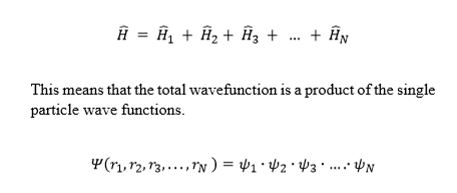
What is the total wavefunction when particles are independent?
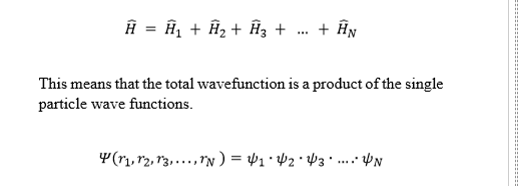
When is this factorisation valid?
For a very dilute gas where particles spread over many energy states.
What condition is stated about quantum states vs number of particles?
The number of available quantum states far exceeds the number of particles.

How are single‑particle energy states written?

What does the index j label?
The energy states.

What is the canonical partition function for identical distinguishable particles?


Distinguishable particles.

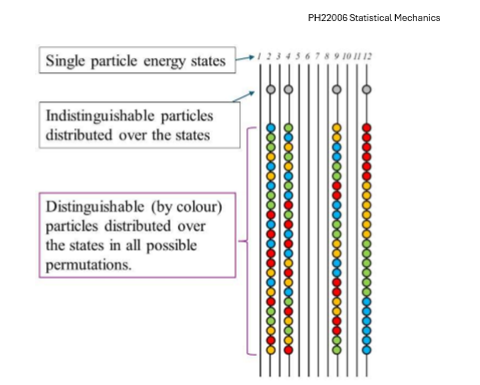
What does “indistinguishable particles” mean in statistical mechanics?
Particles are identical and cannot be individually tracked in a gas or liquid.
Why does indistinguishability matter for energy configurations?
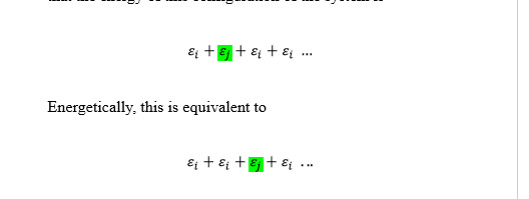
Different permutations of particle labels correspond to the same physical state, causing overcounting.

Give an example of two equivalent energy configurations for indistinguishable particles.

What is the general correction factor for N indistinguishable particles?

When is the correction by N! valid?
When particles are distributed over many more states than particles (dilute ideal gas).
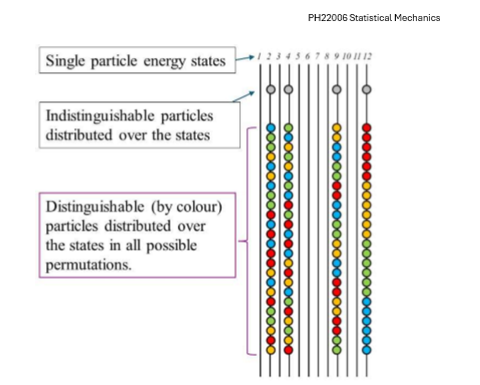
What is the canonical partition function for indistinguishable particles?

What physical condition is required for Boltzmann statistics to apply?
A hot dilute gas.
What is the expression for the number of single‑particle states with energy ≤ ε in a macroscopic box?

What condition must an ideal hot dilute gas satisfy?

What energy is used for a typical particle in the hot dilute gas?
What physical conditions favour the hot dilute gas requirement?
High temperature (hot), low density (dilute), and light particle mass.
What does the single‑particle partition function consider for a monatomic gas?
All degrees of freedom and all energy states.
What types of energy does a monatomic gas have?
Translational energy
Electronic energy
Nuclear energy
Why do we focus only on translational energy?
Electronic levels have separations of several eV, nuclear levels even higher, while
kT=25 meV at 300 K
so these excitations are not thermally accessible.
What is the single‑particle translational energy in a 3D box?

What is the definition of the single‑particle partition function?
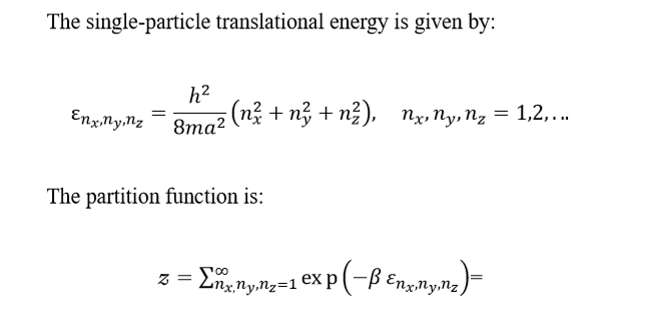
Why is it often easier to deal with energy levels rather than energy states?
Because multiple energy states can share the same energy — they form a single energy level.
What is the degeneracy of an energy level?
The number of states with a given energy, denoted ω.
What defines a rotational quantum state of a molecule?
Angular momentum quantum numbers l (0,1,2,…) and m (−l,…,0,…,+l).
What happens in big systems with closely spaced energy levels?
States form continuous bands rather than discrete levels.
If Φ(ε) is the number of states with energy ≤ ε, what is the number of states between ε and ε+δε?

How do you change variables using the chain rule (example: ε = hν)?

Why is the sum over states transformed into an integral for an ideal gas at room temperature?
Because the states are very dense.
What does ω(ε) represent?
The degeneracy (density of states) associated with energy ε.
What theorem is the expression E=3/2NkT consistent with?
What is the Sackur-Tetrode expression?
Its the expression for the entropy of an ideal monotomic gas

4.8
In the Joule expansion example, what is conserved?
Energy is conserved.

Since E=3/2NkT is constant during the Joule expansion, what happens to the temperature?
The temperature remains constant.
Which entropy expression is used to analyse the Joule expansion examples?


What does the constant c represent in the entropy expression?
It contains all the constants for the gas (and T).