Electricity and Magnetism
 Call Kai
 Learn
 Practice Test
 Spaced Repetition
 Match
 Flashcards
 Knowt Play
1/35

There's no tags or description
Looks like no tags are added yet.
36 Terms
Charge
A property of matter; defined by the particles in the atoms; positive or negative; variable is “q”
Electrostatics
Study of stationary charges
Elementary Charge
How much charge one electron carries; “e”
Coulomb:
Metric system unit of charge; 1 C = 6.25 × 10^8 e
Coulomb’s Law
F = k * (q1*q2/r²)
Electrical Constant
k = 8.99 × 10^9
Electric Force
Force calculated by Coulomb’s law; force of charges acting on one another
Field
Area of effect; represented by lines showing direction/magnitude of force
Field lines
The lines that represent the direction and magnitude of a force on a test charge
Test charge
Positive charge for measuring electric force
Electric Force Equation
F = qE (E is the field strength, measured in Newtons/Coulomb)
EPE
Electric Potential Energy; The potential energy of a charge; Measures how much energy that one charge can output
electron-Volt (eV)
The EPE of a single electron
Electric Potential
Volts; EPE/q - How much EPE something delivers per Coulomb of chargeEle
Electromotive Force, EMF
A “force” that’s really just another name for Voltage. This is because voltage “pushes” charges around
Current
Flow of charge around a circuit; measured in amperes
Amperes
Measure of current; 1 amp = 1 C/s
Battery
“Pushes” charge around a circuit; Rated in Volts; Analogous to a pump
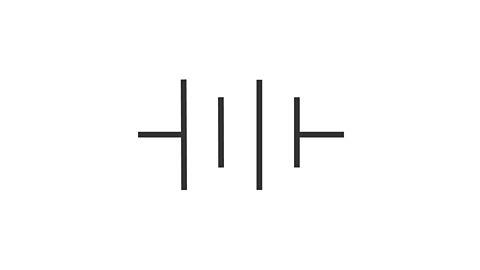
Capacitor
Temporarily stores charges to dump them or deliver them later; Used for things like camera flashes; made of two conductive materials separated by an insulator, usually wrapped up into a spiral

Resistor
Uses current to do work/output energy

Ohm’s Law
V = I * R
Voltage = Current * Resistance
Power
Rate at which energy is converted into other forms; measured in Watts; P = V * I
Watts
Measure of power; 1 W = 1 J/s
Tesla
Measure of magnetic field
Solenoid
Stack of looped currents that create a uniform magnetic field on their inside
Rules of Magnetic Force
Particle must have charge
Particle must be in a magnetic field
Particle must be moving
Motion must be perpendicular to the field
Right Hand Rule #1
Curve your fingers around a wire with your thumb pointing in the direction of current; Your fingers follow the magnetic field generated by said current
Right Hand Rule #2
Point thumb in direction of motion of charge, fingers in direction of motion of magnetic field: Palm is facing the direction of magnetic force
Domains
Portions of a solid material with directional charges; Can have charges be aligned to magnetize it!
Induction
When a change in a magnetic field causes a current to flow
Faraday’s Law
Changes in magnetic fields will cause currents to flow if the field is perpendicular to the loop where the current will be
Lenz’s Law
Induced current flows opposite the charge in magnetic fields
Maxwell’s 1st Equation
Divergence of electric field is equal to the charge inside the field
Maxwell’s 2nd Equation
Divergence of Magnetic Fields is equal to 0
Maxwell’s 3rd Equation
Electric fields curl around changing magnetic fields
Maxwell’s 4th Equation
Magnetic Fields curl around currents; the amount of curl is equal to the current inside the field