Theater Appreciation Exam #2
 Call Kai
 Learn
 Practice Test
 Spaced Repetition
 Match
 Flashcards
 Knowt Play
1/47

There's no tags or description
Looks like no tags are added yet.
48 Terms
Primary functions of set design
- to establish the physical world of the play
- conveys the time, location, mood, and atmosphere while supporting the actors and guiding the audience's understanding
How set designers communicate ideas to a director
- Initial Production Meetings
- Research & Mood Boards
- Floor Plans (Ground Plans): Drawn-to-scale blueprints viewed from above show the layout of walls, furniture, exits, and acting areas relative to the stage.
- Front Elevations: Flat, straight-on technical drawings show specific wall details, windows, doors, and platform heights.
- Scale Models Three-dimensional miniature models
flat
- a set term
- two-dimensional panels often made of either stretched canvas or thin plywood attached to a wooden frame to build backgrounds

vanishing point
- set term
- the specific point on the horizon line where parallel lines and receding architectural elements appear to converge, creating an illusion of three-dimensional depth on a flat or shallow stage

renderings
- costume term
- a detailed, colored, scale drawing or painting that showcases exactly what a theatrical element will look like under stage lighting
- sketches can become renderings which become a guide for building and finishing a set
inspiration board
- costume term
- a visual collage used by directors, scenic designers, and costume designers to establish the tone, color palette, era, and emotional landscape of a production
light plot
- lighting term
- provides important peices of information about each instrument —on which part of the stage the light
should be focused, what color it should have, and how it is controlled.
- allows master electrician to hang lights to make the lighting designer's vision happen on stage.
gobo
- lighting term
- It also allows patterns to be projected
- a small template made of steel or glass that is placed
in a slot in the center of the light between the source and the lens. The pattern is then projected onto the stage.

gel
- lighting term
- allows color to be created
- a colored plastic filter placed in front of a light-
ing instrument in order to change the color of the light it emits.

wash fixture
- lighting term
- lights that will cast a large, even field of light

PAR can
- lighting term
- PAR fixtures, or parabolic aluminized reflector lamps, are a mainstay of concert lighting
- The term can refers to the round extruded metal
housing that absorbs some of the extra light from the PAR fixture. This extruded metal housing looks something like a coffee can that has been painted black

cyclorama
- lighting term
- often fabricated of special seamless canvas, a cy-
clorama, or "cyc," is typically white or light blue. It is commonly
used, in cooperation with the lighting designer, to create a "sky"
behind the set or to present washes of color.
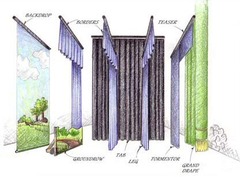
responsibilities of the technical director
- determine the appropriate materials and methods of construction for realizing the set designer's creation
- are intimately familiar with both the catalogue of scenic elements and building techniques.
responsibilities of the sound designer
- The primary role of a sound designer is to make the storytelling more potent.
- Job one is making sure that we can hear the actors. Sometimes
that's completely passive—you're in a room where that already happens and everybody is happy.
- working with set designers to make sure there are surfaces where the sound can bounce off so that the blocking doesn't send all the sonic energy upstage.
major developments in the 19th century
- liberal arts, industrial arts (skilled manual labor), fine arts (beautiful/not practical)
--> Two major developments in the nineteenth century challenged the primacy of painted perspective scenery and opened the door for theatrical artists specifically qualified to capitalize on them. The first was the adoption of the box set, which represented an interior space by enclosing the stage with three walls of scenery. This environment more realistically accommodated the actors and allowed them greater freedom to interact in a "natural" manner with their dramatic environment. The second was the rise of an intense attention to historical accuracy in all aspects of production, especially scene design.
- Lighting Evolution
- Scenic Design: Flat painted 2D backdrops were largely replaced by 3D box sets, moving panoramas, elevator stages, and revolving stages that allowed for unprecedented visual realism.
- melodrama
- romanticism
- realism
- naturalism
Aristotle on comedy
Comedy represents men as worse than they are. Tragedy represents them as better
Henri Bergson's observations on comedy
-nothing is comic outside of what is exclusively human
-insensibility accompanies laughter
-laughter needs company
-comedy is culturally specific
-superimposes the mechanical on the living
incongruity
- psychological theory
- suprising, illogical, or unexpected juxtaposition of ideas/situations
superiority
- psychological theory
- laughter arises from a feeling of superiority, triumph, or "sudden glory" when we recognize the misfortunes, stupidity, or inferiorities of others—or even a past version of ourselves
release
- psychological theory
- laughter releases unconcious turmoil/cathartic
farce
- a type of comedy that has absurdly complicated plots, broad characters who behave irrationally, and lots of physical comedy
- extravagant plot
- no psychological truth
- slapstick humor
- quick transformations
- concealments/discoveries
high comedy
- "comdey of manners"
- characters are upper - class
- life is a game, best player wins
- not moral universe
- players are witty and articulate
- underlying sexuality
- playing a game of life and tryung to win it
melodrama
- popular in the 19th century
- most influential Western genre
- focus on emotional appeal
-virtuous hero hounded by villain
- musical underscoring
- strict poetic justice (bad guy looses)
- often elaborate spectacle
- were formulaic performances that emphasized plot and action over any character development
realism
- lifelike dialogue
- scenery inhabitable (box sets/4th wall)
- actors speak to eachother
- subconcious mind
-characters with psychological detail
- focus on genuine concerns
new idea of "character"
- blends traditional dramatic acting with immersive, unscripted, or meta-fictional elements to build deeper authenticity between the performer, the role, and the audience
- does the character outwardly display good/bad (MELODRAMA MODEL)
- are there factors like past, biology, society, economics, etc that influence a character (REALISM MODEL)
Henrik Ibsen's "A Doll's House"
- Norwegian playwright Henrik Ibsen is considered one of the most important dramatists of all time
- His controversial play A Doll's House (1879), the story of a woman who realizes she has been living her life as a plaything, spearheaded an international move toward dramatic realism.
Naturalism (David Belasco & Andre Antoine)
- subset of realism
- shows effects of enviornment
- theatre as a "science lab"
- dramatizes social determination (how our enviornment influences our lives)
- scenes depicted very realiztically
- Another advocate of naturalism was American producer and playwright David Belasco (1854-1931), who pioneered the use of technology to bring greater realism to the stage.
- Antoine produced scripts featuring colloquial dialogue;
plots that unfolded in an unhurried, organic manner; and settings that were extremely authentic and detailed
Tragedy
- imitation of an action
- serious
- of a certian magnitude
- incidents arousing pity + emotion
- accomplishes catharsis
- Historians generally believe that tragedy was the most common type of theatre in classical Greece.
dithyramb
- song narrative poems
- a chorus of fifty men with a leader who told stories about a fertility god named Dionysus
Dionysus
- theatre of Dionysus was a tragedy and displayed one's relationship to the cosmos
- fertility god
definition of tragedy according to Arthur Miller
"I think the tragic feeling is invoked in us when we are in the presence of a character who is ready to lay down his life to secure his sense of personal dignity"
futurism
- rejects the past (burn libraries and museums)
- product of "machine age"
- glorifies energy and speed
- proposed "synthetic drama"
- short, fast plays
demise of futurism
- primarily caused by the outbreak of World War I, the loss of key movement leaders, and the shift into institutionalized Italian Fascism
afrofuturism
- reimagines the future of the black experience
- fuses sci-fi, fanatsy, and history
- celebrates uniqueness/immovations of black culture outside white dominat cultural narratives
- fascination with techno-culture
- rich color palette
- African iconography
- unlike formal futurism, embraces past
How afrofuturism is different from European futurism
- While both movements reject stale historical traditions and use technology to imagine new realities, they diverge completely in how they view humanity, time, and power.
expressionism and influence on theatrical practice
- shows the inner emotional world extrenally
- distortion (setting, dialogue, characters, action)
- not character-types
- dialogue compressed into "texting" style
- presentational acting style
- stage reflects the persons emotional state of mind
dadaism
- "art is dead. Long live dada"
- disgust with modern society
- intended to shock the audience/shake up the art world
- art must be senseless, uncivilized, anything that pops into the mind
surrealism
- truth can be found by surrendering to the "dark forces of the unconscious"
- we are freest in dreams
- use of "automatic writing"/games
theatre of the absurd
- name for plays (late 40s, 50s, 60s) with a certain outlook
- the world has no meaning/rules
- contains characters trapped in time and space
- first to win fame: Samuel Beckett's Waiting for Godot (1953)
#1 rule for stage violence
- the victim is always in control
Minstrelsy
- white fantasy of nostalgia for plantation life
- most popular form of theatre in the US from 1850-1900
- black-face on stage
T.D. Rice
- Thomas "Daddy" Rice
- defines the origins of 19th-century blackface minstrelsy
- white entertainer
Jim Crow
- Laws designed to enforce segregation of blacks from whites
- the 19th-century blackface stage persona and song-and-dance routine created by white entertainer Thomas Dartmouth Rice
Stephen Foster
- It is a Broadway-style outdoor musical drama written by Pulitzer Prize-winning playwright Paul Green.
- The performance chronicles the 19th-century life of American composer Stephen Collins Foster.
- tells the historical context of the era, including the hardships faced by enslaved people.
zip coon
- the urban dandy
Uncle Tom
- an anti-slavery book by Harriet Beecher Stowe, already one of
the most popular books of the nineteenth century. Audiences throughout the country could watch the story of runaway slaves Eliza and George and their escape from cruel masters and slave traders along with the travails of Uncle Tom, a faithful slave rewarded only with misery.
aunt Jemima
- theatrical and minstrel show stock character before being commercialized as a brand mascot.
Yaller Gal
- a prominent racial and sexualized caricature featured in antebellum blackface minstrel shows