RWFM 611 Grazing test 1
 Call Kai
 Learn
 Practice Test
 Spaced Repetition
 Match
 Flashcards
 Knowt Play
1/78

Earn XP
Description and Tags
Tamu RWFM 611 grazing management principles and planning
79 Terms
What is grazing management?
The intentional spatiotemporal distribution of grazing and rest within a system to balance animal needs with plant recovery optimize resource use and meet ecological or production goals… To boil it down… it is about when where and how long animals graze
Which species are more palentable, what happens to them overtime?

Principles vs practices
Prin- broadly applicable across grazing systems( •Fundamental concepts that are broadly applicable across grazing systems)
prac- specific management actions used to apply the principles (•Specific management actions that are used to apply principles), {context specific}.
Extent of grazing lands… acres and private land percentage
634 million acres of non-federal grazing lands in the United States
47% of all private land in the US is grazed
Benefits of grazing management- 3
ecosystem functions (ground cover, support plant and wildlife biodiversity), animal production, producer (economic efficiency)
Paradigm
the lens through which you see the world.
it doesnt change overnight, it needs some evidence and experiences to make a change in your mind.
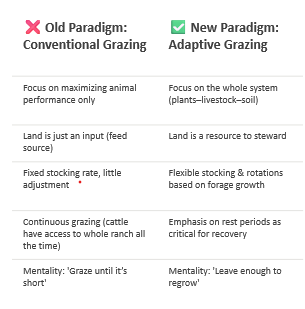
conventional grazing paradigm vs adaptive grazing,- Maybe name three differences
focuses on maximising the output of the animals. The biggest change between the views is that in the adaptiving grazing you want to leave enough biomass and leaf tissue for the plant to grow back.
when does the bison range get really small? (the great die off)
1896,Bison co evolved with grasslands.
equilibrium theory of range management–
in the early 1900s , equilibrium theory of range management– systems are though to move towards a single stable climax community. No concept of carrying capacity yet
Dust bowl
1930s federal government starts to make some policies to help with over grazing.
Taylor grazing act-
divided public lands into grazing districts that controlled the amount of livestock.
The earliest grazing management research focused on what?
on the effects of static stocking rates in continuously grazed systems.
when were Adaptive multi paddock (AMP) grazing management practices were developed.
1970s
1970s grazing management
Adaptive multi-paddock (AMP) grazing management practices were being developed. - (oRequired the use of multiple paddocks, high stock densities, and frequent movement of cattle through the paddocks to facilitate short grazing periods and long recovery periods between grazing events)
This was to minic the movement of natural heards
Equilibrium Theory of Range Management
•Systems are thought to move toward a single stable climax community
1950s and 1960s grazing management
Lots of rotation systems were implimented, ( deferred rotation, rest rotation, short duration grazing, the Merrill three-herd/four-pasture system, high intensity-low frequency grazing, and seasonal suitability systems)
1980s grazing management
State and Transition Model/ Non-Equilibrium Theory.
Ecosystems were capable of existing in multiple different stable states based on ecological thresholds
Once transitioned into new stable state, its very difficult to go back
In contrast to traditional range science, sparked debate.
Grazing Management Evolution – 1999 - 2000s
rotational grazing was being widely recommended, but heavy grazing and over stocking continued to be a serious problem in the U.S,
Grazing Management Evolution – 2000s-Present
recognition that equilibrium and non equilibrium dynamics operate simultaneously. Landscape heterogeneity, spatial and temporal. Currently - recognise complexities and context specific nature of management response.
Why prioritize ecological health?
A. ecological health{
1. Ecosystem structure 2. Ecosystem processes, 3. ecosystem function}
B. ecosystem services, { (4)
Energy flow, the movement of energy through the ecosystem
Nutrient cycling
Water cycling
Community dynamics (biodiversity) }
These 4 processes are very important for ecosystem functioning, sustaining life and response to disturbances.
Energy flow-
-•describes how energy moves through living systems, starting with the sun and transferring through trophic levels.
- decomposers are essential for moving the nutrients faster to the bottom of the pyramid.
What is often the limiting nutrient in a grazing system?
in not often how much rainfall but how much of the water infiltrates into the soil. This is achieved by having more plant cover (less bare ground) and higher carbon content.)
Why are ecosystem services important to landowners?
It boils down to resilience ( the ability to bounce back after a change) You can last through t he drought
Supporting ecosystem services. Provisioning
Food, fresh water, wood and fiber, fuel
Supporting ecosystem services. Regulation
Climate regulation,
Food regulation
disease regulation
water purification
Supporting ecosystem services. Cultural
aesthetic, spiritual, educational, recreational
What is Soil Health?
•The continued capacity of soil to function as a vital living ecosystem that sustains plants, animals, and humans
Dynamic soil properties and Inert soil properties
DSP = soil characteristic that change with management, (SOM, SOC, BD,.
Inert soil properties = dont change over our life time, ( texture, parent matterial.)
Physical Soil Properties
BD, SOIL texture, depth, Organic matter, compaction, soil structure
Clay vs sand
Sands have a low CEC while clay has a higher CEC. Clays can store nutrients better over time. Lower ph also means fewer CEC sites.
What are the key elements of a system?
Components- cows, grass, rain
Relationships- the interactions
Purpose / function- the outcomes
Emergence- the whole has properties you cant understand
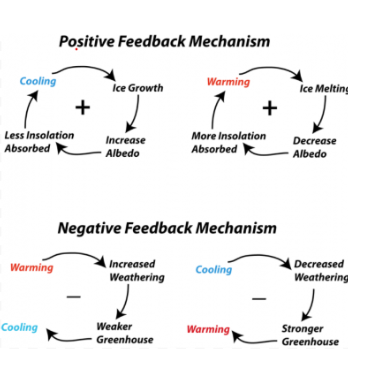
Positive and negatuve feedback loops
Negative is like homeostasis
Types of uncertainty in the grazing system.
Partial control, environmental variance, partial observability, structural uncertainty)
Systems thinking
diving below the surface of observable events, and observing factors that lead to an event.
Mental model
A mental model is built on what you know and what you have perceived. (no connection from what is happening to the model) the results are not changing the loop
Double loop learning
when the information we get back from the real world is effecting our management strategies or decisions. THis allows us to form more dynamic views
What is adaptive management?
It is a structure interactive process in which management sanctions are adjusted based on monitoring actions are adjusted based on monitoring and evaluating outcomes as well as in response to external factors such as weather. In the literature you will se it described as flexible. “Data driven decision making”.
5 components of adaptive management
(Planning, implementation, monitoring, evaluation. adjust)
Daily forage requirement is _% of body weight.
3
1 AUD =
AU x Days
1 AUM =
AUM = AUD/30
1 AUY
AUY = AUD/365 = AUM/12.17]
What component does stocking rate need?
Time
Is stocking rate a management decision?
Stocking rate is based off of caring capacity and is a management decision
•Rancher Susan has 40 – 1,000 lb cows on 200 acres for 90 days. What is the stocking rate in AUD/Ac, AUM/Ac, and AUY/Ac?
AU = 40
40 AU x 90 days = 3600 AUD
3600 AUD/200 acres = 18 AUD/Ac
Carrying capacity
- measure of forage supply, it determines the maximum stocking rate that can be applied without degrading the land resource. Based off the history and location.
Carrying Capacity Equation

Which is greater stocking rate or carrying capacity?
CC
•A 300 acre property produces 1,200 lbs of forage per acre. Assuming that a 25% harvest efficiency is desirable, how many 900 lb cows can this property support for one year?
o1,200 lbs/acre x 300 acres = 360,000 total lbs of forage
o360,000 lbs x 0.25 harvest efficiency = 90,000 lbs of available forage
oAUE = 0.9
o1 AUY = 10,950 lbs forage demand
o10,950 x 0.9 = 9,855 lbs forage demand per cow
o90,000 lbs available forage / 9,855 lbs forage demand per cow = 9- 900 lb cows
Stock density
The relationship between the number of animals and the specific unit of land being grazed at any one time
Four levers of grazing management.
1.Timing (season)
2.Intensity
3.Frequency
4.Duration
What will a cow graze in slope and rock percentage
Grazable acers: cows wont do more than 10% slope and 30% rock cover.
Margin
The total amount of production increase from an increase in one unit of input
Maximum total production=
carrying capacity. Risks associated with weather increase as max production per acre is approached.
Gross margin and maximun total revenue
The number of animals needed to hit maximum gross margin is before the maximum total revenue. Maximum gross margin is more money than maximum revenue.
•Foraging velocity
The rate at which animals move through the landscape
•Intake Rate
= The amount of forage consumed per unit of time
Herbivor spatial memory
Can remember locations and relative availabilities of food for at least 20 days
Can remember areas that have been recently depleted
Can remember for at least 8 hours
Ecological groupings of grasses
Native and introduced, Tall grasses , short grasses,
Bunchgrasses, [rhizomatous, stoloniferous,]<- these two grasses tolerate grazing better.
Perennials annuals,
C3 grasses
have a rubisco limitation during hot climates so they are a cooler area grass. When they are growing they have a higher nutrient content than c4 grasses.
C4 grasses
Additional steps before the calvin cycle. This process reduces photorespiration, meaning they are more efficient in hotter climates.
C3 and C4 grasses grow at different times based on space and time and temperature.
Cam plants
still have a two stage process. - open stomata at night, close stomata during the day.
What do plants use their carbohydrate hydrates for
> stored in rotes , used for respiration to produce atp, develop seeds, allocated to roots for elongation, released into soil. 95% of plant food is from the atmosphere,
Responses to grasing,
and carbs
If it is grazed too much then the plant has to rely on its stored carbohydrates.
grazing during different stages of growth
Grazing During Growth Stages
Stage 1 (Vegetative):
Moderate impact—plants can recover if rest is allowed; supports vigorous regrowth.Stage 2 (Boot/Bud):
Least impact—plants recover fastest; best time to graze.Stage 3 (Reproductive):
Greatest impact—plants focused on seed, low carb reserves; grazing harms long-term health.
Rest v recovery.
Rest = a period in which a pasture is not being grazed. (should occur during a growth period.)
Recovery- a period after grazing when plants are actively regrowing leaves replenishing carbohydrate reserves, and rebuilding root systems.
Grazing resistance; {Avoidance}
biological compounds, morphological characteristics,
Grazing resistance;{Tolerance}
- low apical meristems, intercalary meristems. Basal meristems. Modified growth forms (decumbant growth form.). Store carbs, hormone regulation, nutrient mobilization.
Stocking Methods
allows manipulation of
how, when, where, what, and how much the animals graze
Also incorporates when, where, and how long areas are resting
Extensive vs. Intensive
Extensive – small number of larger pastures (2-6)
with longer grazing and rest periods with livestock
moved infrequently (monthly or seasonally
Intensive – larger number of smaller paddocks (8-
30+) with livestock moved frequently (daily to
weekly
Switch Back System
(Extensive ) Two-pasture one herd system.
• Simplest rotational grazing method in
which livestock alternate between two
pastures
Three-herd four-
pasture Merrill System
(Extensive ) Four pasture, three herd system in which
livestock rotate among four pastures on a four
month schedule
o Each pasture is grazed for 12 months and
rested for 4 months in a 16 month cycle
o Allows rest periods to occur in different
seasons each year
Short-Duration Grazing (SDG) System
Uses 8-30 paddocks, short grazing periods (intesive)
Adaptive Multi-Paddock
Grazing
Adaptive multi-paddock grazing is a strategy that utilizes a
large number of small paddocks, high stock densities, short
grazing periods, and long recovery periods ( intensive)
Is adaptive grazing a stocking method?
Adaptive grazing management- is not a stocking method, It is a process of evaluation, learning so its a decision making frame work
, THe opposite of adaptive management is a precision plan, that is based on a fixed calendar schedule.
Winter feeding cost in texas
40-50% of a cow’s input cost in a cow calf operation.
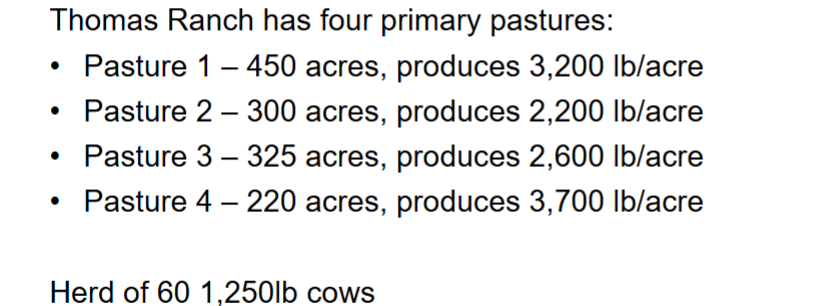
Grazing Days per Pasture = (equation)
(graze-able acres X forage estimate X utilization rate)/Daily Forage Demand

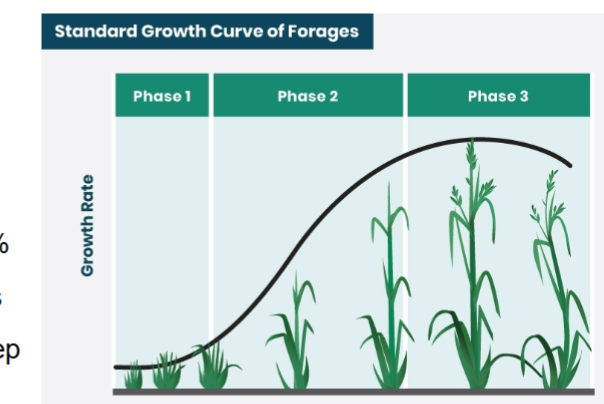
What do grazing plans try to do about plant growth stages?
• Good grazing plan adjusts the length
of grazing and rest periods to match
the growth rate of forage
o Keep the plants in the most productive
state (Phase II of growth curve)
If I have 50 1200lb cows and I want them to graze
for 3 days, what size paddocks do I need if my
pasture produces 2500 lbs/acre?
