Unit 6
 Call Kai
 Learn
 Practice Test
 Spaced Repetition
 Match
 Flashcards
 Knowt Play
1/139

There's no tags or description
Looks like no tags are added yet.
140 Terms
What did Rosalind Franklin perform in the 1950s?
X-Ray Crystallograpy of DNA
What did Rosalind Franklin’s work reveal about DNA?
Helix shape
What did Edward Chargaff analyze?
DNA samples from different species
What did Edward Chargaff find?
Amount of adenine = thymine, amount of cytosine = guanine for all species
What do Edward Chargaff’s findings support?
AT and CG base pairing
Structure of purines:
Double ring structure
Purines include:
Adenine, guanine
Structure of pyrimidines:
Single ring structure
Pyrimidines include:
Cytosine, uracil, thymine
Components of nucleotides:
Phosphate group, nitrogenous base, sugar
What holds nitrogenous base pairs together?
Hydrogen bonds
How many hydrogen bonds do adenine and thymine have?
2
How many hydrogen bonds do cytosine and guanine have?
3
What did Watson and Crick combine the findings of Franklin and Chargaff to create?
First 3D double helix model of DNA
Structure of DNA:
Double stranded helix
Backbone of DNA:
Sugar-phosphate
Center of DNA:
Nucleotides pairing
DNA strands are ______
Antiparallel
One DNA strand runs from ___ to ___, the other runs from ___ to ___
3’ to 5’, 5’ to 3’
5’ end of DNA strand:
Phosphate group
3’ end of DNA strand:
Free hydroxyl group
What does DNA do to genetic information?
Store and pass from one generation to next
Exception of genetic information being stored in DNA:
RNA in virus
What is RNA source of in viruses?
Heritable info
Eukaryotic DNA vs prokaryotic DNA:
DNA found in nucleus vs nucleoid region, linear vs circular chromosomes
What contains plasmids?
Prokaryotes and some eukaryotes
Small circular DNA molecules that are separate from chromosomes
Plasmids
Do plasmids replicate independently from chromosomal DNA?
Yes
Where are plasmids primarily found in?
Prokaryotes
What do plasmids contain?
Genes useful to prokaryote in particular environment but may not be required for survival
What can people do to plasmids in laboratories?
Manipulated
How are plasmids manipulated in laboratories?
Plasmids removed from DNA, gene of interest inserted into plasmid to form recombinant plasmid DNA
What happens when recombinant plasmid is inserted back into bacteria?
Gene expressed
What can bacteria do with neighboring bacteria?
Exchange genes found on plasmids
What can bacteria do once DNA found on plasmid is exchanged?
Express the acquired genes
What does exchanging of genes on plasmids by bacteria help with?
Survival of prokaryotes
RNA vs DNA:
Ribonucleic acid vs deoxyribonucleic acid, single stranded vs double stranded, A=U and C=G vs A=T and C=G
When does DNA replicate?
During S phase of cell cycle
Models for DNA replication:
Conservative, semi conservative, dispersive
What do the parental strands do for the conservative model?
Synthesize entirely new double stranded molecule
What happens to parental strands during conservative model of DNA replication?
Fully conserved
What do each of the parental strands do for the semi conservative model?
Make a copy of itself
What do the two daughter molecules each have after one round of replication for the semi conservative model?
One parental and one new strand
What happens to the material in the two parental strands for the dispersive model?
Randomly dispersed between daughter molecules
What do the daughter molecules contain after one round of replication for the dispersive model?
Random mix of parental and new DNA
What did Meselson and Stahl perform in 1954?
Experiment using bacteria
What was the bacteria that Meselson and Stahl used originally cultured with?
15N
Is 15N a heavy or light isotope?
Heavy
What did Meselson and Stahl do to the 15N cultured bacteria?
Transferred to medium with 14N
Is 14N a heavy or light isotope?
Light
What did Meselson and Stahl do to the DNA after each replication?
Centrifuge and analyze
What model did the parental strands in Meselson and Stahl’s experiment follow?
Semi-conservative
What sites does DNA replication begin at?
Origins of replication
What attaches to the origins of replication?
Proteins
What do the proteins that attach to the origins of replication do?
Open DNA to form replication fork
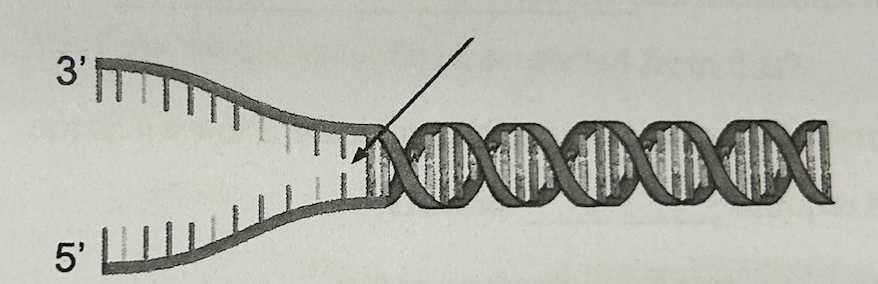
Replication fork
What does helicase do?
Unwind DNA strands at replication fork
What do single strand binding proteins do?
Bind to DNA to keep open
What does SSBP stand for?
Single strand binding protein
What does topoisomerase prevent?
Strain ahead of replication fork
How does topoisomerase prevent strain ahead of replication fork?
By relaxing supercoiling
What initiates replication of DNA?
Primase
How does primase initiate replication?
By adding primers to parental DNA strand
What are primers?
Short segments of RNA
What can the enzymes that synthesize DNA only do?
Attach new DNA nucleotides to existing strand of nucleotides
What do primers serve as?
Foundation for DNA synthesis
What does DNA polymerase III do?
Attach each primer on parental strand and moves in 3’ to 5’ direction
What does DNAP III stand for?
DNA polymerase III
What does DNA polymerase III do as it moves from 3’ to 5’ direction?
Adds nucleotides to new strand in 5’ to 3’ direction
What does the DNA polymerase III that follows the helicase create?
Leading strand
How many primers does the DNAP III that creates the leading strand require?
One
What does the DNAP III that moves away from the helicase create?
Lagging strand
How many primers does DNA polymerase III that creates the lagging strand require?
Many
What is leading strand synthesized in?
One continuous segment
What is lagging strand synthesized in?
Chunks
Why is lagging strand synthesized in chunks?
It moves away from replication fork
Segments of the lagging strand:
Okazaki fragments
What does DNAP I do after DNAP III forms an okazaki fragment?
Replaces RNA nucleotides with DNA nucleotides
What does DNA ligase do?
Joins okazaki fragments to form continuous DNA strand
All enzymes involved in DNA replication:
Topoisomerase, DNA helicase, DNA polymerase III, DNA polymerase I, DNA ligase, primase
Can DNA replication finish on the 5’ end of a lagging strand?
No
Why can’t DNA replication finish on the 5’ end of a lagging strand?
DNAP III can only add nucleotides to 3’ end
What would happen over many replications if DNA replication cannot finish at the 5’ end of a lagging strand?
DNA would become shorter and shorter
Repeating units of short nucleotide sequences that do not code for genes:
Telomere
What do telomeres do?
Form cap at end of DNA to postpone erosion
What does telomerase do?
Adds telomeres to DNA
What does DNA polymerase do as it adds nucleotides to new DNA strand?
Proofreads bases added
What will take place if errors occur during DNA replication?
Mismatch repair
What do enzymes do to the incorrectly paired nucleotide during DNA replication?
Remove and replace
What happens when segments of DNA are damaged?
Nuclease removes segments and DNA polymerase and ligase replace them
Proteins are ______ made up of ______
Polypeptides made up of amino acids
What are amino acids linked by?
Peptide bonds
The process by which DNA directs the synthesis of proteins:
Gene expression
Stages of gene expression:
Transcription and translation
Does gene expression occur in all organisms?
Yes
Transcription turns what into what?
DNA to RNA
Translation turns what into what?
RNA to protein
Where does transcription happen?
Nucleus
Where does transcribed RNA go to?
Cytoplasm
Where does translation occur?
Ribosomes in cytoplasm