College 1
 Call Kai
 Learn
 Practice Test
 Spaced Repetition
 Match
 Flashcards
 Knowt Play
1/35

Earn XP
Description and Tags
Human error
36 Terms
error
the failure of planned action to achieve their desired goals without some unforeseen or chance intervention
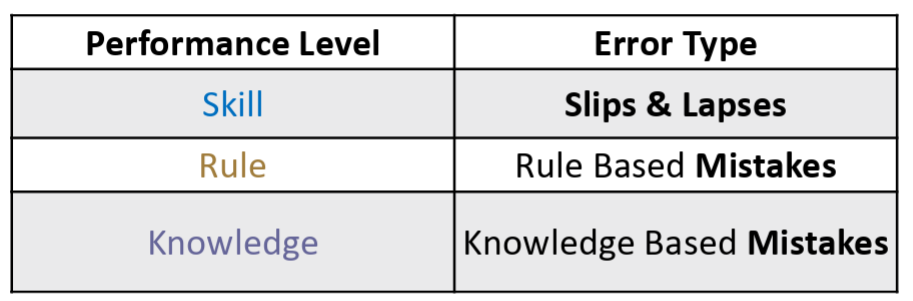
error types
errors on automation
slips: attention failure, action related
lapses: memory failure
errors on conscious control
mistakes: intention failure
Violation?: you are aware that you are doing something you’re not supposed to
human performance model

generic error-modelling system
Skill based errors typically proceed detection of a problem
Rule and knowledge based errors typically follow detection of a problem
double-capture slip
skill level error
you get distracted, making you forget something special
stronger automation takes over
omissions following interruptions error
skill level error
attentional check fails after an external event (your normal behavior gets interrupted)
delay reduces controle error
skill level error
when you forget why you walked into a room
“What am I doing here?”
perceptual confusions
skill level error
pattern matching problem, e.g. when thinks look a lot like each other so you mistake them for the other (can have serious consequences, e.g. when you mistake a gun for a taser)
interference error
skill level error
control issue, when you say something wrong (Freudian slip is where you say one thing but mean your mother
overattention error
skill level error
when you can type blind, you make more errors when you look at your keyboard
types of error based on performance level
skill based error:
inattention/omission
overattention
rule based error:
misapplication of good rules
application of bad rules
first exception
rule level error
first time an exception is met will lead to creation of sub rules
e.g. when you always look over your shoulder but nothing ever happens, and then one dat something does happen
countersigns and nosigns error
rule level error
confusing information
Signs: all or some of the conditional aspects of the rule met
Countersigns: indicate another rule is appropriate
Nosigns: do not relate to any existing rule and are simply noise in the system
informational overload error
rule level error
makes it hard to notice signs and countersigns and ignore nosigns
rule strenght error
rule level error
the more a rule is used, the easier it will ‘fire’
general rule error
rule level error
strong rules, exceptions are exceptional
redundancy error
rule level error
repeated encounters result in ignoring information
rigidity error
rule level error
if it ain’t broke don’t fix it
encoding deficiencies
rule level error
I don’t see a curve in the earth so it must be flat
action deficiencies
rule level error
wrong and inadvisable rules
selectivity error
Knowledge level errors
attention towards psychological salient rather than logically important
e.g. buying something bad because it has a nicer color than the good thing
workspace limitations
Knowledge level errors
can’t keep everyting in your brain
limited resources
recent info bias
availability heuristic
Knowledge level errors
out of sight out of mind
confirmation bias
Knowledge level errors
effort after meaning & expectation
overconfidence error
Knowledge level errors
disregard contradictory signs
biased reviewing
Knowledge level errors
the ‘check-off’ illusion
illusory correlation
Knowledge level errors
correlation is not causation
halo effect
Knowledge level errors
if someone is physically attractive, they must also be a good person
Problems with causality:
knowledge based error
Underestimating future irregularities
Representativeness heuristic
Causality biased on similarity between cause and effect
Availability heuristic
my grandfather smoked and lived to an old age, so smkong cannot be that bad
Anecdotal arguments
Hindsight bias
Illusion of control
problems with complexity
knowledge based errors
Delayed feedback
Insufficient considerations of processes in time
Thinking in causal series
Thematic vagabonding (jumping, superficial)
Encysting (“myopic” detailed attention, ignore larger issues)
Difficulty with exponential developments
violations
Intent is not to have negative consequences
Cutting corners, saving effort
Thrill seeking
No intention to do harm (in general)
risk
The probability of an outcome x the consequence of that outcome
This calculation is one that requires the Knowledge level
Effortful
Biased
Increased waiting time – risk rating changes
risk monitoring
target level of risk
target feeling of risk / task difficulty/effort
or zero risk?
control of risk
Mostly carried out at the skill and rule level
NOT the most gain for least loss
In general Avoidance
Feeling/Emotion based
Subjective
Why increase automation?
decreases chance of error
but increases the consequences of errors
latent failure model
system failures occur when hidden weaknesses in a system align with human errors
