bio task 2 study notes
 Call Kai
 Learn
 Practice Test
 Spaced Repetition
 Match
 Flashcards
 Knowt Play
1/78

There's no tags or description
Looks like no tags are added yet.
79 Terms
what is HCG?
Human chorionic gonadotropin (HCG) is a hormone produced by some of the cells in the blastocyst/embryo when it implants in the endometrium
HCG maintains the corpus luteum
what is the corpus luteum?
oxytocin
stimulates the production of milk and
causes the uterine muscles to contract and cervix to soften i.e causes female to go into labour and give birth
after birth, oxytocin secretions continue, causing uterus to contract and expel placenta
what is the role of relaxin?
loosens uterine muscles during pregnancy and prepare the body for birth
what is the role of lutenising hormone?
promotes final maturation of the ovarian follicle, ovulation and development of the corpus luteum in females.
also stimulates the secretion of testosterone.
what is the role of follicle stimulating hormone (FSH)?
stimulates maturation of follicles in the ovaries of females
what are the two types of proteins?
fibrous proteins: form structural components of cells and tissues. They are long and insoluble in water eg. collagen in skin and keratin in hair
Globular proteins: usually spheircal in shape, compact and soluble in water
Eg. haemoglobin, antibodies, hormones and enzymes
what is internal fertilsation?
Sperm is released inside female’s body in copulation.
union of male and female gametes (sperm and egg) inside the body of the female
isnt restricted to terrestial organisms but is favourble
eg. humans, tortoise, most mammals
what is external fertilisation?
External fertilisation occurs in an outside environment
Has to occur in a body of water otherwise the male and female sex cells dry out.
Are exposed to external elements and can contract diseases, be eaten or die out
Generally is only done by animals that can be in a body of water eg.
■ Fish such as salmon
■ Amphibians such as frogs
advantages of external fertilisation
little energy required to mate
larger numbers of offspring produced
large numbers of gametes released: more zygotes, higher chance of survival and more offspring produced
less competition
disadvantages of external fertilisation
fertilised is not nurtured by parent, which leaves it susceptible to predation and disease. the likelihod of it surviving until birth is low
Droughts and dry seasons tarnish the quality of the deposited gametes, so it is favourable for it to occur in aquatic environments
what are nonsense mutations?
a type of point mutation.
Occurs when the DNA change creates a premature STOP codon which truncates the polypeptide. Cystic fibrosis is an example
what are the 3 types of substitution point mutation?
non sense
mis sense
silent
what are the advantages of internal fertilisation?
advantage:
fetus is nurtured inside the body of parent, protecting it from predation and disease
- This means genetically varied offspring survive to continue to sexually reproduce, which increases genetic diversity. This it increases likelihood of a population being able to survive a selective pressure, enabling it to continue to adapt to changing environments and reproduce, as a result, contributing to the continuity of the species.
close proximity: increased likelihood of fertilisation
what are the advantages and disadvantages of sexual reproduction?
advantages:
variation in the population
species are able to adapt better to their environment and any environmental changes
disease events less likely to affect the population
disadvantages
time consuming
requires mating partner
large energy expenditure
fewer offspring produced
what are the advantages and disadvantages of asexual reproduction?
advantage:
populations can increase rapidly when conditions are favourable
only one parent needed
able to be enacted under external pressures (i.e quick and not energy intensive)
no requirement for investment in care of offpspring
disadvantage:
lack of genetic diversity
reduced ability to adapt to external pressures- which can result in large extinction events (eg. the brie mould going extinct)
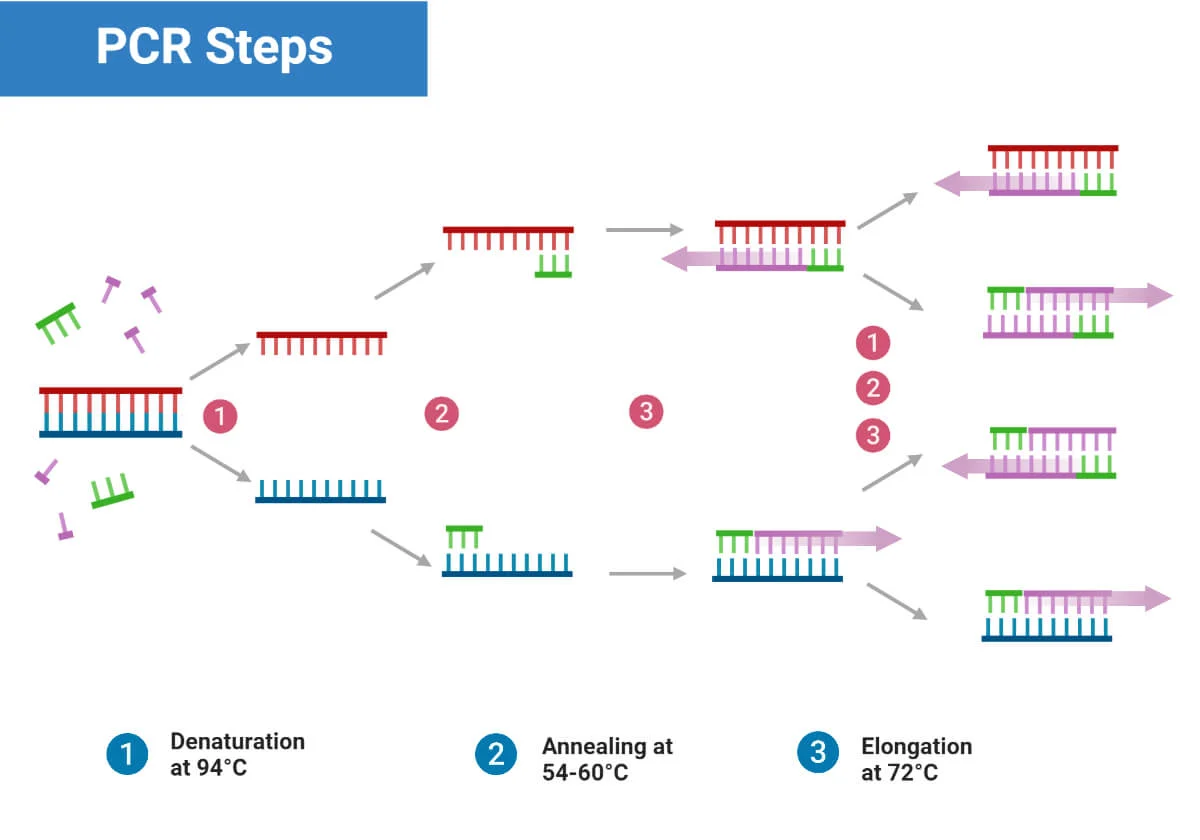
what are the steps of PCR?
denaturation- DNA sample is heated ~95ºC to separate the two strands of DNA
annealing- DNA sample is cooled to ~50ºC to allow primers to anneal to the start of the single strand of DNA
extension- sample is heated to the optimal temperature (~72ºC) for a heat tolerant polymerase (Taq) to function

what is a frameshift mutation?
when a single base is inserted or deleted, every single codon after the mutation is affected, altering the reading frame of the gene
They have a huge effect on the DNA as it can change the amino acid sequence, ultimately impacting the protein it will produce.
what is a mutagen?
A mutagen is an agent that increases the rate of genetic mutation by interfering with the function of nucleic acids.
They can be spontaneous (caused by copying errors during DNA replication) or induced by exposure to external elements
they can be physical (radiation), chemical or biological.
what is PCR?
polymearase chain reaction
a technique used to amplify DNA, in vitro
each PCR reaction doubles the amount of DNA
The reaction occurs in a thermal cycler and uses variation in temperature to control the replication process
what is the difference between point and chromosomal mutations?
point: a change in one nucleotide in the DNA
chromosomal: changes to segments of a chromosome, leading to large scale changes in the DNA
what processes can be involved in a point mutation?
Insertion (extra nitrogenous base added)
Deletion (nitrogenous base not include)
Substitution (wrong nitrogenous base added)
how can the physical structure of proteins be described?
The structure of proteins can be described as primary, secondary, tertiary or quaternary
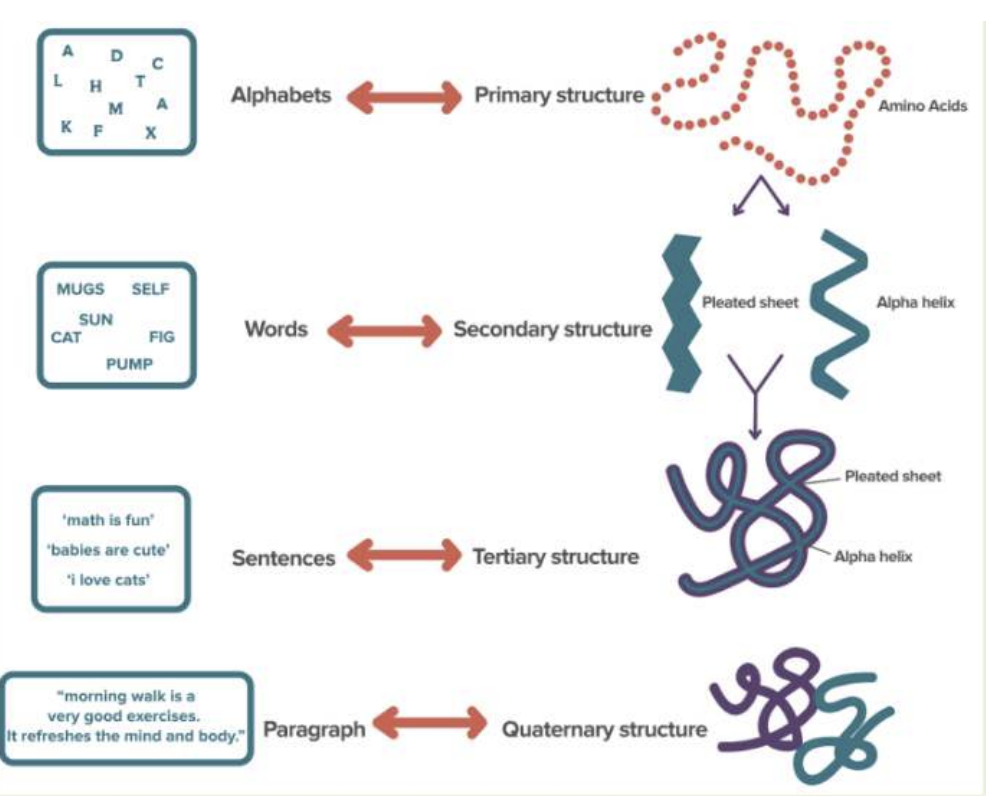
primary structure of proteins
a polymer of amino acids arranged in a linear chain (polypeptides)
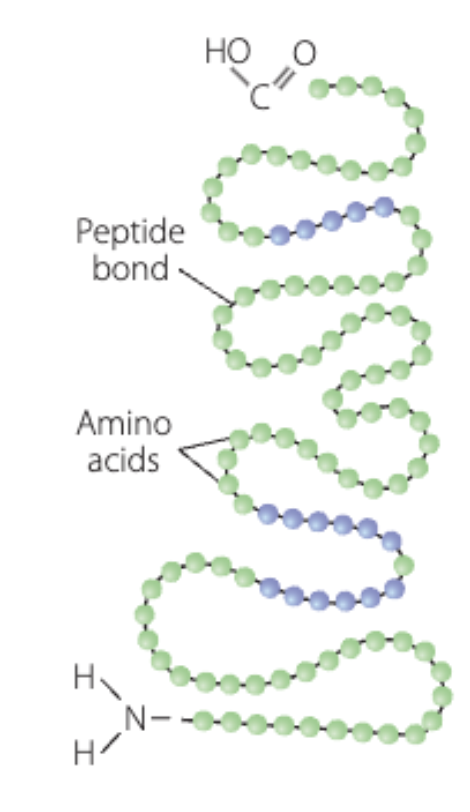
secondary structure of proteins
The polypeptide chain then folds up in various ways.
forms as a result of the amino acid chain becoming linked by hydrogen bonds, either
twisting the polypeptide into a spiral (alpha helix) or folding it into a pleated sheet (beta pleated sheet)
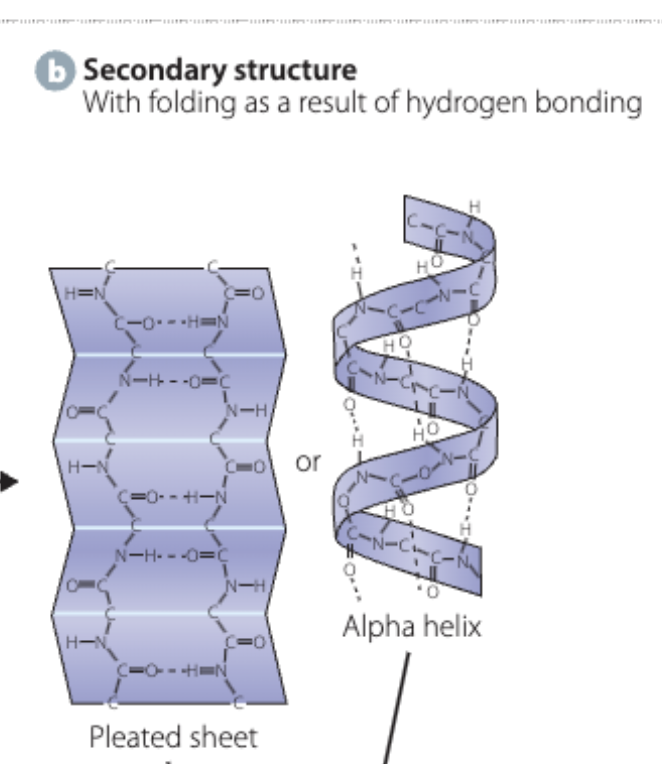
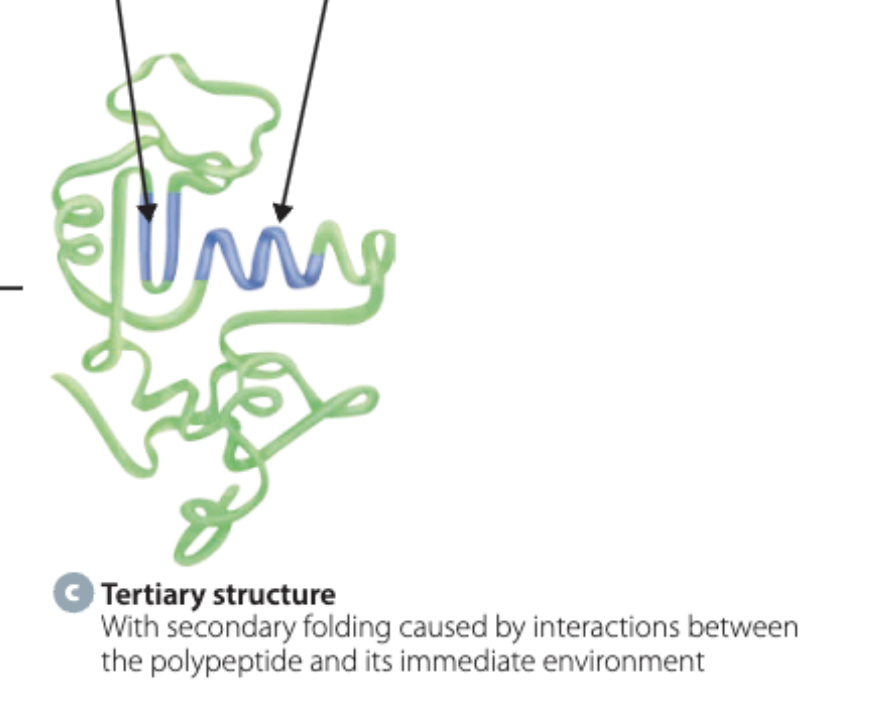
tertiary structure of proteins
Certain forces of attraction between alpha helices and pleated sheets (such as disulfide bonds) cause the polypeptide to fold into a more complex three-dimensional shape
results from further folding of secondary proteins, can form globular proteins
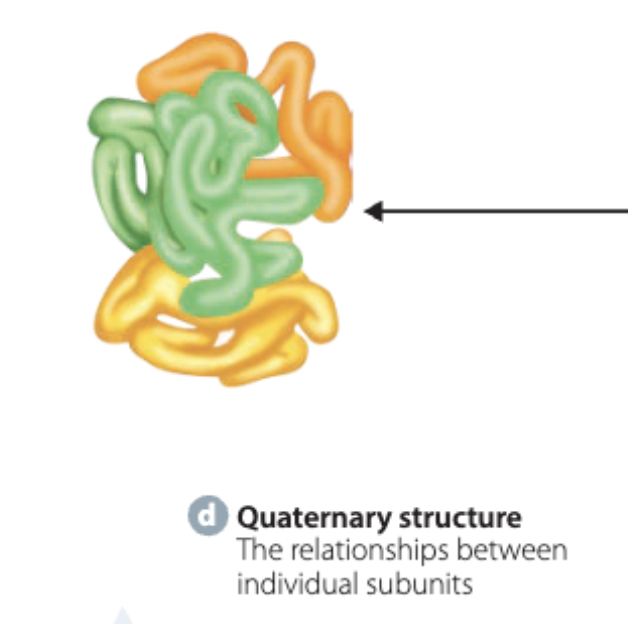
quaternary structure of proteins
some complex proteins consist of more than one amino acid chain
Each polypeptide chain is referred to as a subunit.
what is a structural protein?
protein function
Structural proteins are often fibrous and stringy (such as collagen and elastin), and found in connective tissues such as skin, cartilage, bone, tendons and ligaments
what are enzymes?
Protein molecules are involved in all biochemical aspects of cellular metabolism
Important in gene functioning, replicating, repairing and transcribing DNA
catalyse bio chemical reactions
what are sensory proteins?
proteins that change their shape or biochemical activity in response to stimuli (changes in the environment).
eg: opsins are proteins in the retina (innermost layer) of the eye that detect light.
Transport and storage proteins
Bind, store or carry other molecules in cells
Eg. histones package DNA, ferritin stores iron in haemoglobin
hormonal proteins
coordinate an organism's activities by triggering responses
Examples: insulin, glucagon
immunological proteins (antibodies)
protect against disease by recognising foreign bodies and microbes; activate immune cells
Eg: immunoglobulins (antibodies), complement, major histocompatibility complex proteins
fungi (asexual reproduction)
reproduce asexually when conditions are good/ favourable
spores: mitosis produces genetically identical cells which are distributed into the environment by wind or vectors
eg. dust clouds when mushrooms are stepped on
budding: nucleus divides and a bulge is formed on the side of the cell which is then split off by cytokinesis and bud detaches itself from the mother cell
After a bud develops to a certain point and even before it is severed from the parent cell, it is itself capable of budding by the same process. (a chain of cells may be produced.)
fungi (sexual reproduction)
occurs when conditions are bad via meiosis. this increases genetic variation
what is binary fission?
a single cell divides into two daughter cells
begins with DNA replication where the genetic information is copied and divided into two
the cell elongates and splits into two in cytokinesis, producing daughter cells with identical genetic information as the parent
asexual reproduction
occurs in bacteria and protists
protist reproduction
can reproduce both asexual or sexual
Binary fission: the division of the parent body into two identical daughter cells. eg. amoeba, paramecium
Budding: A small outgrowth develops from the cell of the parent body which separates and develops into a new individual. Example: Arcella
Interphase (Before mitosis)
DNA is present as uncondensed chromatin (not visible under microscope)
DNA is contained within a clearly defined nucleus
Centrosomes and other organelles have been duplicated
Cell is enlarged in preparation for division
DNA replication occurs as cell prepares for divison
Prophase (mitosis)
DNA supercoils and chromosomes condense (becoming visible under microscope)
Chromosomes are comprised of genetically identical sister chromatids (joined at a centromere)
Paired centrosomes move to the opposite poles of the cell and form microtubule spindle fibres
The nuclear membrane breaks down and the nucleus dissolves
metaphase (mitosis)
Microtubule spindle fibres from both centrosomes connect to the centromere of each chromosome
Microtubule depolymerisation causes spindle fibres to shorten in length and contract
This causes chromosomes to align along the centre of the cell (equatorial plane or metaphase plate)
anaphase (mitosis)
Continued contraction of the spindle fibres causes genetically identical sister chromatids to separate
Once the chromatids separate, they are each considered an individual chromosome in their own right
The genetically identical chromosomes move to the opposite poles of the cell

telophase (mitosis)
Once the two chromosome sets arrive at the poles, spindle fibres dissolve
Chromosomes decondense (no longer visible under light microscope)
Nuclear membranes reform around each chromosome set
Cytokinesis occurs concurrently, splitting the cell into two
Meiosis 1
Meiosis 1:
P-I: Chromosomes condense, nuclear membrane dissolves, homologous chromosomes form bivalents, crossing over occurs
M-I: Spindle fibres from opposing centrosomes connect to bivalents (at centromeres) and align them along the middle of the cell
A-I: Spindle fibres contract and split the bivalent, homologous chromosomes move to opposite poles of the cell
T-I: Chromosomes decondense, nuclear membrane may reform, cell divides (cytokinesis) to form two haploid daughter cells
Meiosis II
The second division separates sister chromatids
P-II: Chromosomes condense, nuclear membrane dissolves, centrosomes move to opposite poles (perpendicular to before)
M-II: Spindle fibres from opposing centrosomes attach to chromosomes (at centromere) and align them along the cell equator
A-II: Spindle fibres contract and separate the sister chromatids, chromatids (now called chromosomes) move to opposite poles
T-II: Chromosomes decondense, nuclear membrane reforms, cells divide (cytokinesis) to form four haploid daughter cells
what is the difference between mitosis and meiosis?
mitosis:
produce 2 identical daughter cells
diploid cells
PMAT 1x
occurs in somatic (body) cells
meiosis:
procue 4 different daughter cells
haploid cells
PMAT 2x
occurs in germ line cells (gametes)
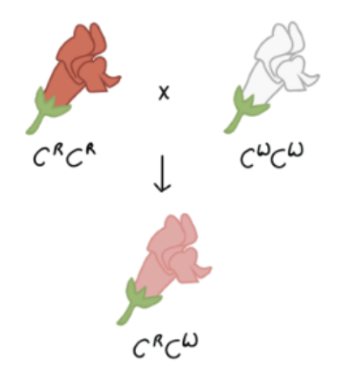
Incomplete dominance
The phenotype of heterozygous individuals appears as a blend of the phenotypes of either type of the homozygote
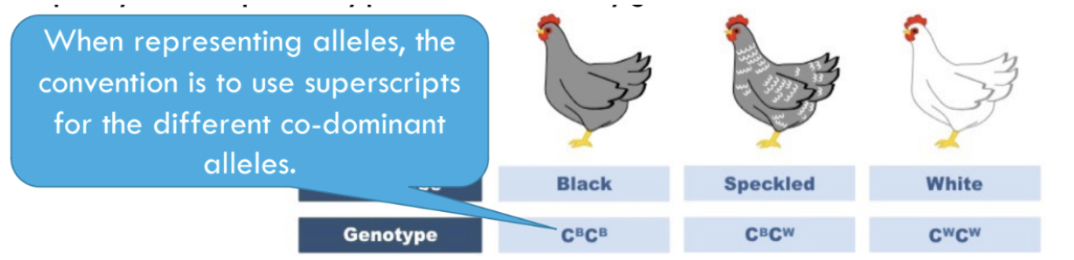
Co dominance
Occurs when pairs of alleles are expressed equally in the phenotype of a heterozygous individual
superscripts used to indicate different co dominant alleles
autosomal recessive inheritance
recessive allele is only expressed when no dominant allele is present
have to be homozygous recessive for it to be expressed
not sex linked
eg. cystic fibrosis
autosomal dominant
dominant allele is always expressed
only need one allele for dominant trait to be expressed (hetero or homo)
eg. Achondroplasty dwarfism
x linked dominant
affect both genders equally since it only needs one x chromosome for the trait to be expressed
x linked recessive
affect men more than women
higher chance of a male to inherit one faulty x chromosome
if a woman has dominant allele, it will mask the recessive one
eg. haemophilia, red-green colour blindness
what are the steps in transcription?
RNA polymerase binds to a sequence of DNA called the promotor found near the beginning of a gene.
RNA polymerase moves along the DNA strand, unwinding a small section of DNA and breaking its hydrogen bonds
RNA polymerase reads the template strand, matching complementary free floating nucleotides to create a chain containg the same coding info
A mRNA molecule is sequentially snythesised by RNA polymearase as it continues to move along the DNA strand
terminator sequences end the transcription of DNA and the mRNA molecule moves from the nucleus to the cytoplasm
what are the steps in translation
mRNA attaches to a ribosome at a particular start codon
Ribosomes move along mRNA temporarily pairing the bases of transfer RNA (tRNA) anticodons with their complementary codons on the mRNA
A second tRNA molecule attaches to the next codon on the mRNA strand
The ribosome catalyses the formation of a peptide bond between two amino acids
The first tRNA molecule moves away from the ribosomes leaving its amino acid
The ribosome continues to move along the mRNA until it reaches a stop codon
The polypeptide chain and mRNA strand are released from the ribosome
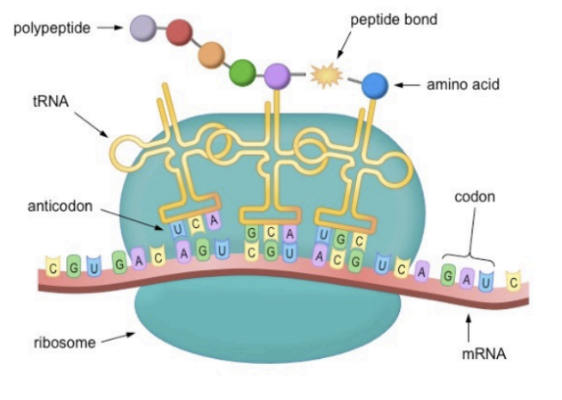
what is transcription and translation?
transcription: the process of making an mRNA copy of a gene’s DNA sequence
translation: the process in which ribosomes decode the genetic information in mRNA to form a polypeptide chain
what is DNA and why important
DNA (deoxyribonucleic acid) is a type of nucleic acid that is responsible for storing genetic information in cells
It acts as an instruction manual containing information needed for the growth, survival and replication of an organism
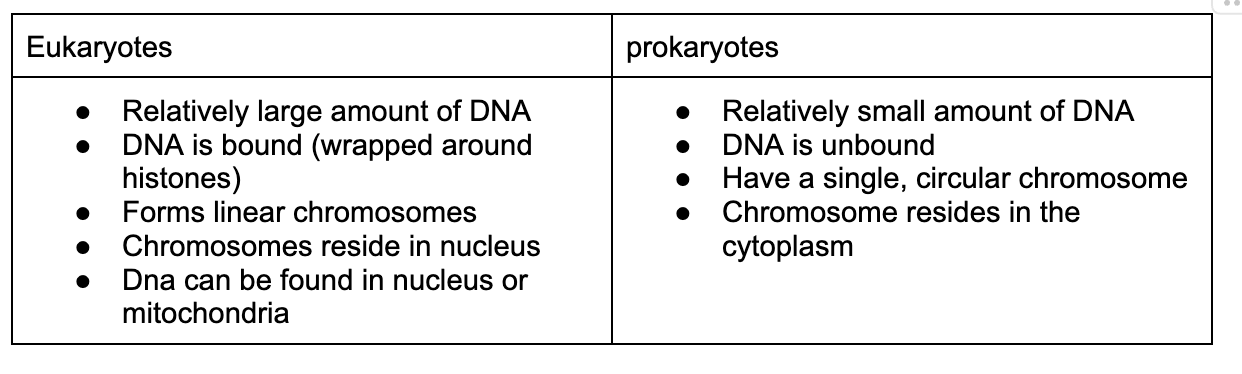
eukaryotic vs prokaryotic DNA
DNA structure?
DNA is a long chain and double stranded molecule, in the shape of a ‘double helix’ (similar to a twisted ladder)
It is made up of two strands that have an antiparallel arrangement- they are parallel but run in opposite directions
The vertical sides of the ladder are made of alternating sugar and phosphate molecules (sugar-phosphate backbone)
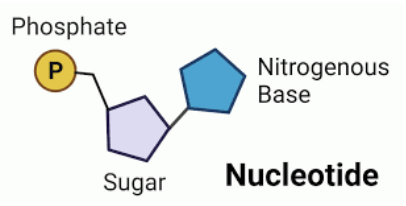
Consists of building blocks called nucleotides which are composed of a deoxyribose sugar, a phosphate group and a nitrogenous base
There are 4 nitrogenous bases: adenine, thymine, cytosine and guanine (all tigers can growl)

what are nucleotides
Consists of building blocks called nucleotides which are composed of a deoxyribose sugar, a phosphate group and a nitrogenous base
There are 4 nitrogenous bases: adenine, thymine, cytosine and guanine (all tigers can growl)
The nitrogenous bases bond to each other through weak hydrogen bonds
A and T have a double bond and G and C have a triple bond
Each base has a complementary base pairing (Adenine and thymine), (Cytosine and Guanine)
Ensure the proportions of bases are maintained (A:T and G:C is alway 1:1)
RNA structure
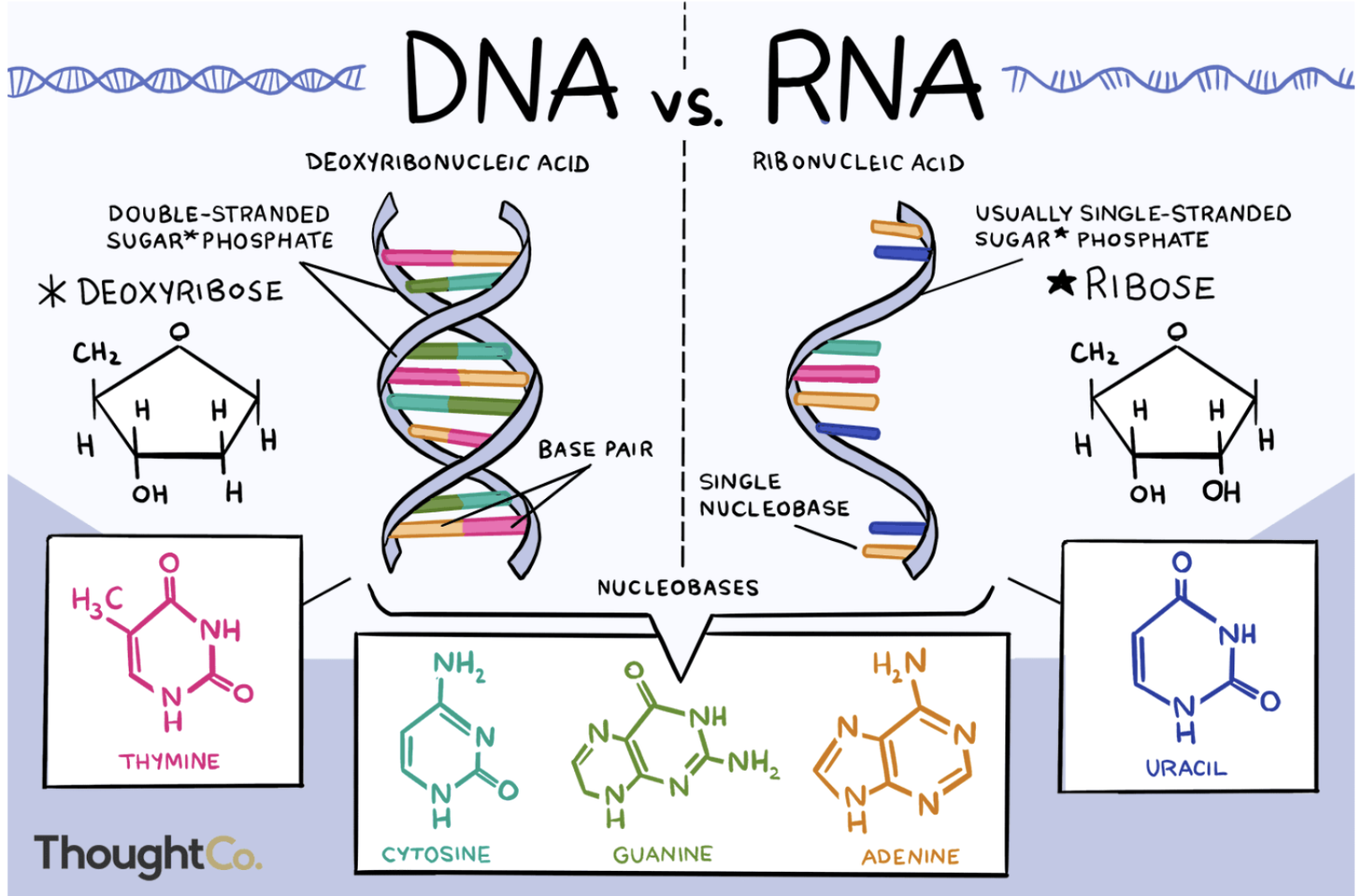
RNA structure
Consists of nucleotides, which contain a ribose sugar, phosphate and nitrogenous bases
Unlike DNA, RNA is single stranded
Has the same bases as DNA except for thymine which is replaced with uracil
Therefore, adenine pairs with uracil while cytosine pairs with guanine
FOLLICLE STIMULAATING HORMONE (FSH)
important for stimulating maturation of follicles in the ovaries of females
luteinising hormone (LH)
promotes final maturation of the ovarian follicle, ovulation and
development of the corpus luteum in females. It also stimulates the secretion of testosterone.
Duplications chromosomal mutation
part of chromosome is copied, resulting in duplicate sections (potentially increases gene
expression)
Changes amount of proteins produced
translocation chromosomal mutation
Translocation (crossing over/ recombination): segments of two chromosomes are exchanged (may interrupt gene sequences)
Deletions
a portion of the chromosome is removed (along with any genes contained within this segment)
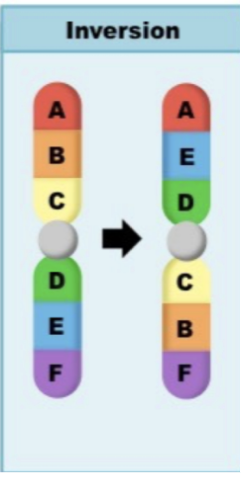
Inversions
– a segment of a
chromosome is removed and then
replaced within the chromosome in
reverse order
what is a chromosomal mutation
Changes to segments of a chromosome, leading to large-scale changes to the DNA of an organism
They occur due to spontaneous errors in cell division
Crossing over during meiosis increases the probability of error
Part of chromosome: inversion, deletion, translocation, duplication
whole chromosome: aneuploidy/ non disjunction
aneuploidy
aneuploidy/ non disjunction
Non-disjunction refers to the chromosomes failing to separate correctly, resulting in gametes with one extra, or one missing, chromosome.
causes chromosomal abnormalities
eg. Down syndrome (trisomy 21, 3 copies of chromosome 21)
steps in DNA replication
enzyme helicase unwinds and unzips DNA
Single-stranded binding proteins bind and stabilise the separated strands
DNA primase creates primers on DNA strands (primers signal beginning of replication)
DNA polymerase III reads and adds complementary nucleotides after the primer
DNA replication occurs in the 5’-3’ direction
DNA polymerase I will proofread and edit the strand to check for errors
Two new strands sealed together by ligase
which direction is DNA replication done
5’ to 3’
DNA replication is continous for leading strand (5’-3’) and discontinius for lagging strand (3’-5’)
lagging strand is replicated in sections (okazaki fragments)
DNA is anti parallel and dna replication is semi conservative
what are SNPs?
single nucleotide polymorphism
a nucleotide is substituited for another
Not classified as a mutation because it occurs in at least 1% of the population
mostly occur in non coding regions (introns)
Why are SNPs useful in genetic studies?
Determine differences between individuals and populations (similar to fingerprinting)
Track human migration routes throughout history
Study human evolution
Help increase genetic diversity and prevent species from going extinct
Genetic screening for the presence of diseases eg.sickle cell anaemia
DNA profiling vs DNA sequencing
DNA sequencing determines the precise order of nucleotides
DNA profiling is used to identify and compare individuals by characteristics in their DNA
sexual reproduction in plants
Through the use of pollinators eg. bees, the pollen is transferred to each flower. The pollen is transferred to the female reproductive organs where the pollen attaches to the stigma and then transports the sperm cells inside to the ovary where fertilisation occurs
sex organs in flowers
female: Carpel: ovary( fertilisation) , style, stigma (sticky part where pollen germinates/ collects)
male: stamen: anther (produces pollen) , filament
asexual plants
vegetative propagation
○ parts of the parent plant detach and will grow into new individuals
■ only one parent and specialised plant tissues in the parent plant can grow into offspring which are clones of the parent
population genetics in conservation
Its aim is to avoid extinction of species by applying conservation methods that ensure the maintenance of biodiversity
used to
investigate speciation
monitor inbreeding
measure extinction risk
Population genetics in disease inheritance
Identifying the regions of DNA associated with a disease can show
How to treat it
Who is more likely to be affected
What goes wrong in the cell to cause it
Applications of DNA profiling
Determining parentage- a person’s DNA profile consists of a combination of their parent’s alleles
All of the STRs in a person’s DNA profile should also be present in their mother’s and/or father’s DNA profile
Identification-
Used to determine the identity of a suspect of a crime or unrecognisable victims in forensic investigations
Natural disaster- determine the identity of people killed in natural disaster
applications of DNA sequencing
genetic testing (determine likelihood of someone getting a genetic disease or diagnose it)
Molecular biology research:
study Human evolution and migration routes
identification