Cross-Cultural Psych
 Call Kai
 Learn
Learn Practice Test
 Spaced Repetition
 Match
Match Flashcards
 Knowt Play
1/93

There's no tags or description
Looks like no tags are added yet.
Name | Mastery | Learn | Test | Matching | Spaced | Call with Kai | Chat |
|---|
No analytics yet
Send a link to your students to track their progress
94 Terms
Nature
The condition of heredity to our physical structures and behaviors→ GENES
Nurture
the contribution of environmental factors and experiences to our physical structures and behaviors → CULTURE
Culture
Interrelated set of thoughts, tools, and practices that is shared song a group of people who possess a common society identity
What are the three aspect of culture?
mindset, behavior, symbols and tools
What are apart of cultural stability?
shared meaning, rituals, norms, traditions and values
Cultural changes inlcude
ecology (city changes over time), social structures (hierachy, family), ideology (political)
Why is culture important
Affects a range of psychological processes, including perceptual, cognitive, personality, behavior, and social processes
What is self-concept?
An overarching idea about who we are- physically, emotionally, socially, spiritually, and in terms of any aspects that make u who we are
How do we measure one’s self-concept?
the 20 statement tests (give 20 different answers to the question of who am i?)
In the 20 questions there are 3 types of answers
physical (I am tall), social (leaner, sister), and mindset (I am curious)
There are cultyral impact on which ctageoires are most popylar
Cultural psychology
Self is socially constructed and varies across cultures
In individualistic cultures, how is the self described?
the self is often their personal traits and their own beliefs
ex: “I am hardworking, independent, funny, and I believe strongly in equality
In the collective cultures, how is the self defined?
defined social charactertctics
ex: I am a daughter, a member of my family, a student, and someone who supports my community.
Independent Self
associated with individualistic culture,
being unique is very important
taught to us by parents and teachers
focus on promotion
well-being is based on self-esteem
communication: direct
low context sensitivity is what and associated with what type of self?
it means not needing to know background or context, and more to the direct
associated with independent self
Interdependence self
defined themselves in terms of social relationships, group charctertsices, self and others are blurred
high context sensitivity: where are you from?
motivaton: preventing negatives
communication: indirect
Individual self-primacy hypothesis
people generally think about themselves first as unique individual before thinking themselves as members of a group
Private self
how you see yourself internal
Ex: I am shy, hardworking…
Public self
how you think people in general see you
collective self
how you see yourself based on the groups you belong to
Ex: I am a supportive member of my friend group”
Tranis argues that we can’t
just describe cultures only as Individuals or collectivistic; there are cultural dimensions
Complexity
how many different social groups, roles, and relationships a person has
Someone who lives in a larger city and has more groups they are in would have
because they move between many different griups, they may develop a stronger sense of who am I independelty of these groups
While those who are apart of small city/village would
have a stronger collective self, as their identify may be more closely connected to their family and community
How could technology influence compleixty?
technology incraeses comlexity ad it exposes people to more groups, relationships, and environments
Tight cultures
strong social norms and clear expectations about proper behavior
What does tight culture encourage and why?
It encourages public self and collective self
why?
people will pay attenrion to what other will think
what does my group expect me to do
Loose cultures
has weaker social norms and greater tolerance for people behaving differently
Loose culture encourages
private self
peole have more freedom to ask what do I personally wnat to do
Trait psychology
assumes traits are
consistent: appear across situation
stable: remain similar over time
difference between people
influence behavior
Ex: if someone is extraverted, we might expect them to behave more socially in many situations
Big 5 Personality traits
Openness
Conscientiousness
Extraversion
Agreeableness
Neurocistms
What does trait psych assume about the Big 5?
assume personality traits are universal, but psychologists question whether personality operates identically across culture
Agentic traits
focus on individual effectiveness and independence
Communal traits
focus on relationships and social harmony
Why is individualism vs collectivism not enough??
a culture could be collectivistic, but people in the culture may value/display agentic qualities
exx:
1960 is when
cross-cultural psychology becme an independent field from general psych
cross-cultural psychology
Ongoing changes in variables reflecting
Relationship of psychological variables with sociocultural, ecological, and biological variables
similarlities & differences in individual psychological functioning in various cultural & ethnocultural groups
1970s in cross-cultural psych
cognition and perception
1980s in cross-cultural psych
interest in methodologies of social psych
self-report surveys
Individualism vs collectivism: universal psychological law
Shift from culture as external to internal
extenral: political organization — internal: shared beliefs, religions and values
1990s cross-cultural psych
debate on universalism vs relativism, maybe differnet cultures have different view
Exterme Relativism
everything is subjective (every experience you have is unique)
Moderate Relativism
people develop psyche to function in a spefic culture
moderate universalism
differences do not necessarily imply different psychological functions and processes
extreme univeralism
behavior is not influenced by culture
Culture comparative approach
finding causes and effects between culture and psyche
ex: How do different political organizations lead to individualism vs collectivism?
ecological approach (Berry)
cultural psychology
Culture is inseparable from the person and different psyches (emotions, cognitions, behavior-processes and culmination) emerge in different cultures
Field dependent cognitive style
thinking style that relies heavily on context and relationships; info is understood as part of a larger whole
Indigenous psychology
Is scientific study of human behavior or mind that is native, not transported from other regions and that is designed for its people
Examining psychological phenomena in their native context
Cultural neuroscience
How biological processes may play a role in observed psychological difference between cultures
field-independent cognitive style
analytical thinking style in which a person can separate info or objects from their surrounding context
WEIRD Bias
bias caused by relying heavily on Western, Educated, Industrialized, Rich, and Democratic populations and assuming the finding apply universally
Vygotsky’s Sociocultural Theory
higher mental processes( (reasoning, problem-solving, memory, decision-making) not of individual but collectivity DEVELOPS OVER TIME OF SOCIETIES
Luria’s Cultural-Historical Approach
people’s ways of thinking can differ depending on their cultural environment, education, experiences, language, therefore patterns of thinking can also change.
Values
motivational orientations that guide actions and evaluations
power distance (cultural dimension)
how much people accept that power is distributed unequally.
High power distance..
people are more accepting of
authority
unequal power
The boss is the boss. You don’t question them!
Low power distance …
people expect greater ability to challenge authority
Why should that person have more power than me?
Inidviualism vs collectivism (dimension2 )
individualism: people are more loosely connected to groups and take care of themselves and immediate family
collectivism: strobgly connect to in-groups that
REMEMBER THAT A CULTURE CAN HAVE BOTH
individualistic and collectivistic characteristics
I: personal goals
C: strong family toes, grandparents helping with children
individualistic and collectivistic characteristics vs Femininity (Power dimension 3)
cultural values
masculinity value: achievement, assertivement
Femininity: cooperation, modesty
Uncertainty Avoidance (PD 4)
how uncomfortable people are with uncertainly and ambiguity
High uncertainty avoidance
people prefer predictability
Low uncertainty avoidance
people tolerate risk and uncertainty
Long-term Orientation (PD5)
focuses more on adpating, future planning
Short-term orientation(PD5)
focuses more on maintaining traditions, following existing norms
Indulgence (PD6)
culture permits people to satisfy desires associated with
fun
enjoyment
leisure
Restraint (PD6)
culture places more limits on gratification and expects people to control desires
Monumentalism
A person sees themselves as stable and consistent over time
“I have strong values. I don't change who I am depending on the situation.
Flexhumility
A person believes they should adapt depending on circumstances
“My behavior can change depending on the situation, and that's okay
Horizontal individualism:
individuals strive to be distinct without desiring special status
I want to be different, but equal
Vertical individualism
strive to be distinct and desire special status
“It’s important that I do my job better than others”
I want to succeed and rise above others
Horizontal collectivism:
emphasize interdependence but do not submit easily to authority
If a co-worker gets a prize, I would feel proud
We are a group of equals
Vertical Collectivism
emphasize interdependence and competition with out-groups
The group comes first, even if I sacrifice.
“It is my duty to take care of my family, even when I have to sacrifice what I want”
Schwartz theory of basic human values
what values have people (universality), what we have in common
Values across from each other are in tension because they push behavior in opposite directions
self-enhancement vs transcendence
openness to change vs conservation
Religion is central
to the self!
5 functions of religion
Providing answers to spiritual mysteries
Offering emotional comfort
Creating a place for social interactions
Fostering group cohesion and integration
Social control and social norms
Attributions
the way people explain the cause, the WHY things happen
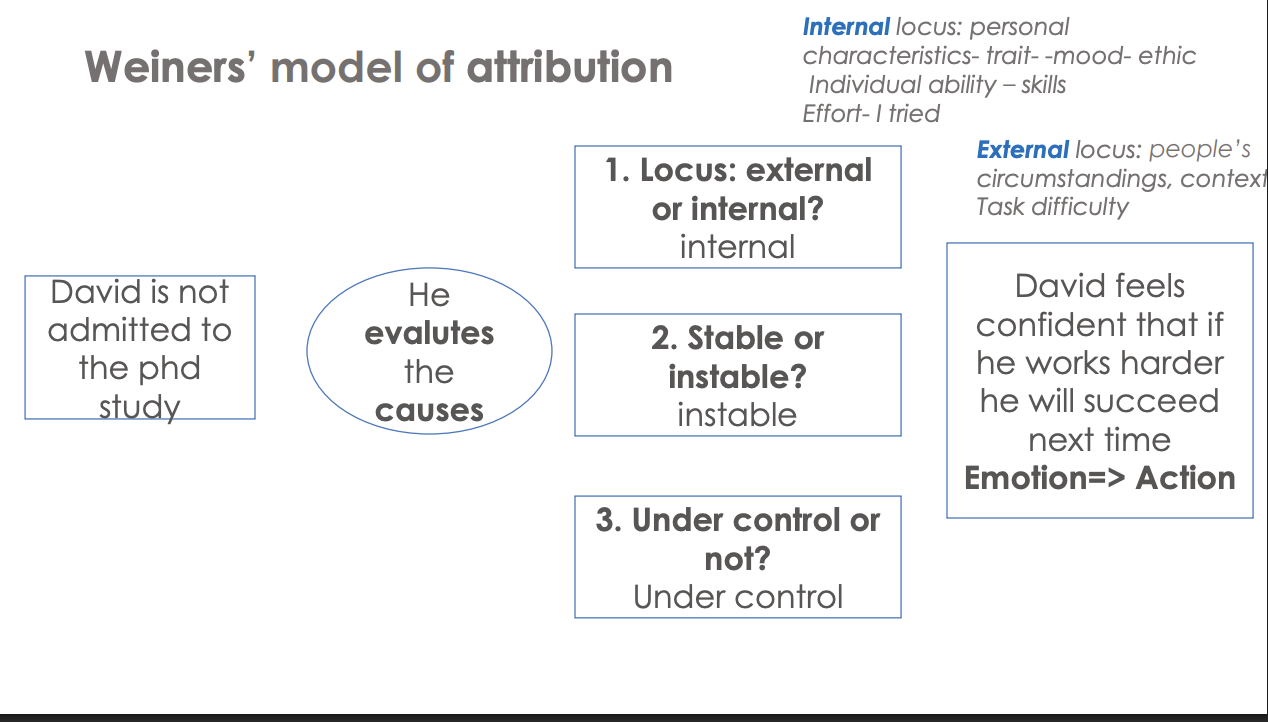
Weiner’s model of attribution
explains that the way people evaluate the causes of events lead to emotions and determine function actions
1) cause is internal or
2) cause is stable or unstable
3) can I control the cause?
self-serving bias
Take credit for personal success and avoid responsibility
considered the western bias
Unassuming bias
Explain success more as a result for external factors and failure in terms of internal factors
considered the eastern bias
ex: In Japanese: I did well in school because the test was easy/the professor prepared me well. I failed because I did not study or prepare enough…
Fundamental Attribution error
underestimate the influence of external factors and overtime the influence of personal factors when evaluating other people’s actions
a person does not make eye contact with, they must be rude
typical for individualistic culture
Moral disengagment
Cognitive mechanisms that make people feel themselves less guilt and shame about misdeed
victim blame attribution
responsibility transfer (put it onto the group)
seems to have higher level in collectivist culture, with example of responsibility transfer
Health and Healing belief (western causal attribution)
Within the individual: you become ill due to bad habits, stress
Natural environment (pollution: germs)
Individualistic (cultural origin of attribution)
independent self
explain situations in individual attributions
internal locus of control
Collectivism (cultural origin of attribution)
interdependent self
explain situations in group causal attribution
External factors
Context, family, group
What increase fundamental attribution error?
1) strong emphasis on personal characters
2) judgment of behavior according to social norms of respects, loyalty
3) social networks based on family and close friends with focus on reputation
4) Catholicism focuisng the ideas of virtue and guilt
What decreases fundamental attribution error?
1) Context
family, friends, financial needs
“I can’t be at this meeting due to family obligations”
2) Judgement of behavior accordion to social norms of respect, loyalty, courtesy correctness
Health and Healing belief (non-industralized attribution)
Social world: interpersonal stress, action of others- medical facilities
Supernatural: God, destiny, indigenous beliefs
Social Behavior
Actions between 1 or more person
Pro-social behavior
give benefit to other helping, sharing, comforting, forgiving, cooperation
Anti-social behavior
actions that violate the rights of others, break social norms, or cause nuisance, distress, and harm to society
exclusivity, bullying, violence, teasing, aggression