A & P Final Exam (Ch. 11, 12,13, 14, 15)
 Call Kai
 Learn
 Practice Test
 Spaced Repetition
 Match
 Flashcards
 Knowt Play
1/139

Earn XP
Description and Tags
Chapters added so far:
140 Terms
Nervous system
The master controlling and communicating system of the body
electrical, chemical
Cells communicate via ____ and ____ signals
Sensory input, Integration, Motor output
The three overlapping functions of the nervous system
Sensory input
Information gathered by sensory receptors about internal and external changes
Integration
Processing and interpretation of sensory input, analyzes sensory information, stores information, makes decisions
⭐
Motor output
Activation of effector organs (muscles and glands) produces a response
Central nervous system (CNS), Peripheral nervous system (PNS)
The two main parts of the nervous system
Central nervous system (CNS)
Brain and spinal cord of dorsal body cavity
⭐
False;
The central nervous system is the integration and control center that interprets sensory input and dictates motor output
(T/F) The peripheral nervous system is the integration and control center that interprets sensory input and dictates motor output
Peripheral nervous system (PNS)
The portion of the nervous system outside the CNS; consists mainly of nerves that extend from brain and spinal cord
Spinal; cranial
____ nerves go to and from the spinal cord
____ nerves go to and from the brain
Sensory (afferent) division, Motor (efferent) division
The two functional divisions of the peripheral nervous system (PNS)
⭐
Somatic sensory fibers, visceral sensory fibers
Which sensory fibers does the sensory (afferent) division consist of?
Somatic sensory fibers
Convey impulses from the skin, skeletal muscles, and joints to the CNS
Visceral sensory fibers
Convey impulses from the visceral organs to the CNS
Motor (efferent) division
Transmits impulses from CNS to effector organs
Somatic nervous system, autonomic nervous system
Two divisions of the efferent division
Somatic nervous system
Somatic motor nerve fibers conduct impulses from CNS to skeletal muscle
Autonomic nervous system
Motor fibers that conduct nerve impulses from the CNS to smooth muscle, cardiac muscle, and glands (increase breathing rate or slow down the heart)
While studying for an exam, you reach for a beverage. To extend your arm, your ____ nervous system is activated.
somatic
The door slams shut loudly and you flinch. After a few seconds, you realize that your heart is beating very rapidly and forcefully. This response is the result of your ____ nervous system.
autonomic
Neuroglia (glial cells), neurons (nerve cells)
What are the two principal cell types of the nervous tissue?
Neuroglia (glial cells)
Small cells that surround and wrap delicate neurons
Neurons (nerve cells)
Excitable cells that transmit electrical signals
Astrocytes
Most abundant CNS neuroglia
Capillary
Label “1”

Neuron
Label “2”
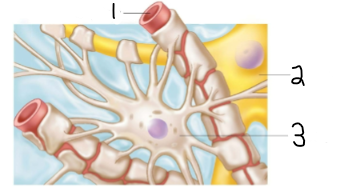
Astrocyte
Label “3”

Astrocytes
Most abundant, versatile, and highly branched of glial cells
neurons, synaptic endings, capillaries
Astrocytes cling to ____, ____, and ____
Which of the following is not a function of astrocytes?
Form myelin sheaths around axons in the CNS
Which of the following is not a function of astrocytes?
Line the ventricles of the brain and circulate cerebrospinal fluid
True
(T/F) Astrocytes participate in information processing in brain
CNS
Microglial cells are defensive cells in the ____
Oligodendrocytes
____ have processes that form myelin sheaths around CNS nerve fibers
neuroglia
Another name for glial cells
Neurons
Another name for nerve cells
Satellite cells
Surround neuron cell bodies in PNS, function similar to astrocytes of CNS
Schwann cells
Surround all peripheral nerve fibers and form myelin sheaths in thicker nerve fibers, similar function to oligodendrocytes
Neurolemmocytes
Another name for schwann cells
peripheral
Schwann cells are vital to regeneration of damaged ____ nerve fibers
Neurons
Structural units of the nervous system
Nerve cells
Another name for neurons
impulses
Neurons are large, highly specialized cells that conduct ____
Extreme longevity, amitotic, high metabolic rate
What are special characteristics of neurons?
cell
All neurons have a ____ body and one or more processes
perikaryon, soma
The neuron cell body is also called the ____ or ____
Neuron cell body
Biosynthetic center of the neuron
proteins, membranes, chemicals
What does the cell body synthesize?
Nissl bodies
Chromatophilic substance is also called ____
False;
The neuron cell body contains abundant rough ER
(T/F) The neuron cell body contains abundant smooth ER
⭐
plasma membrane
In most cell bodies, ____ is part of the receptive region that receives input from other neurons
CNS
Most neuron cell bodies are located in the ____
Nuclei
Clusters of neuron cell bodies in the CNS
Ganglia
Clusters of neuron cell bodies in the PNS
⭐
amitotic
Neurons are ____, meaning they don’t divide
⭐
Neuron processes
armlike processes that extend from cell body
CNS
____ (CNS/PNS) contains both neuron cell bodies and their processes
PNS
____ (CNS/PNS) contains chiefly neuron processes
Tracts
Bundles of neuron processes in the CNS
Nerves
Bundles of neuron processes in the PNS
Dendrites, axons
What are the two types of neuron processes?
Dendrite
Receptive (input) region of a neuron
Axon
Conducting region of a neuron
Dendrites
Label #1

Cell body
Label #2
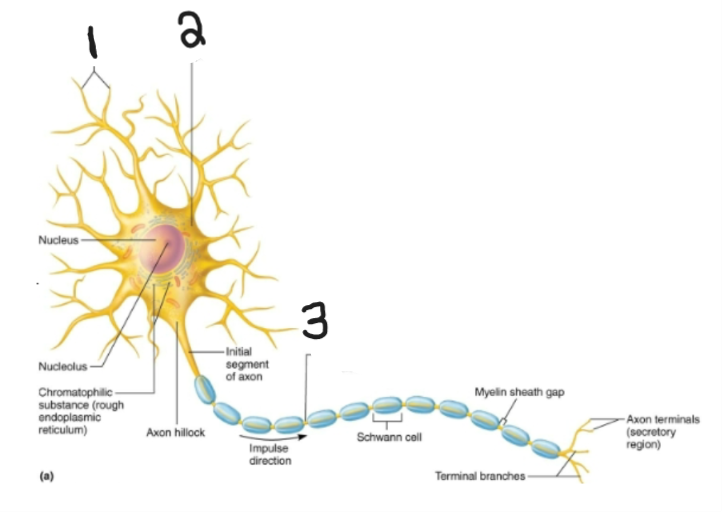
Axon
Label #3

True
(T/F) The nucleus of the cell body is located inside the CNS
False;
A ganglia is a collection of many neuron cell bodies; they are located outside the CNS
(T/F) Ganglia are located inside cell bodies
False;
They are located in the white matter of the CNS
(T/F) Axon tracts are located inside cell bodies
True
(T/F) Axon nerves are located outside the CNS
nerve fibers
Long axons are called ____
⭐
axon terminals or terminal boutons
Distal endings of axons are called
axolemma, axon terminal
The axon generates nerve impulses and transmits them along the ____ to the ____
(Axon) terminal
Region that secretes neurotransmitters, which are released into extracellular space
⭐
True
T/F: The axon terminal can excite or inhibit neurons it contacts
myelin
The myelin sheath is composed of ____, a whitish, protein-lipid substance
myelin
The function of ____ is to protect and electrically insulate the axon, to increase the speed of nerve impulse transmission
Myelinated fibers
Nerve fibers where a segmented sheath surrounds most long or large-diameter axons
Nonmyelinated fibers
Nerve fibers that do not contain a sheath
Nonmyelinated
____ fibers conduct nerve impulses more slowly
Schwann
Myelination in the PNS is formed by ____ cells
Multipolar, bipolar, unipolar
What are the types of structural classifications of neurons?
Multipolar
Neurons with three or more processes (1 axon, others dendrites) are ____
Bipolar
Neurons with two processes (one axon, one dendrite) are ____
Multipolar
Most common and major neuron type in the CNS
Retina, olfactory mucosa
Examples of where bipolar neurons are located
Sensory, motor, interneurons
What are the functional classifications of neurons?
Functional
____ classifications of neurons are based on the direction in which the nerve impulse travels relative to the CNS
Sensory
____ neurons transmit impulses from sensory receptors toward CNS
Motor
____ neurons carry impulses from the CNS to effectors
Interneurons
____ lie between motor and sensory neurons
Interneurons
Also called association neurons, they connect the sensory and motor neurons
⭐
resting membrane potential
Unlike most other cells, neurons can rapidly change their …
True
(T/F) Neurons are highly excitable
voltmeter
A ____ can measure potential (charge) difference across the membrane of a resting cell
70
Resting membrane potential of a resting neuron is approximately __ mV
negatively
The cytoplasmic side of a membrane is ____ charged relative to the outside
False;
The membrane of a neuron is polarized
(T/F) The membrane of a neuron is non-polarized
Action potentials
Principal way that neurons send signals