Sensations and Perceptions Exam 4
 Call Kai
 Learn
 Practice Test
 Spaced Repetition
 Match
 Flashcards
 Knowt Play
1/130

There's no tags or description
Looks like no tags are added yet.
131 Terms
Euclidian Geometry
As lines extend in space, parallel lines remain parallel
As objects move in space: Objects maintain same size
As lines extend in space
parallel lines remain parallel
as objects move in space
objects maintain same size
Binocular summation
combination of signals from each eye in ways that make performance on many tasks better with both eyes than with either eye alone
Binocular Summation means
the 3-D images from each retina are not the same
Binocular disparity
differences between the two retinal images of the same scene
Adult human eyes are 6cm apart
each retina gives a different view
Stereopsis
two images combined for depth information
Depth cue
Information about the third dimension of visual space (depth)
Monocular depth cue
Binocular depth cue
Monocular depth cue
cue that is available when the world is view with one eye
Binocular depth cue
cue that relies on info from both eyes
Frontal eyes
Predators have a wider visual field seen by both eyes, mostly just frontal vision, with little vision out to the sides seen by one eye each
More binocular, better depth perception
Lateral eyes
Prey have a very small visual field seen by both eyes, have close to 360 vision, seeing parallel and mostly behind them, except for a small blind spot. Vision out to the sides and behind them is monocular
more monocular
less depth perception, better awareness of surroundings
Types of Cues
Monocular cue
Triangulation cue
Binocular cue
Monocular Cues
Pictorial depth cue
Occlusion
Nonmetrical depth cue
Cast Shadows
Relative Size
Metrical depth cue
Relative Height
Metrical depth cue
Texture gradient
Familiar Size
Metrical depth cue
Aerial perspective (haze)
Linear perspective
Anamorphosis (anamorphic projection)
Triangulation Cues
Motion Parallax
Accommodation
Convergence
Divergence
Binocular Cues
Horopter
Vieth-Müller circle
Panum’s Fusional area
Diplopia
Crossed Disparity
Uncrossed Disparity
Stereoscope
Free fusion
Random dot sterereogram (RDS)
A stereogram made of a large number of randomly placed dots

Stereoblindness
inability to make use of binocular disparity as a depth cue
Can result from childhood visual disorders, such as strabismus, in which the two eyes are misaligned
Most people who are stereoblind do not even realize it
Binocular Vision Problems
Correspondence Problem
Correspondence Problem
In binocular vision, the problem of figuring out which bit of the image in the left eye should be matched with which bit in the right eye
Solutions for correspondence Problem
Uniqueness constraint
Continuity constraint
Uniqueness constraint
Observation that a feature in the world is represented only once in each retinal image
Continuity constraint
observation that, except at the edges of objects, neighboring points in the world lie at similar distances from the viewer
Stereopsis
Two images combined for depth information; the object is located at a different point than the fixation point, leading to eyes having two separate pictures of the object, creating depth perception (Both stereopsis)

C: Crossed disparity
B: Uncrossed disparity
Combining spatial cues lead to some very intresting
illusions
Stereoacuity
Measure of the smallest binocular disparity that can generate a sensation of depth
Dichoptic:
Critical period: period of time when organism is particularly susceptible to developmental change
2–4 months: Stereoscopic vision is very poor or not yet well developed.
Around 4–6 months: Stereoscopic acuity improves significantly.
Adulthood: Stereoscopic vision reaches and maintains a much higher level of acuity.
Strabismus
Misalignment of the two eyes such that a single object in space is imaged on the fovea of one eye and on a nonfoveal area of the other (turned) eye
Esotropia
Exotropia
Esotropia
one eye deviates inward
Exotropia
one eye deviates outward
dichoptic
Referring to the presentation of two stimuli, one to each eye.
Pictorial depth cue
cue (of distance or depth) used by artists to depict three-dimensional depth in two-dimensional pictures
monocular cues
Occlusion
A cue to relative depth order in which, for example, one object partially obstructs the view of another object
A Nonmetrical depth cue
monocular cues
Nonmetrical depth cue
A depth cue that provides information about the depth order (relative depth) but not depth magnitude
monocular cues
Occlusion
A cue to relative depth order in which, for example, one object partially obstructs the view of another object
monocular cues
Cast Shadows
a dark area on a surface that's created when an object blocks light from reaching it
monocular cues
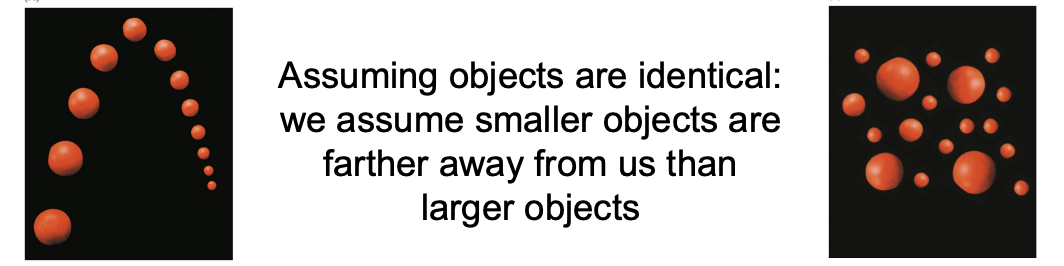
Relative Size
Comparison of size between items without knowing the absolute size of either one
A metrical depth cue
monocular cues
Metrical depth cue
a depth cue that provides quantitative info about distance in the third person
monocular cues
Relative Height
for objects touching the ground, those higher in the visual field appear to be farther away
A Metrical Depth cue
monocular cues
Texture gradient
depth cue based on the geometric fact that items of the same size form smaller, closer spaced images the farther away they get
monocular cues
Texture gradient does not work as well when _________
organized vertically
monocular cues
Texture gradient is very dependent on both __________ and ____________
relative size and relative height
monocular cues
Familiar Size
Cue based on knowledge of the typical size of objects
a metrical depth cue
monocular cues


A: What lets us know which ball is closer?
B: How far away are they?
A: Nonmetrical depth cue (relative position)
B: Metrical depth cue (Amount of distance. How far away is an object? How much distance separates two objects?)
monocular cues
Aerial Perspective (Haze)
depth cue based on the implicit understanding that light is scattered by the atmosphere
More light is scattered when we look through more atmosphere
More distant objects appear fainter, bluer, and less distinct
monocular cues
Linear perspective
Parallel lines in the 3D world will appear to converge in a 2D image as they extend into the distance
monocular cues
Vanishing point
point at which parallel lines receding in depth converge
monocular cues
Linear perspective
Parallel lines in the 3D world will appear to converge in a 2D image as they extend into the distance
monocular cues
Anamorphosis (anamorphic projection)
use of rules of linear perspective to create a 2D image so distorted that it looks correct when viewed from special angle or mirror that counters the distortion.
monocular cues
Motion Parallax
Images closer to the observer move faster across the visual field than images farther away
The brain uses info to calculate distances of objects in environment.
triangulation
Accommodation
process by which eye changes its focus (lens gets fatter as gaze is directed toward nearer objects)
triangulation
Convergence
ability of the two eyes to turn inward, often used to focus on nearer objects
triangulation

Divergence
ability of the two eyes to turn outward, often used to focus on farther objects
triangulation

Horopter
Location of objects whose images lie on the corresponding points
Objects on the horopter are seen as single images when viewed with both eyes
set of locations in space where objects appear to have the same depth as the point you're currently focusing on
Binocular

Vieth-Müller circle
Location of objects whose images fall on geometrically corresponding points in the two retinas
Binocular
Panum’s fusional area
Region of space, in front of and behind the horopter, within which binocular single vision is possible
Objects fall slightly outside corresponding retinal points, but your brain can still combine the two images into one.
binocular
Objects significantly closer to or farther away from the horopter fall on noncorresponding points in the two eyes and are seen as _________
two images (Outside the panum’s fusional area)
Diplopia
double vision
binocular
Crossed Disparity
Sign of disparity created by objects in front of the plane of the horopter
You're looking at a professor, but your finger is held up close to your face. Your finger has crossed disparity relative to the professor.
binocular

Uncrossed Disparity
sign of disparity created by objects behind the plane of the horopter
You're looking at your finger, but there's a tree in the distance behind it. The tree has uncrossed disparity relative to your finger.
binocular

Stereoscope
A device for presenting one image to one eye and another image to the other eye
The binoculars with the flip-up film
binocular
Free fusion
technique of converging (crossing) or diverging (uncrossing) the eyes to view a stereogram without a stereoscope
binocular
Attention
Any of the very large set of selective processes in the brain
nervous system has evolved mechanisms that are able to restrict processing to a subset of things, places, ideas, or moments in time
Selective attention
form of attention involved when processing is restricted to a subset of the possible stimuli
Types of attention
External
Internal
Overt
Covert
Divided
Sustained
External Attention
attending to stimuli in the word
Internal Attention
Attending to one line of thought over another or selecting one response over another
Overt Attention
Directing a sense organ toward a stimulus like turning your eyes or your head
Covert attention
Attending without giving an outward sign you are doing so
Divided attention
splitting attention between two different stimuli
Sustained attention
continuously monitoring some stimulus
Reaction time (RT)
measure of the time from the onset of a stimulus to a response
Cue
A stimulus that might indicate where (or what) a subsequent stimulus will be
Inhibition of return (IOR)
relative difficulty in getting attention (or eyes) to move back to a recently attended (or fixated) location
Theories of attention
spotlight model
Zoom lens model
Spotlight model
Attention is restricted in space and moves from one point to the next
Zoom lens model
Attended region can grow or shrink depending on the size of the area to be processed
Visual Search
Looking for a target in a display containing distracting elements
Target
goal of a visual search
Distractor
in visual search, any stimulus other than target
Set size
the number of items in a visual search display
Featured search
search for target defined by a single attribute (Very efficient)
Salience
vividness of a stimulus relative to its neighbors (Very efficient)
Parallel
referring to the processing of multiple stimuli at the same time (Very efficient)
Serial self-terminating search
search from item to item, ending when a target is found (Not efficient)
Guided search
Attention is restricted to a subset of possible items based on information about the item’s basic features (e.g., color or shape)
Conjunction search
Search for a target defined by the presence of two or more attributes
Scene-based guidance
Information in our understanding of scenes that helps us find specific objects in scenes
Binding Problem
challenge of tying different attributes of visual stimuli, which are handled by different brain circuits, to the appropriate object so we perceive a unified object
Illusory Conjunction
erroneous combination of two features in a visual scene
Rapid serial visual presentation (RSVP)
experimental procedure in which stimuli appear in a stream at one location (typically the point of fixation) at a rapid rate (typically about 8 per second)
Attentional blink
difficulty in perceiving and responding to the 2nd of two target stimuli amid an RSVP stream of distracting stimuli
2nd target usually missed if appears ~200-500 ms after 1st target
Green and Bavelier (2003): (attentional blink)
reported that people who play first-person shooter video games have a reduced (better) attentional blink
This suggests that visual attention performance can be improved with practice!
Visual-field defect
portion of the visual field with no vision or with abnormal vision, typically resulting from damage to visual nervous system.
Parietal lobe damage
damage to the parietal lobe can cause a visual field defect such that one side of world is not attended to
Extinction
In visual attention, the inability to perceive a stimulus to one side of the point of fixation (e.g., to the right) in presence of another stimulus, typically in a comparable position in other visual field (e.g., on the left side)
Neglect
In visual attention, the inability to attend to or respond to stimuli in the contralesional visual field
can also be object based
ADHD is not a disorder of
visual attention
Attention Deficit Hyperactivity Disorder (ADHD)
neurodevelopmental disorder characterized by impulsivity, hyperactivity, and inattention
Visual attention is normal
Selective pathway
permits recognition of one or very few objects at a time
Nonselective pathway
contributes information about the distribution of features across a scene and information about “gist” of the scene