M1 Mackay- Population genetics I: Population structure
 Call Kai
 Learn
 Practice Test
 Spaced Repetition
 Match
 Flashcards
 Knowt Play
1/11

There's no tags or description
Looks like no tags are added yet.
12 Terms
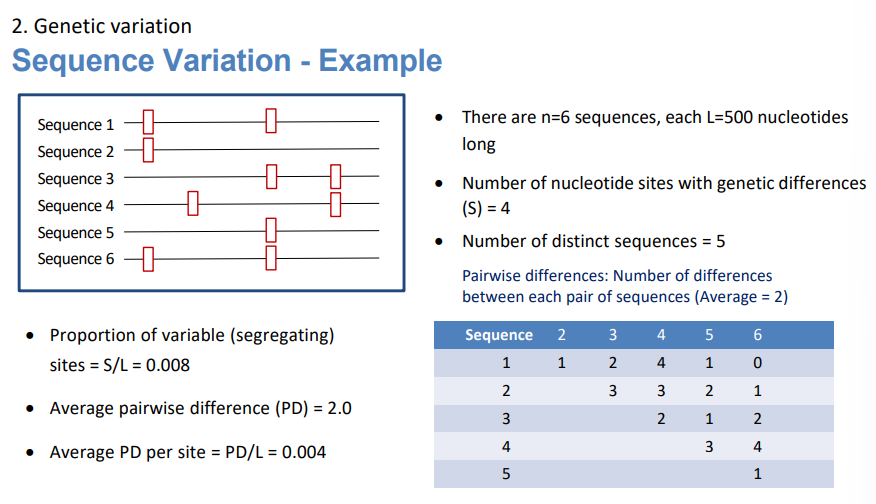
what calculations can we use to assess sequence variation at single nucleotide polymorphisms?
proportion of variable sites (number of polymorphic sites/total number of bases)
pairwise differences (PD) between each pair of sequences
average pairwise difference
average pairwise difference per site (PD/total number of bases)
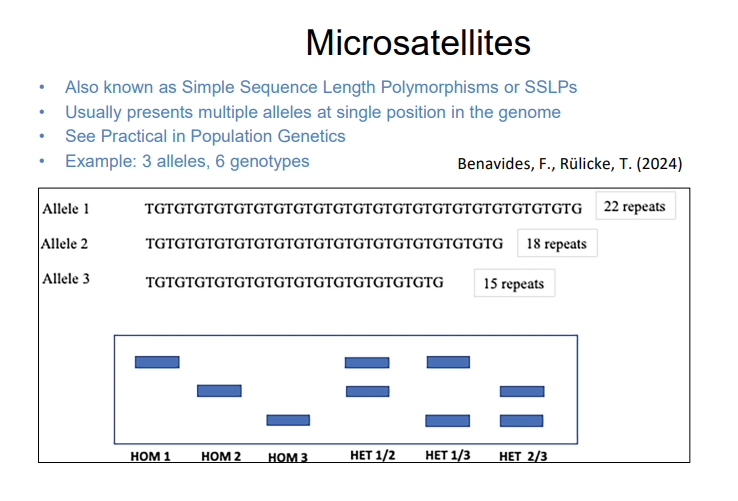
what are microsatellites?
small insertions of simple sequence length polymorphisms (SSLPs), often repeated many times for variable amounts
what is heterozygosity and average heterozygosity and how do we calculate them?
h is calculated as 1 minus the sum of each of the squared allele frequencies

what is the hardy-weinberg principle and what are its assumptions?
in the absence of evolutionary forces (null model), the genotype frequencies are in equilibrium, and will be reached after only one generation of random mating
if genotype frequencies change from those predicted, then at least one evolutionary force is acting (if there is significant F, the departure of observed heterozygosity from expected heterozygosity → F = 1 - (H0/HE))

what evolutionary forces act on population genetics at different levels? how do they affect allele frequencies + heterozygosity?
molecular level:
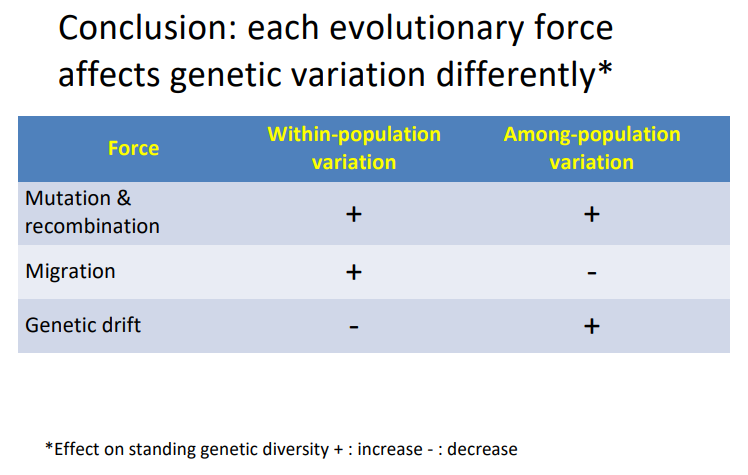
mutations- rare but are the driving force of diversity
recombination- transmission of genes on the same chromosome is not independent (linkage disequilibrium) but is reduced in populations due to recombination producing novel gametes (or gets preserved by selective sweeps)- doesn’t affect allele frequencies but increases heterozygosity
population level:
non-random mating- does not affect allele frequencies but decreases heterozygosity
inbreeding- individuals mate with relatives more often than chance → inbreeding depression due to increasing homozygosity in recessive deleterious alleles reduces fitness
positive assortative mating- individuals mate based on having similar phenotypes
random genetic drift- changes allele frequencies and decreases heterozygosity due to chance alone, strongest in small populations and hence often after a bottleneck → founder effects (increasing homozygosity of recessive deleterious alleles)
migration (gene inflow/outflow)- increases diversity within sub-populations but decreases diversity between them
natural selection/adaptation- selection acting on the whole organism, specifically on phenotypes that are associated with fitness (different kinds/directions have different effects on the population)
what is the fixation index and how is it calculated?
the fixation index (FST) is a measure of how much migration has caused differences in genetic diversity between populations vs within them
ie. an FST of 1 indicates no migration, so the populations are completely diverged (low heterozygosity in each population)
ie. an FST of 0 indicates frequent migration, so the populations are highly similar (high heterozygosity in each population)
HT is the total heterozygosity pooled across all populations
HS is the heterozygosity averaged across each population
FST = (HT - HS)/HT

what is the effective population size?
the effective population size, Ne, accounts for the fact that not all individuals within a population have an equal propensity to reproduce
this means it is almost always smaller than the census (real) population size, N
effectively, the population that evolutionary forces are acting on is smaller than the actual population size

what are the different kinds of selection in single and multi locus models? how is fitness expressed?
eg. of balancing selection- with sickle cell anaemia, the homozygous recessives suffer from anaemia but heterozygotes are protected against malaria
two additional kinds:
frequency dependent selection (fitness is high when the allele is rare, and low when the allele is common)
fluctuation selection (fitness changes dependent on a rapidly + constantly changing environmental factor) also maintain genetic variation

how can the change in allele frequency be quantified in haploids?
s is the selection coefficient, the fitness of an allele relative to a reference allele (with a fitness of 1)
if s = 0.3, an allele has 30% greater fitness than a reference allele
if s = -0.6, an allele has 60% lower fitness than a reference allele
therefore q increases when s is positive and decreases when s is negative, the rate of change being proportional to the magnitude of s

how can the change in allele frequency be quantified in diploids?
s is the selection coefficient, the fitness of an allele relative to a reference allele (with a fitness of 1)
if s = 0.3, an allele has 30% greater fitness than a reference allele
if s = -0.6, an allele has 60% lower fitness than a reference allele

how do allele frequencies change in single-locus models depending on the degree of dominance?

what is neutral evolution theory?
