SOME TINGS ARE BOUND TO BEEE
 Call Kai
 Learn
Learn Practice Test
 Spaced Repetition
 Match
Match Flashcards
 Knowt Play
1/152

There's no tags or description
Looks like no tags are added yet.
Name | Mastery | Learn | Test | Matching | Spaced | Call with Kai | Chat |
|---|
No analytics yet
Send a link to your students to track their progress
153 Terms
What is a population?
The group of people or things you’re interested
What is an example of unit of analysis?
If your population is SB students, the student is your unit of analysis (not SB as a school but the individual students).
If your population is NFL games, the _______ is your unit of analysis
game
What are cases?
Each concrete single unit of your population
What is an example of a case?
If your population is SB students, each concrete student that you may study is one of your cases.
If your population is NFL games, _______ that you study is a case
each INDIVIDUAL game
What is the difference between a case and a unit of analysis?
case= EACH specific entity being analyzed
unit of analysis= the entity in general
What is a sample?
the subset of cases within your population for which you have information.
What is a variable?
anything that has a quantity or quality that varies
What is an example of a variable?
height, weight, number of siblings, favorite song, etc (within a population/sample)
What are QUANTITATIVE variables?
NUMERICAL VALUES!!!
(age, income, how many cups of coffee you have in the morning)
What are QUALITATIVE variables?
WORDS AS VALUES!!!
(religion, where you are from, favorite pizza topping)
What are the formats of datasets?
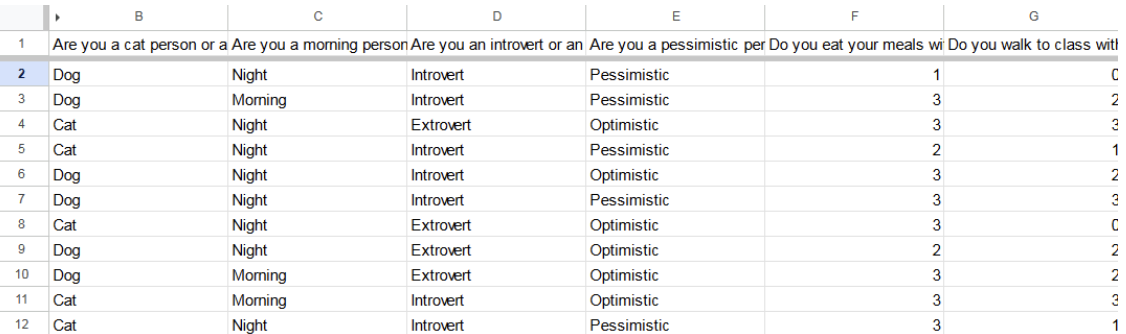
spreadsheets
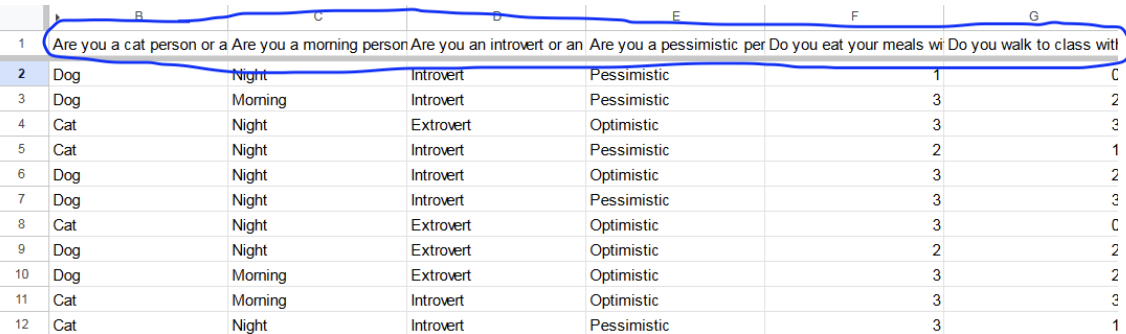
Cases are rows
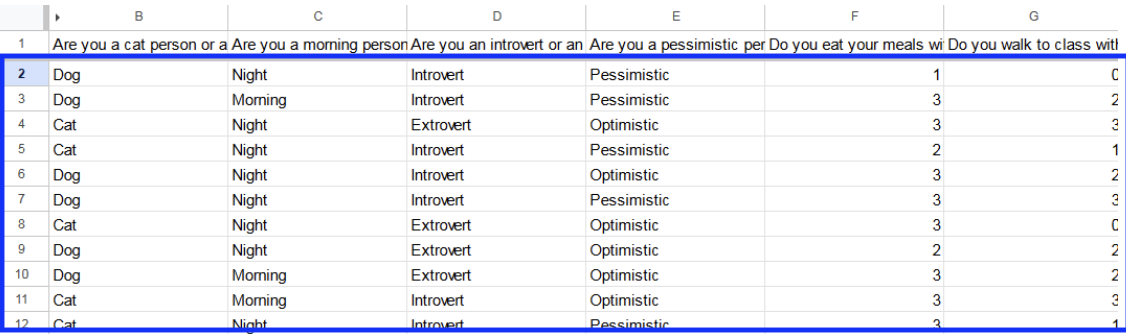
Columns are variables
In a dataset spreadsheet, cases are _________?
rows
In a dataset spreadsheet, variables are
columns
What is a visual example of a spreadsheet?
What is a visual example of a variable in a spreadsheet?
What is a visual example of a case in a spreadsheet?
What is a codebook?
a text document (MS Word or PDF) listing the variables (questions) and the options that respondents could choose from.
What is conceptualization (of variables)?
defining the variables
What are examples of conceptualizations?
Dimensions
Indicators
Definition
In terms of a variable, what is a dimension?
different aspects or sides
What are examples of a dimension?
different causes
types of symptoms
coping mechanisms
In terms of a variable, what is an indicator?
simple measures “indicating” the absence/presence or frequency of something that may be revealing.
What is an example of an indicator?
If our focus in on schoolwork-related stress, an
indicator could be how often the student worries about schoolwork.
If our focus is on symptoms,
an indicator could be whether the __________
student is able to sleep restfully
Based on the dimension and indicator that we decide to single out, we can go ahead and ________ the concept
define
Stress, for instance, could be defined as _______________
worrying about schoolwork on a
regular basisby one its symptoms (as anxiety-induced loss of sleep)
What is operationalization (of variables)?
how exactly to measure or observe the variable in the real world.
The way researchers usually employ operationalization is through ___________
questions
Questions can either be ____________ or____________
open or closed
An open question is when the respondent can __________
answer any way they want
A closed question is when the respondent ____________
choose from a list of options
What are attributes/categories?
the options respondents choose from (within a closed question format)
What are some examples of attributes/ categories (within a closed question format)
If the variable is religion: (Muslim, Christian, Catholic, etc.)
If I write a question that
asks people to rank their preferences from “Strongly Agree” to “Strongly Disagree,” the
attributes may be __________________
1) Strongly Agree
2) Agree
3) Neutral
4)Disagree
5) Strongly Disagree
The TWO REQUIREMENTS of an attribute are:
1) They must be EXHAUSTIVE
2) They must be mutually exclusive
When an attribute is EXHAUSTIVE, it means that ________________
meaning that all possible answers are covered by the attributes—that’s why it’s common to include “Other” as an option
When an attribute is MUTUALLY EXCLUSIVE, it means that ________________
here’s no overlap between attributes: they need to exclude each other
What is measurement level?
One of the main decisions we make in operationalizing our variables is whether we’ll collect
quantitative data or qualitative data
Measurement level focuses on ________________ variables
continuous and categorical
What is a CONTINUOUS variable?
Variables that measure quantities
What is an example of a continuous variable?
age, income, blood pressure, number of siblings, hours worked per week, GPA
(NUMERICAL VALUES!!!)
What is an example of a categorical variable?
gender, race, religion, place of birth, favorite color, and any yes/no questions
(WORDS!!!!)
What are 2 types of categorical variables?
NOMINAL and ORDINAL.
What are examples of questions asked for nominal variables?
“Are you an athlete?” or “What’s your favorite
pizza topping?”
(NO PARTICULAR ORDER!!!!!)
What are examples of questions asked for ordinal variables?
“What is your school year”? or questions that ask strongly agree all the way
to strongly disagree
(YOU CAN ORDER THE ANSWERS FROM LOW TO HIGH (AND VICE VERSA)!!!!!)
What kind of variable is GENDER?
It’s a nominal variable
What kind of variable is RELIGION?
It’s a nominal variable
What kind of variable is RACE?
It’s a nominal variable
What kind of variable is AGE?
It’s a continuous variable
What kind of variable is EDUCATION? (number of years in school)
It’s a continuous variable
What kind of variable is EDUCATION? (highest level of education achieved)
It’s an ordinal variable
What kind of variable is PLACE OF BIRTH?
It’s a nominal variable
What kind of variable is ZIPCODE? (!!!!)
It’s a nominal variable
What kind of variable is INCOME?
It’s a continuous variable
What kind of variable is MURDER? (like how many murders were committed?)
It’s a continuous variable
What kind of variable is SCHOOL YEAR?
It’s an ordinal variable
What kind of variable is “FROM 1-5: HOW LIKELY ARE YOU TO VOTE?”
It’s an ordinal variable
Continuous variables offer ________ precise data than categorical variables.
more
What is an index?
a variable that results from combining other variables
(asking several questions and combining the answers)
What is a questionnaire?
The list of questions that you will use to create your survey form.
A typical questionnaire is likely to include both ________________
Demographic and Behavioral/attitudinal questions
In a questionaire, both question types are acceptable but __________ is preferred
closed
In deciding how to write our questions we need to pay attention to each question’s
________________ ; (whether we want it to be nominal, ordinal, or continuous)
measurement level
What are demographic questions ?
questions that gather information about the respondent's personal
characteristics
What are some examples of personal characteristics being evaluated in a demographic question ?
age, gender, race, ethnicity, education level, income, marital status, and
location
For the population you are studying, you will adjust questions. For instance, if your population is college students, you will ___________
not be interested in education level, since you know that everyone is at the same level
Why do we ask demographic questions?
Because these basic characteristics about who we are or
where we live—even when they are not necessarily connected to our topic—may still make a
difference for the behaviors or attitudes we want to understand
It is common to ask the demographic questions at the _______ of the survey.
end
(we don’t want these questions to influence how people answer your other
questions!!!)
What are behavioral/attitudinal questions?
questions about things people do/don’t do, like/don’t
like, believe in/don’t believe in, etcetera.
What are some examples of behavioral/attitudinal questions?
how often you attend church
whether you voted in the last election
how much you enjoy meeting new people.
Demographic questions are used to ________________
describe the group in a general sense
Behavioral/attitudinal questions are used to ___________
explore the specific topic we want to study
What is the advantage of open questions?
people may say things that we don’t expect (unique answers)
What is the disadvantage of open questions?
difficult to organize
What is an example of a continuous question that ALSO works as closed question?
“:How many pets do you have?”
(easy to organize)
What helps make an attribute exhaustive?
Adding OTHER as an option
For closed questions, you need to write the ___________ and the _________
the question and the attributes (options)
You can always turn a continuous data into ordinal or nominal data, BUT __________
NOT THE OTHER WAY AROUND!!!!!
More detail in a survery can lead to _______ accuracy
LESS
You need to decide what type of data to collect (nominal, ordinal, or continuous) based on ______________
what you want to know
The ideal question accomplishes three goals:
• It measures the underlying concept it is intended to tap
• It doesn’t measure other concepts
• It means the same thing to all respondents
The following rules to accomplish the ideal questions are:
Avoid vague terms
Define things very specifically
Avoid complex sentences
Provide reference frames
Avoid double barreled questions
What is an example of a double-barreled question?
“Do you think that SB classes should be easier and more interesting?”
What is univariate analysis?
looking at one variable at a time
What is a frequency distribution?
it’s a way of looking at what answers are more or less frequent.
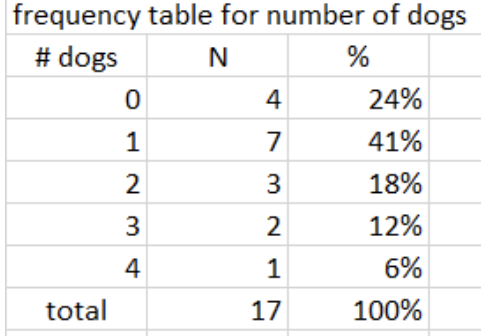
What is a frequency table?
It shows the answers and how many people
choose each of them, expressed both as total
number of cases (we call this N—for number of
cases) and as a percentage of the total number of
cases.
(represents the distribution for nominal
variables
What is a histogram?
another common way to represent a distribution
(represents the distribution for a continuous variable!!!!)
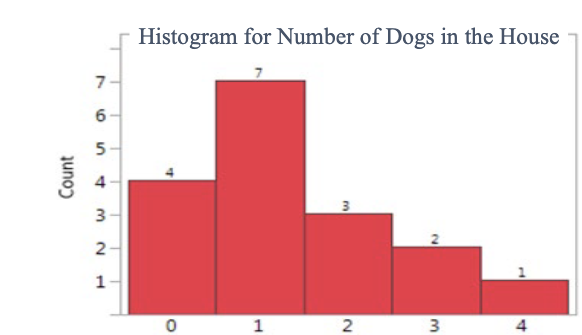
____________________ are used to represent the distribution for a continuous variable
histograms
________________ are used to represent the distribution for a nominal variable
frequency tables
In terms of distribution, ordinal terms can be represented in both __________ and ______________
frequency tables and histograms
What is a normal distribution (BELL CURVE)?
The kind of distribution where most cases are in
the middle.
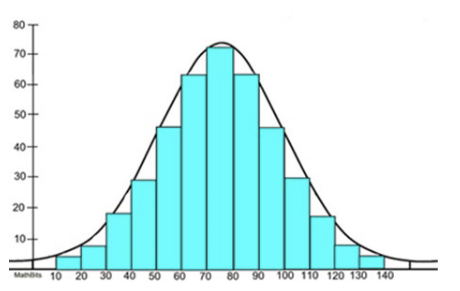
Most distributions in real life are not “normal”, However, one example of a variable that would have a “normal” distribution would be ______________?
height
( as most people tend to be of “average” height,)
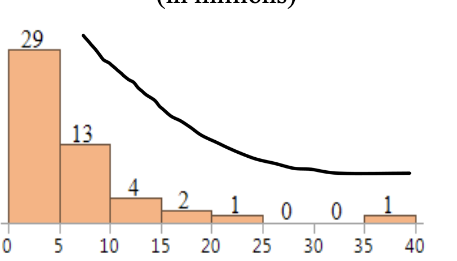
What is a positively skewed distribution?
when most cases are on the lower end—but then
there are some relatively few cases on the very high end.
(“skew” the distribution to the right)
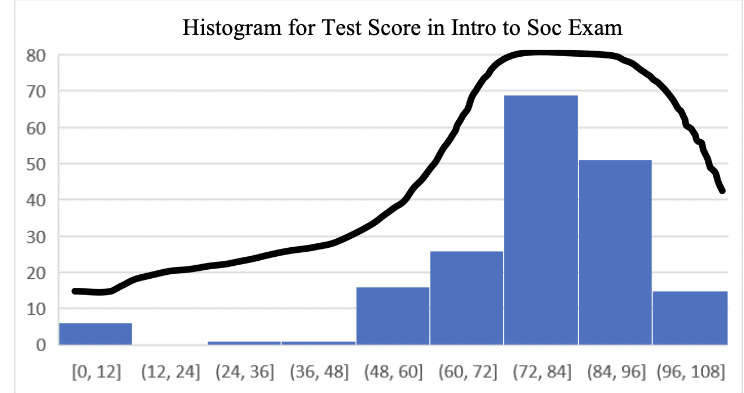
What is a negatively skewed distribution?
when most cases are on the high end of the distribution, but there are some relatively few
much lower cases on the left side
( low cases (“outliers”) skew the distribution to
the left )
Positively skewed distribution is skewed to the _______
right
Negatively skewed distribution is skewed to the _______
left
What is a bimodel/multimodal distribution?
the type of distributions where cases are concentrated not in one area but in two (bimodal distribution) or more (multimodal distribution)
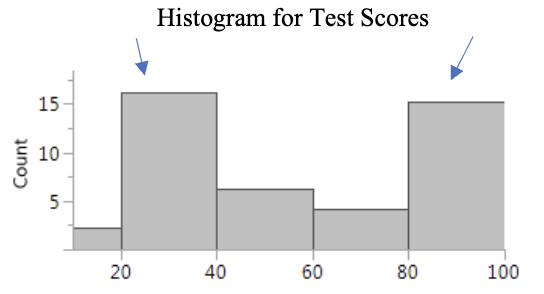
An example of a bimodal/multimodal distribution?
traffic; It tends to be higher at rush hour, both
in the morning (when people go to work) and afternoon (when people come back home).