MSK UE
 Call Kai
 Learn
Learn Practice Test
 Spaced Repetition
 Match
Match Flashcards
 Knowt Play
1/70

There's no tags or description
Looks like no tags are added yet.
Name | Mastery | Learn | Test | Matching | Spaced | Call with Kai | Chat |
|---|
No analytics yet
Send a link to your students to track their progress
71 Terms
Neurological Thoracic Outlet Syndrome
Most common
C8-T1 paresthesia, numbness, weak grip and loss of manual dexterity
Arterial Thoracic Outlet Syndrome
Pulselessness, poor endurance, pallor, cold extremities
Venous Thoracic Outlet Syndrome
Edema, warm, cyanosis, swelling, mottled appearance
Thoracic Outlet Syndrome
Compression of neurovascular bundle- brachial plexus, subclavian artery and vein, phrenic nerve in the thoracic outlet at 3 sites
TOS Interscalene Triangle
Special test: Adson’s Maneuver
Intervention: Stretch the scalene muscles
TOS Costoclavicular Space
Special test: Costoclavicular test/ Military Brace Test
Intervention: Mobilization of the first rib
TOS Axillary Interval (Pec Minor space)
Special test: Wright Test/ Roos Test/ Allen Test
Intervention: Stretch the pectoralis minor
Coracoacromial is the key site of what pathology?
Superior Labrum Anterior Posterior (SLAP) lesion is superior labrum tearing or pulling away by the biceps insertion, which is under the subacromial arch
SLAP Lesion Repair
When biceps tendon is detached, progress cautiously
Limit passive or assisted elevation of UE to 60 deg for 2 weeks and limit to 90deg at 3-4 weeks
Only perform passive humeral rotation with shoulder in scapular plane for first 2 weeks
Progress to 30 deg ER and 60 IR at 3-4 weeks
Avoid tension on the biceps ( elbow extension with shoulder extension) for the first 4-6 weeks
No active biceps contraction for 6 weeks
Rotator Cuff Rehabilitation
Initiate with isometrics
Resisted exercises should NOT cause pain
Rotator cuff strength must be addressed before large primary movers
AROM for shoulder flexion and abduction must be done without shoulder hiking
Dynamic strengthening may begin at 8 weeks for small tear and 12 weeks for a large tear
Light functional activities for 6+ weeks
TMJ Hypomobility
Decreased mouth opening and deviation to same side
TMJ Hypermobility
Increased mouth opening and deviation to opposite side
Disc displacement with reduction
Clicking heard. No deviation, no difficulty with mouth opening
Synovitis
Pain and limited mouth opening, no deviation
Capsulitis
Pain, limited mouth opening and deviation to same side
Opening of mouth (depression of mandible)
Normal ROM: 35-55 mm
Lateral Pterygoid
Can’t say L without opening your mouth
Closing of Mouth (Elevation of mandible)
Temporalis, Masseter, Medial pterygoid
Can’t close your mouth without M
Protrusion of Mandible
ROM: 7 mm
Medial and lateral pterygoid
Retraction of mandible
ROM: 3-4 mm
Temporalis-posterior fibers
Lateral deviation of mandible
Lateral pterygoid (contralateral)
Medial pterygoid (contralateral)
Cubital Tunnel Syndrome
Ulnar nerve entrapment between 2 heads of FCU
MOI: Prolonged elbow flexion, fractures, spurs, arthritis
Sensory (first): Pain/sensory at 4th/5th digits (dorsal and palmar): hypothenar
Motor symptoms: weakness in FDP 3/4, hypothenar muscles, ulnar, interossei, adductor pollicis
Test: Symptoms worse with elbow flexion test, positive froment’s (FPL substitutes for weak adduct pollicis), wartenberg sign, positive tinel at elbow
Guyon’s Canal Syndrome
Ulnar nerve entrapment between hook of hamate and transverse carpal ligament
MOI: history of heavy gripping, twisting, activities involving pressure (bicycling)
Motor: weakness in hypothenar muscles, ulnar interossei, adductor pollicis. NO FDP
Sensory: Pain/sensory symptoms at 4th/5th digits (ONLY Palmer), hypothenar
Tests: Froment’s, Wartenberg sign, Tinel’s sign positive wrist
Boutonniere Deformity
Extension of MCP and DIP joint and flexion of PIP joint (primary deformity)
This deformity is the results of a rupture of the central tendinous slip of the extensor hood and is most common after trauma or in RA
Swan Neck Deformity
Extension of PIP, flexion of MCP and DIP
Due to contracture of intrinsic muscles or tearing of Volar plate (common in RA)
Mallet finger
Due to rupture or avulsion of the extensor tendon at distal phalanx of finger, distal phalanx rest in flexed position
Always traumatic
Tx: splint with a finger extension splint for 6-8 weeks
De Quervain’s Tenosynovitis
Tenderness over lateral wrist and thumb
Abductor pollicis longus and extensor pollicis brevis are muscles affection
Severe pain with wrist ulnar deviation and thumb flexion and adduction
Special test; Finkelstein Test
Carpal Tunnel Syndrome
Tingling/numbness in the median nerve distribution of hand
Repetitive activities and sustained positioning of wrist aggravates pain
Thenar muscle atrophy in later stages
Night pain
Special test: Phalen’s and reverse phalens, tinel sign
Colles Fracture
Dorsal displacement of the distal fragment of radius
Due to FOOSH injury
Leads to dinner fork deformity
Smith Fracture
Volar displacement of distal fragments of radius
Due to fall on flexed wrist
Leads to garden spade deformity
Lateral Epicondylitis
Lateral aspect of elbow pain
Extensor carpi radialis brevis involved-activities involving repeated wrist extension/grasping increases pain (gradual overuse)
Special test: Cozen’s, Mills, Maudsley test
Tx: Offload to reduce pain and gradual progressive strengthening of wrist extensors
Medial Epicondylitis
Anteromedial aspect of elbow pain
Pronator teres+flexor carpi radialis involved-activities involving repeated wrist flexion increased pain (gradual overuse)
Special test: Medial Epicondylitis test
Treatment: offload to reduce pain and gradual progressive strengthening of wrist flexors
Nursemaid’s Elbow
Age: 2-3 yrs
Longitudinal traction on an extended elbow partial slippage of Annular ligament over the head of radius
Position of arm-arm at side with hand pronated, radial nerve can get injured
Tx: Manipulation
Adhesive Capsulitis Stage 1
0-3 months
Mild signs and symptoms-achy at rest and sharp at extremes of ROM
Capsular pattern-loss of ER and ABD is present
Synovitis more than contracture of capsule
Adhesive Capsulitis Stage 2
Freezing/Painful stage
2-9 months with progressive loss of ROM and persistence of pain
The motion loss in stage 2 reflects a loss of capsular volume and response to the painful synovitis
Loss of motion in all planes, as well as pain in most of the range
Adhesive Capsulitis Stage 3
Frozen Stage
9-15 months
Painful stiffening of the shoulder and a significant loss of ROM
Pain only with movements
Atrophy of rotator cuff muscles, deltoid, biceps, triceps
Poor scapulohumeral rhythm with scapular hike
Loss of axillary fold and ROM with capsular restriction
Adhesive Capsulitis Stage 4
Thawing phase
Pain lessens but stiffness persists
Slow and steady recovery
Best Treatments for Adhesive capsulitis
Corticosteroid injection by MD + PT stretching determined by patient irritability
Joint mob-posterior and inferior glide
Subacromial Impingement
Anterior/lateral shoulder pain
Pain at night
Painful arc 60-120 deg
Special test: Neer, Hawkins, Yocum, Empty can/Jobe
Rotator Cuff
Age: >40 (overuse cases) or traumatic
Anterior/posterior/superior should pain with loss of strength
Pain that wakes the during sleep, worse at night
Weakness and atrophy
Special test: ER lag sign, drop arm, Hornblower’s sign, IR lag sign, lift off sign, belly press, bear hug
SLAP-Labrum tear
Traumatic sudden onset
Deep anterior shoulder pain
Clicking/clunking/joint locking, pain with throwing or biceps loading (shoulder flexion and arm supination)
Special test: O’Brien test, biceps load, clunk test
AC joint injury
Trauma that displaces the shoulder girdle inferiorly or heavy weighting
Pain at top of the shoulder
Painful arc (170-180 deg) and pain with horizontal adduction
Step deformity
Special test: Horizontal adduction, Paxinos sign, AC sheer test
Bicipital Tendinitis
Age: 20-45 yrs
Pain with overhead movements
Pain with full extension to flexion. Active LR is limited when arm is at 90deg abduction
Special test: Speed’s test, Yeargason’s test
Median nerve: Hand LOAF
L: lateral 2 lumbricals
O: Opponens policis
A: Abudctor policis brevis
F: Flexor pollicis brevis
Median nerve: Superior layer
Pronator teres, FCR, palmaris longus
Median nerve: intermediate layer
FDS
Median nerve: Deep layer or AIN
FPL, FDP (lateral 2) PQ
Ulnar nerve: Superficial layer
FCU
Ulnar nerve: Deep layer
FDP (medial 2)
Ulnar nerve: Hypothenar AI LOAF
A: Adductor pollucis
I: Interossei PAD/DAB
L: medial 2 lumbricals
O: opposite digiti mini
A: Abductor digi mini
F: flexor dig mini
MOI: over use, between 2 heads of pronator teres
Pronator teres syndrome
What are the positive tests for pronator teres syndrome?
Positive pronator teres test
Positive ULTT
Positive tinels forearm
How do you treat pronator teres syndrome?
Off load and activity modification
What aggravates pronator teres syndrome and what are the symptoms?
Pain, weakness and heaviness
Aggravates: resisted pronation, passive stretching into supination
NO NIGHT PAIN
Is sensory impacted in Pronator teres syndrome?
Entire sensory distribution, thenar, lateral 3 ½ palmar and dorsal tips
MOI: Overuse, fluid retention, wrist flexion pain, under the transverse carpal lig-compression
Carpal tunnel syndrome
What muscles are affected in carpal tunnel syndrome?
L Lateral 2 lumbricals
O Opponens pollicis
A Abductor pollicis brevis
F flexor pollicis brevis
Is sensory affected in carpal tunnel?
Thenar sensory is not affected! Rest of it is affected, palmar cutaneous branch does not cross the carpa tunnels
What are carpal tunnel tests?
Phalen, Reverse phalens, Tinel wrist, ULTT
Cardinal symptoms of carpal tunnel syndrome
Flicks maneuver, shaking hand relieves pain, NIGHT PAIN
MOI: fracture of elbow, supracondylar fracture and elbow dislocation
AIN syndrome
Is sensory affected in AIN syndrome?
NO
What motor is affected in AIN syndrome?
FPL, 2 FDP, PQ
What is the Kiloh nevin sign for?
AIN syndrome, they cannot make the O.K sign
What causes Ape hand Colles fracture?
Median nerve lesion, thenar atrophy no opposition...can’t touch the pinky

What is this called and what nerve is affected?
Median Nerve
Hand of Benediction
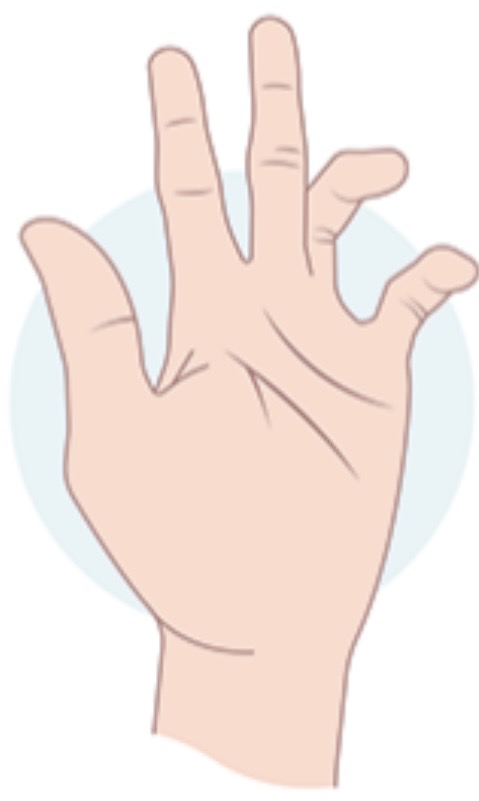
What condition is this called and what nerve is affected?
Claw hand
Ulnar nerve

Wrist Drop
Radial nerve
What does Extensor carpi radialis brevis do?
Wrist extension, radial deviation and grip stabilization
What condition is ECRB involved in?
Lateral epicondylitis, tennis elbow
What is the muscle that causes cubital syndrome?
FCU