ANP Ch 1
 Call Kai
 Learn
Learn Practice Test
 Spaced Repetition
 Match
Match Flashcards
 Knowt Play
1/227

There's no tags or description
Looks like no tags are added yet.
Name | Mastery | Learn | Test | Matching | Spaced | Call with Kai | Chat |
|---|
No analytics yet
Send a link to your students to track their progress
228 Terms
[Foundations] What is anatomy?
The study of the form and structure of body parts and their relationship to one another.
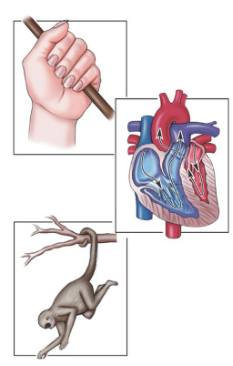
[Foundations] What is physiology?
The study of the function of body parts—how they work to carry out life-sustaining activities.
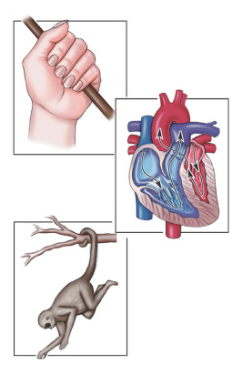
[Anatomy] What is gross (macroscopic) anatomy?
The study of large, visible structures.

[Anatomy] What is regional anatomy?
The study of all structures in a particular area of the body.

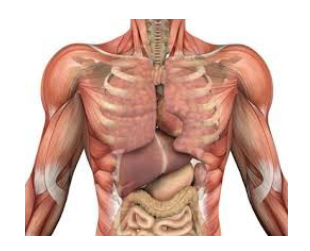
[Anatomy] What is system anatomy?
The study of one organ system, such as the cardiovascular, nervous, or muscular system.
[Anatomy] What is microscopic anatomy?
The study of structures too small to be seen with the naked eye.

[Anatomy] What is cytology?
The microscopic study of cells.

[Anatomy] What is histology?
The microscopic study of tissues.

[Physiology] How is physiology commonly organized?
By organ systems, such as muscular system physiology.
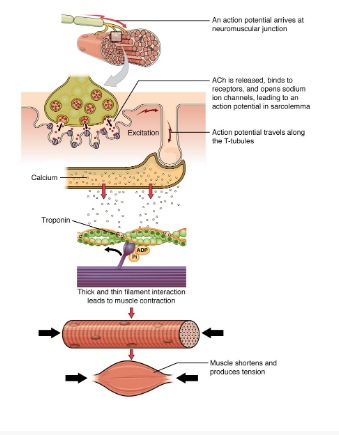
[Physiology] At what levels does physiology often focus?
The cellular and molecular levels of the body.

[Physiology] What does physiology examine about body abilities?
How the body's abilities depend on chemical reactions in individual cells.

[Structure & Function] What is the principle of complementarity of structure and function?
Anatomy and physiology are inseparable; function reflects structure.

[Structure & Function] What is the key idea behind complementarity?
The form or structure of a body part helps determine what it can do.
[Review] What is the study of the body's structure?
Anatomy.
[Review] When anatomy is closely tied to a body part's specific function, what principle is this?
The principle of complementarity of structure and function.
[Structural Organization] What is the order of structural organization from simplest to most complex?
Chemical → cellular → tissue → organ → organ system → organismal.
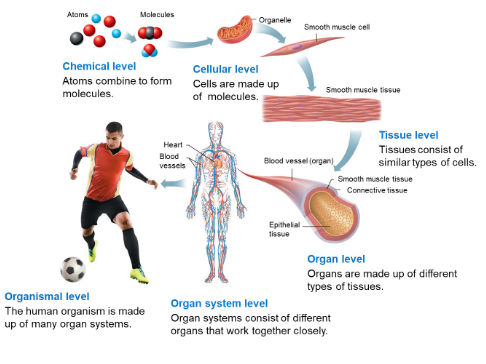
[Structural Organization] What happens at the chemical level?
Atoms combine to form molecules.

[Structural Organization] What happens at the cellular level?
Cells are made up of molecules.
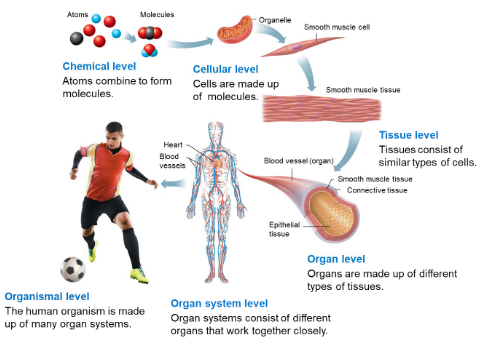
[Structural Organization] What happens at the tissue level?
Tissues consist of similar types of cells.
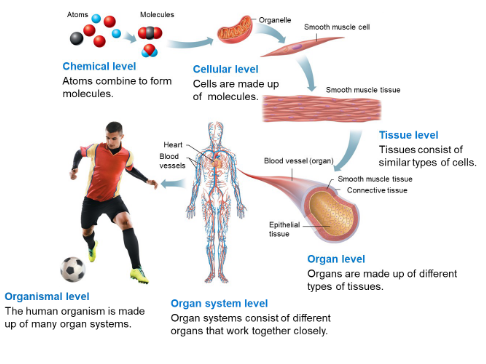
[Structural Organization] What happens at the organ level?
Organs are made up of different types of tissues.
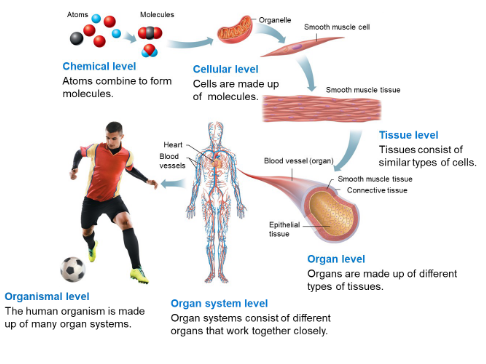
[Structural Organization] What happens at the organ system level?
Organ systems consist of different organs that work together closely.

[Structural Organization] What happens at the organismal level?
The human organism is made up of many organ systems.

[Structural Organization] Which sequence is correct: atoms, molecules, cells, tissues?
Atoms → molecules → cells → tissues.

[Organ Systems] How many organ systems are presented in this chapter?
11 organ systems.
[Integumentary System] What are the major functions of the integumentary system?
Forms the external body covering, protects deeper tissues from injury, synthesizes vitamin D, and houses cutaneous receptors and sweat glands.

[Integumentary System] What structures are listed as part of the integumentary system?
Skin, hair, and nails.

[Muscular System] What are the major functions of the muscular system?
Manipulates the environment, produces movement of body parts and substances, allows facial expression, maintains posture, and produces heat.

[Muscular System] What major structure is listed for the muscular system?
Skeletal muscles.

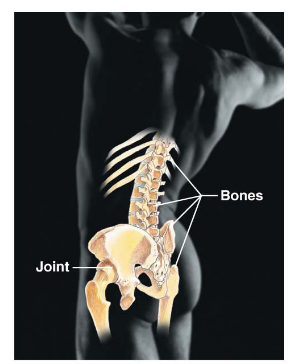
[Skeletal System] What are the major functions of the skeletal system?
Protects and supports organs, provides a framework for movement, is a site of blood cell formation, and stores minerals.

[Skeletal System] What structures are listed for the skeletal system?
Bones and joints.
[Nervous System] What is the nervous system's general role?
It is the fast-acting control system of the body.

[Nervous System] How does the nervous system respond to internal and external changes?
By activating appropriate muscles and glands.

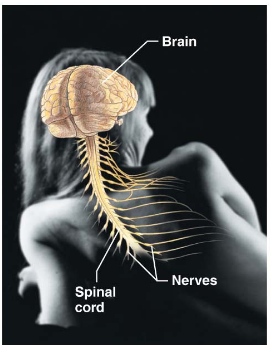
[Nervous System] What structures are listed for the nervous system?
Brain, spinal cord, and nerves.
[Digestive System] What are the major functions of the digestive system?
Breaks food into absorbable units that enter the blood and eliminates indigestible substances as feces.

[Digestive System] What structures are listed for the digestive system?
Esophagus, stomach, small intestine, large intestine, liver, and pancreas.

[Urinary System] What are the major functions of the urinary system?
Eliminates nitrogenous wastes and regulates water, electrolyte, and acid-base balance of the blood.

[Urinary System] What structures are listed for the urinary system?
Kidneys, ureters, and urethra.

[Endocrine System] What is the endocrine system's general role?
Slow-acting control of the body.

[Endocrine System] What do endocrine hormones regulate?
Processes such as growth, reproduction, and nutrient use by body cells.
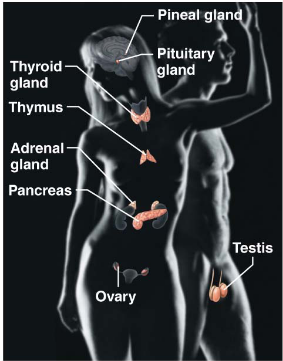
[Endocrine System] What structures are listed for the endocrine system?
Thyroid gland, thymus, adrenal gland, pancreas, and gonads.
[Reproductive System] What are the major functions of the reproductive system?
Production of offspring and production of milk to nourish a newborn.

[Reproductive System] What structures are listed for the reproductive system?
Gonads, sex organs, and mammary glands.

[Cardiovascular System] What is the major function of the cardiovascular system?
Pumps and transports blood carrying oxygen, carbon dioxide, nutrients, wastes, and other substances.

[Cardiovascular System] What structures are listed for the cardiovascular system?
Heart and blood vessels, including arteries and veins.

[Respiratory System] What are the major functions of the respiratory system?
Keeps blood supplied with oxygen and removes carbon dioxide.

[Respiratory System] What structures are listed for the respiratory system?
Larynx, trachea, and lungs.

[Lymphatic System] What are the major functions of the lymphatic system?
Returns leaked fluid to the blood, houses white blood cells involved in immunity, and attacks foreign substances.

![<p>[Lymphatic System] What structures are listed for the lymphatic system?</p>](https://assets.knowt.com/user-attachments/192f7423-37f3-4a02-9bf4-eaa9315d85c9.png)
[Lymphatic System] What structures are listed for the lymphatic system?
Tonsils, lymph nodes, and spleen.
[Organ Systems] Do organ systems act independently?
No. Organ systems work together to complete important life functions.

[Review] Which organ system provides the force to move bones about their joints?
The muscular system.
[Review] Which organ system responds to environmental changes by transmitting electrical impulses?
The nervous system.
[Life Functions] What two broad goals are organ systems designed to accomplish?
Carry out necessary life functions and meet the survival needs of individual cells.
[Life Functions] What necessary life functions are listed?
Maintaining boundaries, movement, responsiveness, digestion, excretion, metabolism, growth, and reproduction.
[Life Functions] What does maintaining boundaries mean?
Separation between internal and external environments.
[Life Functions] What is responsiveness?
The ability to sense and respond to stimuli.
[Life Functions] What is excretion?
Removal of waste.
[Life Functions] What is metabolism?
All chemical reactions that occur in body cells.
[Survival Needs] What five survival factors are listed?
Nutrients, oxygen, water, normal body temperature, and appropriate atmospheric pressure.
[Homeostasis] What is homeostasis?
Maintenance of stable internal conditions despite changes in the environment.
[Homeostasis] Is homeostasis static?
No. The body is always readjusting as needed.
[Homeostasis] What systems are especially important for monitoring and regulating homeostasis?
The nervous and endocrine systems, along with other systems.
[Homeostasis] What is a variable?
A factor that can change.
[Homeostasis] What variables are listed in the slides?
CO2 and O2 concentrations, blood glucose, blood pH, blood volume, blood pressure, and body temperature.
[Homeostasis] Why must variables be regulated?
They must be kept within a narrow range.
[Homeostatic Imbalance] What can loss of homeostasis result in?
Disease and death.
[Review] Which definition best describes homeostasis?
The ability to maintain relatively stable internal conditions even though the outside world changes continuously.
[Homeostatic Control] What are the three components of a homeostatic control system?
Receptor, control center, and effector.
[Receptor] What does the receptor do?
Monitors the internal and external environment and responds to stimuli, or changes in variables.

[Receptor] What example of a receptor is given?
Receptors in blood vessels that monitor changes in blood pressure.

[Control Center] What does the control center do?
Determines the set point, receives input from the receptor, and determines the appropriate response.

[Control Center] Through what pathway does the control center receive input from the receptor?
The afferent pathway.

[Control Center] What blood-pressure example is given for the control center?
The brain determines the set point for blood pressure.

[Effector] What does the effector do?
Receives output from the control center and produces a response that reduces or enhances the stimulus.

[Effector] Through what pathway does the effector receive output from the control center?
The efferent pathway.

[Effector] What blood-pressure effector example is given?
Blood vessels dilate or constrict to return blood pressure toward normal.

[Homeostatic Control] What is the basic information flow of a homeostatic control mechanism?
Stimulus/change → receptor → afferent pathway → control center → efferent pathway → effector → response.
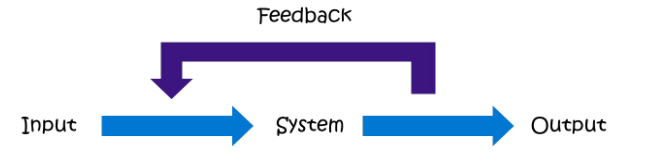
[Feedback Loops] What is a feedback loop?
A process in which outputs of a system are routed back to affect inputs.
[Negative Feedback] What is negative feedback?
A response that reduces or shuts off the original stimulus.

[Negative Feedback] In what direction does the variable move relative to the initial change?
In the opposite direction of the initial change.

[Negative Feedback] Is negative or positive feedback more commonly used in the body?
Negative feedback is the most-used feedback mechanism.

[Negative Feedback] What two examples are shown?
Thermoregulation and blood glucose regulation.

[Thermoregulation] What happens when body temperature rises?
Temperature-sensitive receptors detect the rise, the control center responds, sweat glands are activated, evaporation lowers body temperature, and the stimulus ends.

[Thermoregulation] What happens when body temperature falls?
Temperature-sensitive receptors detect the drop, the control center responds, skeletal muscles produce shivering, body temperature rises, and the stimulus ends.
[Blood Glucose] What happens when blood glucose rises?
Insulin is released; body cells take up more glucose and the liver stores glucose as glycogen, lowering blood glucose toward normal.

[Blood Glucose] What happens when blood glucose falls?
Glucagon is released; the liver breaks down glycogen and releases glucose into the blood, raising blood glucose toward normal.

[Positive Feedback] What is positive feedback?
A response that enhances or exaggerates the original stimulus.

[Positive Feedback] In what direction does a variable continue during positive feedback?
In the same direction as the initial change.

[Positive Feedback] What kind of events does positive feedback usually control?
Infrequent events.

[Positive Feedback] What two examples are shown?
Uterine contractions during childbirth and platelet formation.

[Uterine Contractions] What begins the positive-feedback loop during childbirth?
The baby's head pushes against the cervix.

[Uterine Contractions] How does the childbirth positive-feedback loop proceed?
Cervical stretch sends nerve impulses to the brain → pituitary releases oxytocin → oxytocin strengthens uterine contractions → the baby pushes more strongly against the cervix.

[Uterine Contractions] What ends the childbirth positive-feedback loop?
Birth.
[Platelet Formation] What initiates the platelet positive-feedback loop?
A break or tear in a blood-vessel wall.

[Platelet Formation] How does platelet positive feedback work?
Platelets adhere to the damaged site and release chemicals that attract more platelets.

[Platelet Formation] What ends the platelet positive-feedback loop?
Formation of a platelet plug.

[Feedback Review] Negative vs positive feedback?
Negative feedback opposes the original change; positive feedback amplifies the original change.

[Anatomical Position] What is the standard anatomical position?
Body erect, facing forward, feet slightly apart, palms facing forward, thumbs pointing away from the body.

[Anatomical Position] In anatomy, whose right and left are used?
The right and left of the body being viewed, not the observer's right and left.

[Directional Terms] What do directional terms describe?
The relative position of one body structure to another.

[Directional Terms] What paired directional terms are listed?
Superior/inferior, cranial/caudal, anterior/posterior, ventral/dorsal, medial/lateral, proximal/distal, central/peripheral, and superficial/deep.
