Chapter 11: DNA to Proteins --> Translation
 Call Kai
 Learn
Learn Practice Test
 Spaced Repetition
 Match
Match Flashcards
 Knowt Play
1/93

There's no tags or description
Looks like no tags are added yet.
Name | Mastery | Learn | Test | Matching | Spaced | Call with Kai | Chat |
|---|
No analytics yet
Send a link to your students to track their progress
94 Terms
by specifying protein synthesis
how genes specify traits
proteins
polymers of amino acids
20
number of common amino acids found in proteins
peptide bonds
bonds that connect amino acids to form polypeptide chain
polypeptide chain
peptide bonds bond together amino acids to form this
function
order of amino acids in a protein determine the protein’s ?
primary structure
order of amino acids in a protein
3
code for amino acid requires ? nucleotides
experiment to determine code
long strands of synthetic RNAs are made that only contained one nucleotide (poly A, poly C, poly G, poly U)
homopolymers are added to cell free translation system that contained all 20 amino acids where one amino acid was radioactive
polypeptides are precipitated, filtered, and then checked for radioactivity
tube in which the protein was radioactively labeled contained newly synthesized protein with the amino acid that specified by the homopolymer
homopolymer
during the experiment to determine code, the tube that was labeled with the protein that carries the radioactive amino acid, specified that that amino acid coded for the ? that was used for the experiment
codon
3 nucleotides that give code for a specific amino acid
codon
some amino acids are specified by more than one ?
degenerate
when multiple codons are equivalent to one amino acid —> code is ?
1 (AUG)
number of start codons
3 (UAA, UGA, UAG)
number of stop codons
Met (AUG) and Trp (UGG)
two amino acids that only have one codon for it
tRNAs
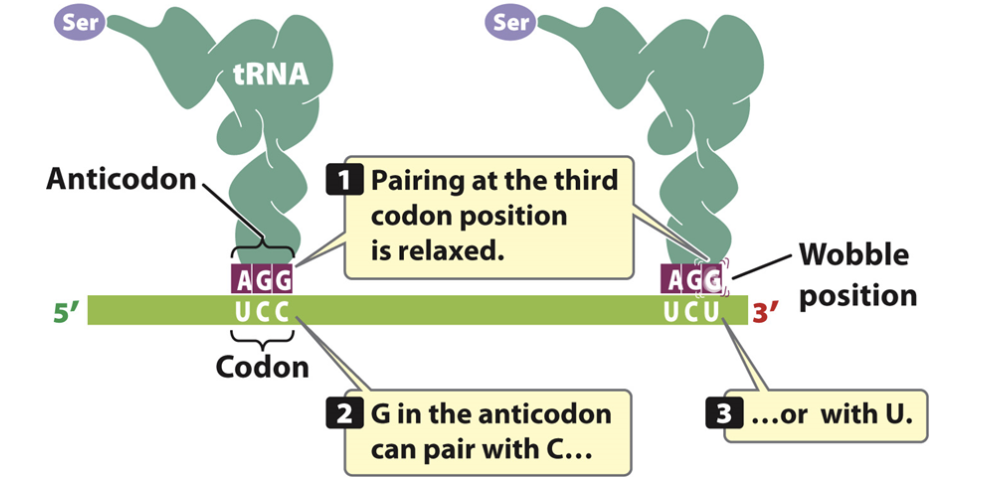
even though there are 64 codons, there are not 64 ? with the complementary anticodon
wobble hypothesis
first bases of the codon on tRNA obeyed pairing rules, but the third base in the codon had a more relaxed base pairing, so one tRNA anticodon ca bind with more than one codon
fixes the problem of having 64 codons but not 64 anticodons on tRNAs
proposed by Watson and Crick
reading frames
for any sequence of nucleotides there are three possible sets of codons, each starting with a different nucleotides —> causes ?
each set of codons specifies different amino acids so it is essential that the ribosome begins reading codons in the correct frame

correct reading frame
always specified by the initiation codon (start codon)
AUG (methionine)
start codon sequence
modified methionine (N-formylmethionine)
what AUG specifies within bacterial DNA
formyl
group contained in modified methionine contained in bacterial DNA that is sometimes removed after the protein is synthesized (sometimes whole modified methionine is removed) (AUG in the middle of the gene specifies normal methionine)
normal methionine
in eukaryotes, AUG always specifies ?
stop codons (UAA, UAG, UGA)
codons that do not encode amino acids and has no tRNAs with anticodons that pair with these
genetic code
almost, but not completely universal (same codons specify same amino acids for almost organisms
mitochondrial genes and bacterial DNA
organisms/genes that do not follow the typical genetic code
translation
carried out on ribosomes, with tRNAs serving to bring the appropriate amino acid for each codon
initiation, elongation and termination
3 stages of translation
binding of ribosome to mRNA and finding start codon
what causes mRNA to be translated
tRNAs with anticodon binds with each codon, brings in amino acid, and is added to growing chain
how each amino acid is added to the growing chain
methionine
AUG
in both prokaryotic and eukaryotic cells, translation always initiates with ? encoded by ?
signals
the ? that identify the specific AUG to start translation are different in prokaryotic and eukaryotic cells
Shine-Dalgarno sequence
signal that identifies initiation codon in PROKARYOTIC mRNAs
Shine-Dalgarno
part of the rRNA in the small subunit of ribosome has a sequence that is complementary to the ? sequence that allows ribosome to bind to prokaryotic mRNA
7-methylguanosine cap at the 5’ terminus
signal that identifies initiation codon in EUKARYOTIC mRNAs —> ribosomes then scan downstream of mRNA until they encounter first AUG —> translation begins
tRNAs
these are transcribed and then must be attached to the correct amino acid that corresponds to its anticodon
aminoacyl-tRNA syntheases
enzymes that recognize a particular amino acid as well as all the tRNAs that accept that amino acid
20 different enzymes (one for each amino acid) that transcribe tRNAs

tRNA charging
when aminoacyl-tRNA syntheases use ATP for energy and attach the amino acid to the 3’ end of the tRNA

anticodon
part of tRNA that base pairs with the complementary codon on the mRNA
antiparallel
binding of tRNA and mRNA are still ?
ex. codon 5’ UGG 3’ base pairs with the anticodon 5’ CCA 3’ (flipped it matches: ACC)
ribosomes
responsible for binding the mRNAs and tRNAs during translation
large and small subunits
prokaryotic and eukaryotic ribosomes both have ? and ?
RNAs and proteins
what each subunit in ribosomes are made up of
small and large subunits
these ribosomal components remain separate until translation is initiated
initiation factor-3 (IF-3)
factor that binds to small ribosomal subunit during translation and prevents large subunit from binding
Shine-Dalgarno
once IF-3 is bound to the small subunit of the ribosome during bacterial initiation of translation, the small subunit binds the mRNA and finds the ? sequence

bacterial initiation
initiation factor-3 (IF-3) binds to small ribosomal subunit
small ribosomal subunit + IF-3 binds to mRNA and finds Shine-Dalgarno sequence
initiator tRNA, fMet-tRNA, attaches to initiator codon, along with IF-2, IF-1, and GTP (30S complex)
initiation factors disassociate and GTP hydrolyzes to GDP —> allows large subunit to bind forming the 70S initiation complex
fMet-tRNA
tRNA that attaches to the initiator codon in mRNA
IF-1, IF-2, and GTP
initiator factors/energy molecule that bind to mRNA or initiator tRNA after fMet-tRNA binds
IF-1, IF-2, and GTP
initiation factors and energy molecule that forms 30s complex during bacterial initiation
70S complex
once initiation factors disassociate and GTP goes to GDP in bacterial initiation, large subunit binds to mRNA forming ? complex
5’ cap
where initiator complex binds in eukaryotic initiation
start codon
once initiator complex binds to 5’ cap in eukaryotic initiation, the complex scans the mRNA to find the ? in the middle of the consensus sequence (Kozak sequence)
Kozak sequence
consensus sequence that is in eukaryotic mRNA and contains a start codon
binding of 3’ poly(A) tail binding proteins and 5’ Cap-binding proteins
binding of the small ribosomal subunits to the 5’ cap in eukaryotic initiation is enhanced by the ?
looped
during eukaryotic initiation, the mRNA is ? so the Cap-binding proteins and poly(a) binding proteins can interact with each other

elongation
when new amino acids are brought by tRNAs and added to the growing polypeptide chain
aminoacyl (A) site
peptidyl (P) site
exit (E) site
3 ribosomal sites that can be occupied by tRNAs
P site
during initiation, the initiator tRNA immediately occupies the ? site on ribosome
A site
where all tRNAs (except initiation tRNA) binds on ribosome
elongation
after initiation tRNA (fMet-tRNA) binds to start codon, it occupies the P site on the ribosome
a charged tRNA with correct anticodon binds with elongation factor Tu (EF-Tu) and GTP, it binds to the A site
once charged tRNA binds to A site, GTP gets cleaved to GDP and the EF-Tu-GDP complex is released from tRNA
rRNA in the large subunit of the ribosome forms a peptide bond between two amino acids —> growing peptide is now on the tRNA in the A site
ribosome then translocates down the mRNA to position its A site over the next A site
as ribosome shifts down, tRNA in P site is now in E site and the tRNA in the A site is now in the P site
tRNA in the E site now leaves to be recharged
with A site open, new tRNA with correct anticodon binds and repeated until whole polypeptide is created
peptide bond
when one charged tRNA is in the P site and another is in the A site, the large subunit of the ribosome forms a ? bond between the two amino acids to start growing polypeptide chain and place it in A site
elongation factor-G (EF-G)
elongation factor that is respond for hydrolyzing GTP to GDP and translocating/shifting ribosome down mRNA to place A site over the next codon
eEF2
EF-Tu
EF-G
three elongation factors in eukaryotic elongation
EF-Tu
elongation factor that binds with GTP to A site on A site of ribosome
EF-Tu
EF-G
two elongation factors in bacterial elongation
eEF2
elongation factor that shifts ribosome down mRNA to place next codon in A site of ribosome only in eukaryotic elongation
eEF2
elongation factor that is a target of the bacterial diphtheria toxin
when toxin is present, it inhibits eEF2 and prevents translocation of ribosome along mRNA and halts protein synthesis
bacterial diphteria toxin
toxin that inhibits eEF2 which prevents translocation of ribosome along mRNA and halting protein synthesis in eukaryotic mRNA
termination
caused when ribosome translocates and a stop codon is in the A site of ribosome
protein synthesis
ends when ribosome translocates and a stop codon is in A site during translation
stop codon
once this codon is in the A site of ribosome during translation, there are no tRNAs with anticodons for it to bind to mRNA so no tRNA enters the A site
RF-1
RF-2
RF-3
3 release factors that terminate protein synthesis
RF-1
RF-2
these release factors bind to the termination codons
RF-3
this release factor binds to GTP and ribosome during termination
termination
polypeptide is released from tRNA in the P site
RF-1/RF-2. bind to the termination codons in A site
RF-3 binds with GTP and binds to the ribosome
ribosome undergoes conformational change and releases RF-1/RF-2 from A site
tRNA in the P site moves to the E site and leaves while GTP is hydrolyzed to GDP
mRNA is released and the ribosome subunits dissociate
ribozyme
an RNA with enzymatic activity
enzymatic
when rRNA in the large subunit of the ribosome forms a peptide bond during elongation, the RNA is exhibiting ? activity
untranslated nucleotides
stop codon in mRNA is followed by ?
3’ UTR (untranslated region)
untranslated nucleotides that follow the stop codon in mRNA
3’ UTR
often contain sequences that affect the stability of the mRNA and influence whether the mRNA is translated
proofreading
in bacteria, evidence supports the proposal that bacterial ribosomes engage in ? (similar to DNA polymerases)
premature termination
after translocation, the ribosome checks the pairing of the codon and anticodon at the P site, if pairing is incorrect, the mRNA and tRNA are not aligned properly —> triggers ? of translation (RF-3 assists in this function)
polyribosomes (polysomes)
when mRNA molecules are translated simultaneously by multiple ribosomes
in both eukaryotic and prokaryotic cells
as new ribosome moves down the mRNA, a new ribosome can begin translating at the beginning of the mRNA
chaperone proteins
some proteins are not able to fold into their correct tertiary structures right after translation —> these proteins are needed
modifications
after translation, proteins in both prokaryotic and eukaryotic cells can undergo ?
cleaved and trimmed
some proteins must be ? and ? to be functional, others have carbohydrates or other groups attached
acetylated
in eukaryotic cells, the amino end of a protein is often ?
antibiotics
these work by binding to bacterial ribosomes and inhibiting specific steps in translation
ONLY bacterial ribosomes not eukaryotic ribosomes
tetracyclines
bind to the A site of ribosomes and block entry of charged tRNAs
type of antibiotic
chloramphenicol
binds to the large subunit and inhibits peptide bond formation
type of antibiotic
streptomycin
binds to the small subunit of the ribosome and inhibits initiation
type of antibiotic
erythromycin
blocks translocation
type of antibiotic