PHM 431 Exam 1
 Call Kai
 Learn
Learn Practice Test
 Spaced Repetition
 Match
Match Flashcards
 Knowt Play
1/66

There's no tags or description
Looks like no tags are added yet.
Name | Mastery | Learn | Test | Matching | Spaced | Call with Kai | Chat |
|---|
No analytics yet
Send a link to your students to track their progress
67 Terms
drug addiction definition and causes
Chronic disease characterized by drug seeking and use that is compulsive despite harmful consequences
starts voluntarily
addiction develops after repeated use
Factors in addition development
Biology (predispositions)
Environment (exposure)
Development (combination of both)
Classification of drug addiction
DSM-5
“Substance use disorder” recognized as official clinical diagnosis
range of severity with symptoms
“addiction” common term applied to severe symptoms
Is addiction psychological or physical?
Psychological?
Craving behaviors that dominate multiple areas of life
socioeconomic status
coping skills
environment
Physical?
Change in the structure/function of cells, tissues, and organs
Genetics
early exposure
exposure frequency
Principles of Drug addiction
Likely to be addictive if they produce euphoria
Euphoria is reinforcing, subject wishes to take drug repeatedly
Dependence can lead to addiction, but dependence does not equal addiction
Withdrawal can occur in dependence or addiction states
All drugs can produce dependence but not all drugs are addictive
Principles of drug addiction
Physical dependence → biological and is a state that develops due to tolerance (adaptation) to drug effects.
resetting of mechanisms maintaining homeostasis
Signs and symptoms of withdrawal are generally opposite to the responses caused by drug administration
Avoidance of withdrawal → part of reinforcing profile → potentiates addiction
withdrawal signs are unpleasant → continue to use to achieve euphoria and avoid withdrawal
Reward circuitry
Prefrontal cortex
nucleus accumbens
Main hub for reward, motivation, and action selection
ventral tegmental area
Neurons in midbrain that serve as primary dopamine producing region

Common definitions in pharmacology
Drug: any substance that brings about a change in biologic function through its chemical actions
Xenobiotic: any substance not produced by your body
Dose: amount of a drug administered
Potency: concentration of drug needed to elicit a specific response
Efficacy: specific outcome of drug treatment’
Agonist: compound that activates a receptor
Antagonist: compound that blocks a receptor from activation
Cell membranes
Composed of lipid bilayer → semi-permeable
Drugs with charge (ionized) are unable to pass through this membrane
Unionized or lipophilic drugs can pass through easily into the cell (via simple diffusion)
Cell surface receptors
Ligand gated ion channel
G protein coupled receptors (GPCR)
Receptors with intrinsic enzymatic activity
Receptors that associate with enzymes
Ligand gated ion channels
Transmembrane proteins with 2 domains
Ligand binding domain (LBD)
Membrane spanning domaine (pore)
With ligand bound ions move down the conc gradient
G protein coupled receptors
G protein is a trimer, G and alpha, beta, and gamma
When ligand binds → beta and gamma release → leaves G and alpha alone
If Gai → inhibits adenylate cyclase (no reaction)
If Gas → stimulates adenylate cyclase
Dose Response Curve
Potency vs Efficacy (efficacy Y, potency on X)

Which opiate has the highest potency? What about efficacy?
China white highest potency → has the highest ED50
All have the same efficacy
Terminology for PK/PD
Pharmacokinetics
ADME
What the body does to the drugs
Pharmacodynamics
Agonist, antagonist, receptor targeted
What drugs do to the body
ADME
absorption: drug is taken into the body and moves from site of exposure to blood
distribution: movement of drug from the blood to the tissues/interstitial fluid
metabolism: metabolized in the liver, becomes a metabolite, if not a pro-drug it will be eliminated
elimination: bye bye leave the body now
Route of administration
Oral
IV
Intranasal
SQ
IM
IP
Suborbital
Oral drug administration
Slow onset, takes time for drug to be digested and absorbed in small intestine
As a result, has a large latency period
Latency: the time between administration of a substance to the peak plasma concentration
First pass effect
Drug enters portal vein and is shuttled to the liver, liver metabolizes and deactivates drug prior to systemic circulations
happens in IP administration too
IM and SQ Administration
Has a long latency too, has to slowly diffuse out into blood stream
SQ is similar to IM, but SQ does have a longer latency than IM
IV Administration
Shortest latency (right into circulation, immediate effect)
Has the highest potential for reaching toxicity threshold due to sharp spike
Absorption and distribution
Site of administration has the highest concentration initially → rapid equilibrium between SOA, circulation, and target tissue
Drug distribution, tissues vs BBB
Peripheral tissues have gap junctions in between cells, which allows some charged drugs to make it through
BBB has tight junctions between cells stitched together by proteins
Glial cells surround the endothelium of the BBB, adds even more cell membrane to pass through
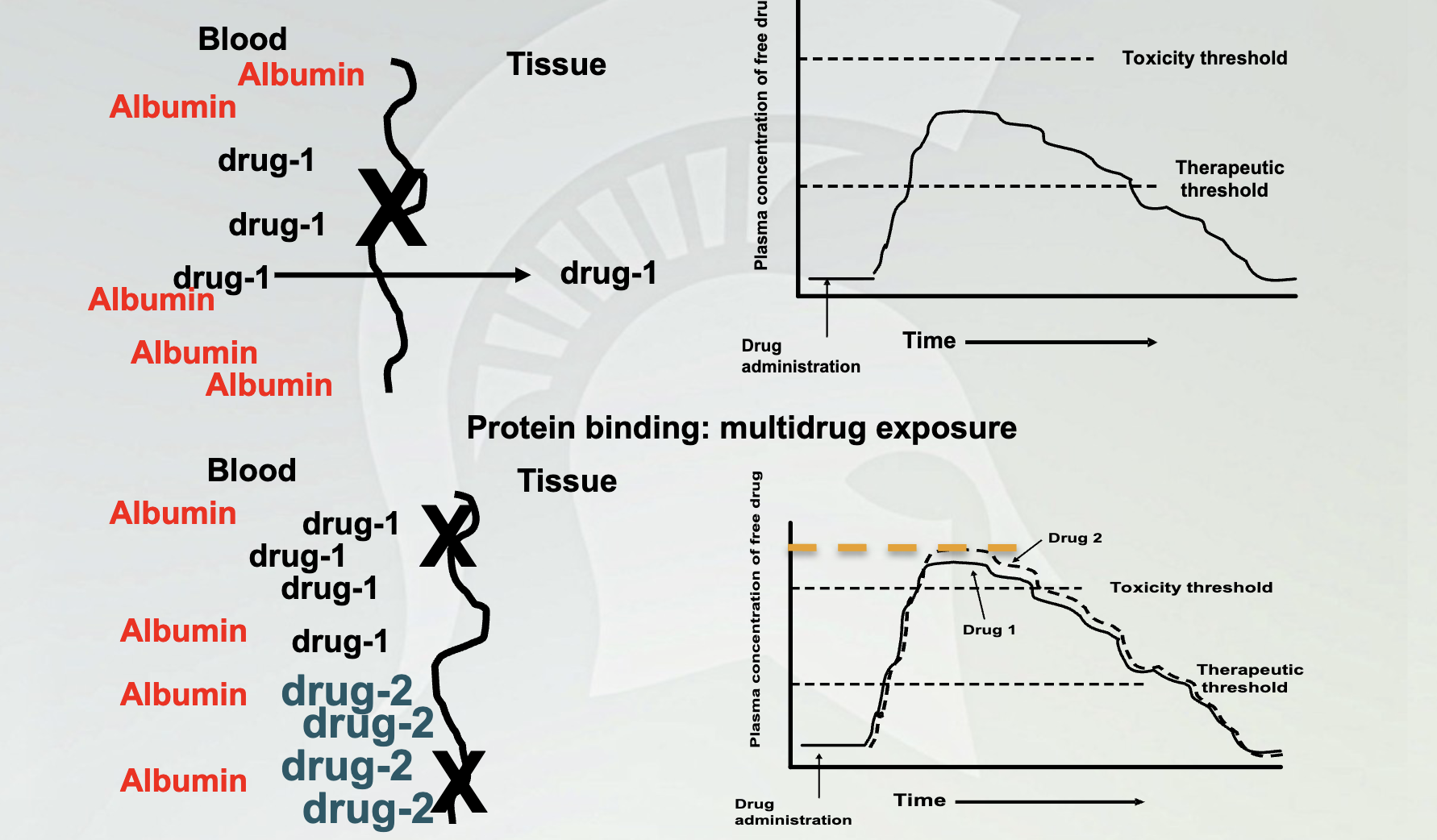
What is this slide illustrating?
Albumin bound drugs cannot pass through into tissues, too large of a molecule, this means the bound drug cannot have an effect
When two drugs enter the system they compete for the same amount of albumin → there is now more free drug allowed to circulate in the blood → pass into tissues and leads to toxicity
Metabolism
A family of enzymes (CYP450) principally in the liver but in other tissues as well acts on drugs and other XBs to inactivate these compounds
Sometimes CYPs increase pharmacological activity of a drug: an inactive molecule may be transformed into an active compound or toxic metabolite
Drug enters phase 1 metabolism → oxidation, reduction, hydrolysis → part of the drug is metabolized (hydrophilic)
Drug enters phase 2 metabolism → conjugation → part of the drug is metabolized (hydrophilic)
TWO drugs enter metabolism → competition and inhibition → much more Drug 1 + Drug 2 left unmetabolized → toxicity
Factors affecting metabolism
Competition: For enzymes by co-administration drugs will lead to increased levels of both drugs
Induction: increased enzyme activity as a result of previous same/different) drug exposure
Natural products + Herbal products over the counter: interfere with metabolism of prescription drugs and changes the effects of these drugs
Drug-Drug interactions: issues for elderly patients
Inhibition: decreased enzyme activity as a result of previous drug exposure
First order kinetics
T1/2 = half life
Kel = elimination rate constant (0.693/t1/2)
Cp0 = plasma concentration at t=0
First order elimination kinetics (most drugs) → 1st order because the amount of elimination is proportional to the concentration of drugs
The derivative of the slope is a straight line

Zero order kinetics
Rate of elimination is constant per unit time: alcohol
Keep an eye on axises (should see rate of change on y, concentration on x)
rate of change vs conc should be a straight line, if a derivative it is a straight horizontal line
Alchohol = 120mg/kg/hr
Pharmacodynamics
Interaction of a drug with its site of action
Drug can have two effects
Non-receptor mediated actions → usually unintended
Receptor mediated actions → specific high affinity binding site for drug
Act as an agonist → binds with high affinity and activates a receptor
Antagonist → binds with high affinity but does not activate a receptor, blocks binding or activation by an agonist
Quantitative description of drug-receptor interaction affinity/efficacy
K1 is forward reaction, K2 is reverse reaction, Ka = K2/K1
Affinity: Small Ka values = high affinity for a receptor = high potency
Efficacy: Agonists have efficacy
antagonists do not have efficacy
agonists can vary in their transduction efficiency there are high efficacy agonists (full agonists) and low efficacy agonists (partial agonists)
Dose Response Curve
Top of the sigmoidal curve is the Emax → maximal effect (measurement of efficacy) plateaus here
Middle of curve → Emax/2 or EC50 (measures potency) → amount needed for ½ max effect in 50% of people
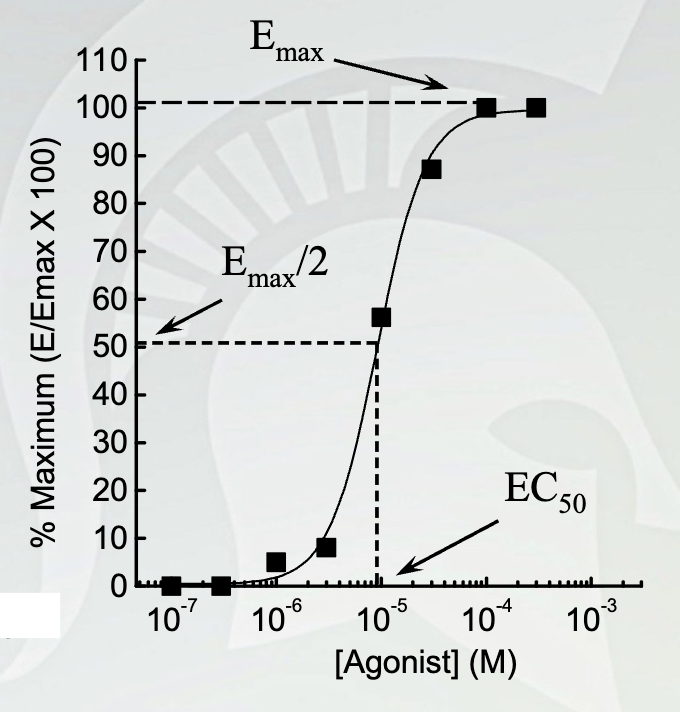
Dose response curve - Agonist vs antagonist
Agonist → binds receptor → causes change response
Antagonist → binds receptor → prevents change in response
imagine the graph with the full, partial, antagonist, and inverse agonist
Dose response curve - potency vs efficacy
Potency increases from right to left, as the curves shift to the left their EC50 decreases
Efficacy increases from bottom to top, the higher the top of the curve → higher maximal effect
EC50 is relevant to each individual drugs max efficacy. A has highest Emax, so its EC50 will appear higher on Y axis but they are equal

Agonist efficacy vs potency
Agonist B > A in efficacy
Agonist B is a full agonist
Agonist A is a partial agonist
Potency: agonist A > agonist B

Therapeutic Index
Equal to EC50 toxic/ EC50 therapeutic
We want a large therapeutic index between curves so we can ensure the drug is safe blah blah

Antagonism
There are two kinds of antagonism
Chemical
Physiological
Competitive antagonism
binds reversibly to the same receptors site as an agonist
effects can be overcome by a higher concentration
shifts dose-response curve to the right without altering maximum response
Non-competitive antagonism
binds to different site or irreversibly to same site
effects cannot be fully overcome by increasing agonist
reduces maximum possible response (efficacy)
Chemical antagonism
direct chemical interaction between drugs
forms inactive complexes
neutralizes drug before reaching target site
albumin → binds to drugs in circulation + not allowing drug to get anywhere
Physiological antagonism
opposing physiological effects through different mechanisms
acts on different receptors or pathways
counteracts functional outcome

Physiological antagonism
Both drugs bind and interact to cardiac muscles in the same pathway but induce opposite effects

Drug tolerance
Defined as a decrease in sensitivity to a drug after repeated administration
Graph: Drug user can still feel the effects but the potency required to reach that same effect a naive person feels is much higher
Innate tolerance: occurs with genetic variations in drug metabolizing enzymes which lead to efficient inactivation of a drug or genetic variations in receptors (or other drug targets) which make those receptors less responsive to a drug

3 types of acquired tolerances
Pharmcokinetic tolerance: changes in drug sensitivity due to changes in the distribution and metabolism of the drug.
ex: alcohol induces enzymes responsible for detox → tolerance to high amounts of alcohol through this change in metabolism
Pharmacodynamic tolerance: changes in the system in response to repeated drug administration.
Ex: down regulation of receptors/their associated effector molecules
Learned tolerance: skills developed through experience with drugs, common with alcohol but can occur with non-abused drugs
Ex: being good at drunk driving
Two forms of desensitization (pharmacodynamic tolerance)
Two forms of desensitization
Internalization: receptor is pulled into the cell and stored within an endosome → happens within minutes to hours → short term desensitization
Downregulation: receptor is pulled into the cell and destroyed by a lysosome → decrease in the total number of receptors over hours to days → longterm desensitization
Receptor or effector molecules can be downregulated!

Cross tolerance
Morphine binds to opiate receptors in the brain → receptor (or effector) downregulation over time → meperidine is a new drug but also binds to opiate receptors → system is desensitized to this drug due to morphine abuse → no effect
Unique structures of neurons
Cell body → soma
Axon terminals at the end of the presynaptic neuron interacts with dendrites on post-neuron
Axonal transport: transport of secretory components and intracellular communication
Cell machinery in soma produces proteins and components for NTs
transport down axon to terminal prior to final packaging
What are the two aspects of neural communication
Neurotransmitter release
Electrochemical potentiation
Resting membrane potential
Nerve cells generate and propagate electrical signals, typically sit at around -60mV at rest (negative resting membrane potential)
Intracellular concentrations: impermeable nucleic acids and proteins (negative charges) and K+
Extracellular concentration: Na+, Cl-, Ca2+
Na+/K+ pump → Energy dependent process that pumps 3 Na+ out and 2K+ in, works to restore -60mV
Also contains K+ leak channels, Cl- pump (both out of cell)
At rest, a neuron can passively release/absorb K+
Membrane Potential of an activated neuron
Resting membrane potential (-60mV)
Rising phase → Influx of Na+ ions → increase in Vm
Overshoot → peak of membrane potential
Falling phase → cells allows K+ to flow out to restore the -60mV
Undershoot → Falls below -60mV → cell utilizes Na/K pump to restore balance and increase back up to -60
As the rising phase begins, there is a point called the “threshold”, once the mV reaches that threshold it is at the “point of no return” → it is going to fire
Saltatory Conduction and action potential propagation
Unmyelinated axon: .5-1 m/s
Myelinated axon
myelin sheath → increases speed of conduction (150 m/s)
nodes of ranvier: high concentration of Na+ channels
Vesicles carrying NTs reach the axon terminal → in order for vesicles to fuse with the presynaptic membrane there must be an influx of Ca ions!
Additionally, SNARE proteins are involved in NT release → imbedded in membranes → activated by Ca release → pull two cells together for NT release
Agents that affect nerve transmission
Botulinum
tetrodotoxin
charybdotoxin
margatoxin
dendrotoxin
conotoxin
Clostridial botulinum (botox)
Attacks snare proteins at cholinergic nerve endings → blocks NT release of acetylcholine → prevents contraction
Tetrodotoxin
Pufferfish one
voltage-gated Na+ channel blocker → inhibit the rising phase of action potential → dead ;(
Charybdotoxin, Margatoxin (scorpion), dendrotoxin (mamba)
K+ channel blockers → K+ cannot exit the cell fast enough → prolongs the falling phase of action potential

Conotoxin
Blocks nerve terminal Ca channels → vesicles cannot bind with presynaptic membrane → no transmission of signals
analgesic medication
The synapse
Presynaptic terminal
NT
synthesis
breakdown
Postsynaptic terminal
receptors
effectors
Primary dopamine pathways in the brain
DA is the biggest NT responsible for developing dependence
Mesolimbic/mesocortical pathway
nigrostriatal pathway
tuberoinfundibular pathway (hormone release)

DA Synthesis in nerve terminals to release and breakdown
Precursor AA is tyrosine → tyrosine hydroxylase → DA → VMAT for packaging into vesicles → release into synapse
can bind to D1 or D2 DA receptors
D1 → Gs+ → activate adenylate cyclase
D2 → Gi- → inhibits adenylate cyclase
→ brought back into presynaptic cell by DAT → 1 of 2 possibilities
1. → DA goes back to VMAT and repeats the above cycle
2. → goes to MAO enzyme and is broken down
Norepinephrine neurons/ pathways in the brain
Locus coeruleus pathway
reaches cortex, hypothalamus, and cerebellum
NE neurons in the peripheral nervous system
cells bodies in the autonomic ganglia send fibers out to target tissues
NE/Epinephrine synthesis to release/breakdown
Begins with tyrosine → tyrosine hydroxylase → becomes DA → dopamine B hydroxylase → NE → reaction occurs in adrenal glands to convert NE finally into EPI
note that all three of these NTs utilize tyrosine
DA → NE happens within vesicle in pre neuron
NE synthesized → packaged by VMAT → released → undergoes post or pre synaptic binding (interacts with alpha and beta receptors on pre or post neuron) → uptaken by NET into pre neuron → either back to VMAT or goes to MAO for breakdown

Serotonin systems in the brain
Two main groups of SER projections
Caudal raphe nuclei
project down into spinal cord
Rostral raphe nuclei
project into cortex and hypothalamus
Serotonin synthesis
Begins with L-tryptophan synthesis → tryptophan hydroxylase → VMAT → release → bind to 5-HT receptors 4,6,7 (Gs+) or receptors 1 and 5 (Gs-) → reabsorbed by SERT → go back to VMAT or eventually broken down by MAO
Cholinergic receptors
pedunculopontine pontine nucleus
lateral dorsal tegmental area
Ach receptors
nicotinic receptors (ligand gated ion channels)
muscarinic receptors (GPCR)
Ach synthesis and breakdown
Glucose → pyruvate that enters mitochondria → acteyl coA + choline → choline acteyltransferase → yields Ach → enters synapse → Ach in synapse is broken down by acetylcholineesterase into choline and acetate!! only NT that is broken down in the synapse!!
This choline molecule can get reused in pre neuron for further synthesis of Ach
Types of neurons
Interneurons are local → transmit signals within the same region of brain
Projection neurons are long distance → transmit into another area of brain

Drugs acting on cholinergic neurons
Curare plant prevents Ach from binding to post nicotinic receptors → no muscle contraction (competitive antagonist)
Mushrooms with muscarine like compound → increases the activation of muscarinic receptors (agonist)
Glutamate synapse
Glutamine precursor → glutaminase → vGlut packages → binds to NMDA, AMPA, and mGluR receptors → EAAT takes back into cell for recycling → back into glutamine
GABA synapse
Glutamine → glutaminase → glutamate → glutamic acid decarboxylase (GAD) → GABA → binds to GABAa and GABAb
enters pre neuron again via GABA transporter → glutamine
Phase 1 clinical trials
Healthy human volunteers (20-100) → small short studies done in a few subjects
Test escalating single doses to multiple doses
PD and PK studies
Safety and tolerance are the endpoints
Phase 2 clinical trials
Several hundred patients with the target disease, can involve multiple institutions
placebo controlled, double blind study (gold standard)
endpoints: efficacy and safety
Phase 3 clinical safety
Hundreds to thousands (300-3000) of patients with disease at multiple institutions
placebo double blind
Endpoint: dosing, must show clinical efficacy
key point in drug development
Concurrent work with phase 3 trials
drug interactions studies in healthy volunteers
long term toxicology: chronic? repro? teratogenic?
manufacturing considerations (can we actually make it?)
prep the market
The funnel
high thorough output screens millions of drugs on immortalized cell line → pre clinical development → clinical development → approval