CH15: Allergy
 Call Kai
 Learn
 Practice Test
 Spaced Repetition
 Match
 Flashcards
 Knowt Play
1/20

There's no tags or description
Looks like no tags are added yet.
21 Terms
Degranulatie
het proces waarbij gespecialiseerde immuuncellen — voornamelijk mestcellen, basofielen en eosinofielen — de inhoud van hun inwendige opslagblaasjes (granula) snel vrijgeven in de extracellulaire omgeving
De sensitisatiefase (1)
pinda-allergeen dringt het weefsel binnen
wordt opgenomen door antigeen-presenterende cellen (APC) en gepresenteerd aan naive T cellen
differentiatie tot Th2-cellen → scheiden cytokine uit (f.e. IL-4 en IL-13)
zet B-cellen aan om allergeenspecifieke IgE-antilichamen te produceren
Deze binden irreversibel aan de receptor (FcεRI) op de buitenkant van mestellen en basofielen
De effectorfase (2)
Als je opnieuw een pinda eet, bindt het pinda-allergeen aan het IgE dat al vastzit op de FcεRI-receptoren van de mastcel
Crosslinking: het allergeen moet tegelijkertijd binden aan meerdere naburige IgE-antilichamen op het celoppervlak
Dit triggert degranulatie
histamine: snelle vaatverwijding, verhoogde vaatpermabilteit, gladde spiercontractie, atc.
cytkokine (nieuw): trekken ontstekingscellen naar het weefsel → aanhoudende ontsteking
Requiremens to induce an allergic response
For an effective FcεRl cross-linking, the distance between these Ig-molecules should be between 5-24nm
This is because the receptors (especially g receptor) needs to be in close proximity to start the signalling cascade (but not too close)
The cross-link should be ~100 secondes
The bigger the cross-link, the better
You need at least a 100 crossings per cel
Th2 response will release 3 different cytokines;
IL-4 is important for the isotype switching of the B cells to make IgE (that will then bind on the mast cell and the basophils)
IL-5 is important for the eosinophils
IL-13 can help to isotype switch B cells, but is mainly active on mature B cells (mainly more on the tissue than on immune cells)
4 hypersensitivity reactions (actually 5)
Hypersensitivity: too much unregulated immune response
Type I: allergy, with IgE and mast cells, etc.
Type II: with IgG (instead of IgE) which binds to surface proteins, which might cause an effect (very common for autoimmune diseases)
Type III: also with IgG, but not to the antigen that’s on the surface, but to immune complexes à big immune complexes are bound to surface proteins (especially in the vessels) and they can give problems in the vessels, kidney or skin
Type IV: without any immunoglobulins. It is a direct response with antigen presenting cells and T cells F.e. contact allergy
Type V: antibodies to a structure, but the structure is not killing something, but the structure binds to the receptor and it can activate or block a receptor. This can activate f.e. graves disease
effect van mast cell activation op je luchtwegen
vernauwing van je spieren → decreases diameter
toename van mucus secretion
effect van mast cell activation op je GI tract
verhoogde vochtsecretie
spiercontractie (persitaltiek)
→
liedt tot maagkrampen, braken en diarree
effect van mast cell activation op je blood vessels
verhoogde blood flow
verhoogde permeabiliteit
→
Edema en inflammatie, verhoogde antigen flow van lymph naar lymphnodes
effect van mast cell activation op je vasculaire systeem
zelfde als bloodvessels
swelling of tissue (incl. tongue)
los of blood pressure
reduced oxygen to tissue
irregular heartbeat
anaphylactic shock
loss of consciousness
late-fase reactie
Geactiveerde mestcellen en Th2-cellen scheiden cytokinen en chemokinen uit
stimuleert het beenmerg om meer eosinofielen aan te maken
trekt deze aan naar het ontstoken weefsel
verandert ook adhesie van endotheelcellen (meer)
De eosinofielen in het bloed blijven aan deze adhesiemoleculen plakken, waarna ze door de bloedvatwand heen kunnen richting het longweefsel
Hier storten ze hun toxische eiwitten en enzymen uit over de bronhciale epitheelcellen → schade, ontsteking, ver
What makes a protein an allergen?
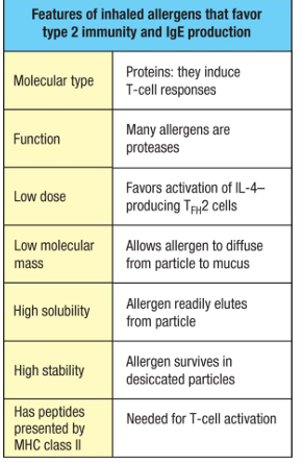
Th2-respons
De Th2-respons gebruikt IL-4, IL-5 en IL-13 om slijmproductie, spiercontracties, IgE-productie en de activatie van mestcellen en eosinofielen te combineren
Huidpriktest
met een naaldje wordt oppervlakkig in de huid geprikt → minimale hvh allergeen door tot de dermis, waar mestcellen zich bevinden
als de patiënt gesensitiseerd is, dragen de mestcellen in de huid al specifieke IgE-antilichamen
allergeen bindt aan meerdere IgE
mastcel degranulation
histamine zorgt voor een klein bultje
positieve controle: histamine
negatieve controle: saline
pollen
Sommige pollenkorrels bevatten hun eigen NADPH-oxidase-enzym.
Zodra pollen in de luchtwegen terechtkomen, genereert dit enzym lokaal ROS
gestresste epitheelcellen scheiden oa IL-8 uit (signaalstof die ontstekingscellen naar de luchtwegen trekt)
de combi van alles zorgt voor een “gevaarsignaal” naar het immuunsysteem
stimuleert naive T0cellen om te differentiëren tot Th2-cellen
stimuleert uiteindelijk de Ige productie
stelt de allergische ontstekingsrectie in gang
House dust mite
bevatten enzymen met protease activiteit.
Deze breken de eiwitverbindingen tussen epitheelcellen van het neus-en longweefsel af.
de beschermende barrière lekt, waardoor allergenen heel makkelijk door het epitheel heen dringen
huisstofmijtallergenen bootsten MD-2 na (TLR4 heeft dit nodig om signaal door te geven van bacteriële herkenning)
Dit alles brengt de epitheelcellen in een alarmtoestand → cytokine en alarmine uitscheiding
Acute allergy treatments (type I hypersensitivity)
Anti histamines
o Potent for allergic rhinitis
o But ineffective for allergic asthma and atopic dermatitis
Decrease in allergen exposure
o Potentially effective for food allergies
o Only effective for asthma and atopic dermatitis when completely depleted (up to 95% reduction has no effect)
First medicine
Blocked the central figure (= IgE)
The concentration of IgE would rebound after ~a week, but the angle of rebound would get lower and lower
So probably, next to getting rid of the IgE, it would also switch off IgE-producing B cells
By taking out the IgE, there would be no more cross-links
Importantly: IgE is also binding to dendritic cells in humans, which facilitates antigen presentation and picking up
F.e. dendritic cells in your skin will more easily pick up the allergen and bring it to T cells if there is IgE on the membrane
However only 1/3 had improvement, 1/3 had less clinical beneficial response and 1/3 had no clinical response at all
Second idea:
made antibodies against IL-5
o Blood eosinophils number decreases after anti-IL5 treatment
o No effect on late asthma reaction
o No effect airway hyperresponsiveness (=lung of asthma patients is more sensitive for nonspecific triggers)
o Also no effect found in atopic dermatitis
Ø =Eosinophils are just innocent bystanders?
Ø =Eosinophils have potent lysophospholipase activity important to inhibit local allergic inflammation? ←→ tissue homeostasis
Ø Only effective in small subgroups
IL-5
o Important for differentiation and maturation of eosinophils
o Chemotaxis; so they start to move faster
o They activate eosinophils (kill extracellulair parasites and helminths)
o If IL-5 is there, the eosinophils will have prolonged survival
Third idea (Dupilumab):
2 things in 1 single antibody: block the effect of IL-4 and IL-13, by blocking the combined receptor: IL4-receptor a-chain
IL4: binds on B cells, T cells and monocytes
IL-13 binds mainly tissue cells, epithelial smooth muscles, fibroblasts, monocytes and already activated B cells
IgE did not go down significantly → effect is independent of lowering IgE
Eczeem = Th2 gedreven weefselziekten: De chronische ontsteking wordt veroorzaakt doordat geactiveerde Th2-cellen continu IL-4 en IL-13 uitscheiden direct in het weefsel→slopen huid.
Het hoge IgE-ghealte is simpelweg een bijprodcut