Haemoglobin and the oxygen dissociation curve.
 Call Kai
 Learn
Learn Practice Test
 Spaced Repetition
 Match
Match Flashcards
 Knowt Play
1/10

Earn XP
Description and Tags
https://www.youtube.com/watch?v=yNYYg02ET8o
Name | Mastery | Learn | Test | Matching | Spaced | Call with Kai | Chat |
|---|
No analytics yet
Send a link to your students to track their progress
11 Terms
How are red blood cells (erythrocytes) adapted for their function
They have a biconcave structure which gives them a large SA:V ratio, allows oxygen to diffuse in and out rapidly
Each erythrocyte contains around 300 million molecules of oxygen carrying protein haemoglobin.
erythrocytes initially have a nucleus, but is lost before the erythrocytes enter circulation, absence of a nucleus means that more of the erythrocytes volume is available to carry haemoglobin.
Explain structure of haemoglobin
Has 4 polypeptide chains, two are shown in red and 2 in blue
Each polypeptide chain is bound to a prosthetic group called haem (shown in green), which makes it a conjugated protein
Haem contains iron ion Fe2+

What can each of the Fe2+ groups in haem molecules do
Combine with one molecule of oxygen, because there are four haem groups in each haemoglobin molecule, one molecule of haemoglobin can combine with four molecules of oxygen
When they both react, it produces oxyhaemoglobin , and since the reaction is reversible, oxyhaemoglobin can release oxygen when required.

Whats the oxygen disassociation curve
We can measure amount of oxygen combining with haemoglobin.
The graph has an S curve, this is called the sigmoid curve

What does oxygen disassociation curve tell us about haemoglobin
At around 4kPa of oxygen , we achieve 25% saturation ( each haemoglobin molecule bound to one oxygen molecule on average)
So at low partial pressures of oxygen, haemoglobin has low affinity for oxygen.
Once one oxygen molecule is bound, the affinity of haemoglobin for oxygen increases, and becomes much easier to bind further oxygen molecules.
What does affinity mean in terms to oxygen disassociation ccurve
Means how strongly the oxygen is bound to the haemoglobin.
Explain oxygen dissociation curve using structure of haemoglobin (positive cooperativity)
If there is no oxygen bound , haem groups have low affinity for oxygen molecules
This means it takes a large partial pressure of oxygen for first oxygen molecule to bind to haem group
However, when one oxygen binds, the quaternary structure of haemoglobin molecule changes, this now increases the affinity of the haem groups for oxygen
So binding oxygen molecules only requires small increase in oxygen partial pressure.
This is positive cooperativity.
Why does fourth haem group only bind to oxygen at fairly high pressure
Thats because 3 of 4 haem groups have already been filled, so chances of an oxygen molecule colliding with fourth haem group is relatively low.
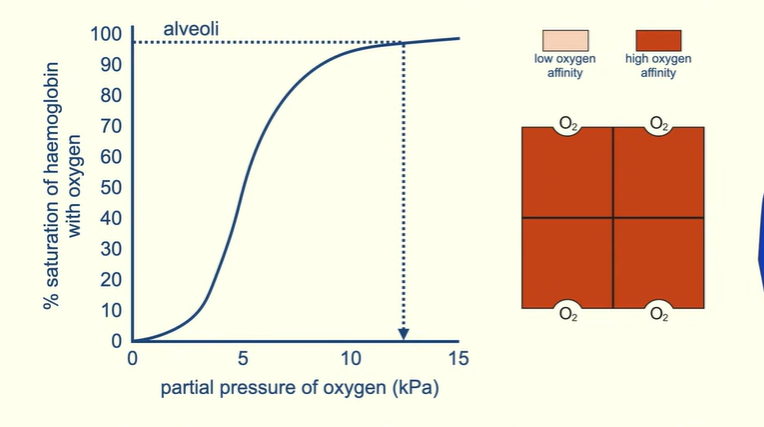
Whats happening in the alveoli
The partial pressure of the oxygen is high, and haemoglobin in red blood cells is around 97% saturated, however as red blood cells make their way into the body tissues, the partial pressure of oxygen decreases as the tissues are carrying out aerobic respiration.
At a certain point, one oxygen molecule now unloads from haemoglobin molecule, this unloading changes the quaternary structure of haemoglobin molecule, the effect of this is to decrease the oxygen affinity of remaining haem groups.

What happens if RBC move into more active tissue
The oxygen partial pressure will be even lower, and two more oxygen molecules will rapidly unload from haemoglobin molecule.
What must happen for final oxygen molecule to unload
The partial pressure of oxygen has to be very low, this is unlikely to happen under normal conditions, but could take place in very active tissue e.g muscle tissue during very intense exercise.