BIO 110 Exam 1 Clark 2026 University of Rochester
 Call Kai
 Learn
Learn Practice Test
 Spaced Repetition
 Match
Match Flashcards
 Knowt Play
1/85

Earn XP
Description and Tags
Name | Mastery | Learn | Test | Matching | Spaced | Call with Kai | Chat |
|---|
No analytics yet
Send a link to your students to track their progress
86 Terms
Approximate percents of human composition?
70% Water
15% Proteins
4% Small molecules
6% RNA
2% Phospholipids
1% DNA
2% Polysaccharides
Defining traits of living things + describe
Cellular organization
cell = smallest structure capable of life processes / basic unit of life on Earth
Energy
acquire and use
Homeostasis
maintaining stable internal environment despite external changes
Information
Hereditary information made mostly of DNA sequences
Metabolism
all chemical reactions that sustain life (acquire/transform/use energy & matter)
highly regulated to avoid energy waste
enzymes often interconnected in metabolic pathways
Growth & Reproduction
Growth heavily regulated (lack/excess can be lethal/cancerous)
Reproduction includes copying hereditary info and is required avoid extinction
All cells originate from other cells
Respond to change/stimuli
Evolution (long-term over population)
Prokaryotes vs Eukaryotes
Prokaryotes = single-celled, lack nucleus (has nucleoid), lack membrane-bound organelles/internal structures
Eukaryotes = single-celled or multi-cellular, have nucleus, have membrane bound organelles/internal structures
What are the 3 domains of life and what led to what after the last universal common ancestor (LUCA)?
Bacteria, Eukaryotes, Archaea
Eukaryotes merged from Bacteria and Archaea
Which organelles used to be independent bacteria?
Mitochondria and Chloroplasts
Structure determines ______ (for most biological molecules)
function
Anabolism vs. Catabolism
Anabolism = build together, requires energy
Catabolism = breaks apart, releases energy*
*(because the formation of more stable bonds releases more energy than it takes to break the original bonds)
The Scientific Method
Observation [and description of phenomenon]
Questions
Hypothesis (states the relationship between 2 variables; best attempt to answer question)
Predictions (including the existence of other phenomena or quantifying what the results may be — “If ___, then ____.”)
Experimental tests (+repeat)
What conclusions can we make about a null hypothesis?
Reject or fail to reject
Controlled experiment vs. Comparative experiment
Controlled experiment = starts with groups that are as similar as possible and only manipulates one independent variable to see impact on dependent variable [in comparison to an unmanipulated control group]
Comparative experiment = starts with the prediction that there will be a difference between 2 or more naturally existing groups (based on the hypothesis) and compares unmanipulated data
What characteristics make a project more experimental?
Manipulation + hypothesis test
Independent vs. Dependent variable
Independent variable is manipulated, and dependent variable changes in response
Experimental group vs Control group
Experimental group = exposed to the independent variable
Control group = exposed to all the same conditions as the experimental group EXCEPT the independent variable
Null hypothesis
States that there is no relationship between 2 variables, and any observed differences are due to random chance
Negative vs. Positive control
Negative control = group where no phenomenon is expected (guarantees no effect)*
Positive control = group where the phenomenon is expected (guarantees desired effect)
*careful of double negatives!!! eg) phenomenon we’re looking for is “cells not growing / lack of cell growth,” so the negative control would make sure cells DO grow, while positive control would ensure no cell growth
What was chosen as the indicator for life on mars and why? (1970s experiment)
CO2 (from oxidizing radioactively-marked carbon)
It assumes that life on mars uses a similar system to cellular respiration, which reflects a broader goal of people possibly being sustained there.
Elements in each biomolecule
Carbohydrates = CHO
Lipids = CHO (less O in comparison to carbs)
Proteins = CHONS
Nucleic Acids = CHONP
How can you test which way a reaction will proceed?
Put equal concentrations of reactants and products;
if the concentration of products increase, it proceeds forward/right
if the concentration of reactants increase, it proceeds in reverse/left
if the concentrations remain the same, the reaction is already at equilibrium
Equilibrium
Rate of forward reaction = rate of reverse reaction
Equilibrium constant equation

Total free energy change equation[s] & explanation[s]
ΔG = [Energy]products - [Energy]reactants
negative if reaction is spontaneous and releases energy (exergonic)
positive if system isn’t spontaneous and needs energy (endergonic)
or
ΔG = ΔH - TΔS = enthalpy - entropy
only use if you can explain enthalpy (heat content of system — negative if heat is release / exothermic, positive if heat is taken from surroudnings / endothermic) and entropy (disorder of system — positive = products are simpler / more disordered)
Which way does a reaction proceed relative to the energies on each side?
Higher energy —> Lower energy
Relationship between Keq, ΔG, and direction that the reaction proceeds
direct relationship between Keq and ΔG
ΔG = -RTlnKeq

Endergonic vs. Exergonic reaction
Endergonic = reaction requires energy
Exergonic = reaction releases energy
Energy coupling
Energy from a favorable reaction can go straight into an unfavorable reaction that requires energy
Chemical bonds and interactions + descriptions
Covalent bond = sharing of electron pairs; strongest
Ionic attraction = attraction of opposite charges (pretty strong for noncovalent)
Hydrogen bond = interaction between partially positive H and partially negative O, F, or N (pretty strong for noncovalent)
Hydrophobic interaction = interaction of nonpolar substances clustering together in the presence of polar substances (like water)
van der Waals interaction = temporary/brief interactions of moving electrons of nonpolar substances; weakest
Electronegativity
atom’s attraction strength towards electrons (tendency of atom to pull electrons to itself)
Compare electronegativities of H and C, O, and N
C=H
O>H
N>H
(determines partial charges for hydrogen bonding between H and O or N and how C-H bonds are covalent/nonpolar)
Up to how many hydrogen bonds can a water molecule make?
4 max
Explain the hydrophobic interaction with grouped objects in relation to entropy, order, and energy efficiency
Two nonpolar substances being separately surrounded by water = lower entropy, highly ordered, less efficient regarding energy
Two nonpolar substances grouped together and surrounded by water = higher entropy, less order, more efficient regarding energy
Condensation vs. Hydrolysis
Condensation removes water to form a bond between monomers
Hydrolysis adds water to break a bond between monomers
Prokaryote structures
Single or double plasma membrane
Sometimes cell wall {made of peptidoglycan}
Nucleoid (region of free-floating DNA)
Sometimes flagellum (for locomotion)
Free-floating ribosomes
Eukaryote structures + descriptions
Plasma membrane = selective fluid barrier controlling transport in & out of cell through phospholipid bilayer; proteins embedded for transport, signaling, & structure; primarily held by hydrophobic interactions
Mitochondria = ATP production through cellular respiration; has double membrane
Cytoskeleton = structural support, transport, and cell movement through network of protein filaments; actin & myosin help cell change shape
Nuclear pores = protein complexes in nuclear envelope that regulate transport between nucleus and cytoplasm (like with RNA/proteins)
Nucleolus = rRNA synthesis and ribosome assembly; not membrane-bound (inside nucleus)
Nucleus = genome storage and transcription; surrounded by double membrane (nuclear envelope); site of RNA synthesis
Endoplasmic reticulum = membranous tubules connected to the nuclear envelope:
Rough ER = has ribosomes; protein synthesis & modification [for secretion / membrane insertion / organelles]
Smooth ER = lacks ribosomes; lipid synthesis [+detoxifies chemicals and stores calcium]
Ribosomes = protein synthesis (free-floating makes proteins for cytoplasm/nucleus; rough ER makes for secretion/membranes); made of rRNA and proteins
Golgi = stacks of membranous sacs; modifies, sorts, and ships proteins and lipids; one side receives vesicles from ER, other ships vesicles to organelles or plasma membrane
Vesicles = membranes that transport molecules
Centrioles = organizes microtubules (which make up spindle fibers & maintain cell shape) for cell division and motility (ability to move)
Interactions between ER and Golgi
Proteins/lipids from ER go to Golgi to be modified {by glycosylation and phosphorylation}
Golgi returns some [escaped] proteins/membranes to ER for recycling
-transport between them happens through vesicles
What aspects of mitochondria point to their endosymbosis?
Having its own maternal circular chromosome
Having its own ribosomes
Unique structures of plant cell + descriptions
Central vacuole = maintains turgor pressure (lots of water —> structural support) and stores water & ions {+tonoplast = its membrane and helps maintain cell pressure/homeostasis}
Chloroplasts = carry out photosynthesis
Cell wall = made mostly of cellulose; gives structural support/protection and maintains cell shape {+plasmodesmata = channels between cell walls for direct transport/communication}
How do proteins go where they should?
Their last string of amino acids acts as a signal sequence that is recognized by specific receptors
Motor proteins + examples
move along cytoskeletal filaments to transport organelles and vesicles + help cell movement
eg) Kinesin uses ATP to move along microtubules with cargo; Dynein does the same thing in the opposite direction; Myosin is similar but with actin filaments
Fluorescence microscopy
fluorescent dyes bind to specific cell structure to help visualize them
Immunohistochemistry
visualizes proteins under a microscope by using antibodies that bind to antigens (target molecule; often proteins) — antibodies can then be attached to glowing molecules
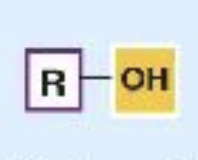
Hydroxyl group
Carboxyl group

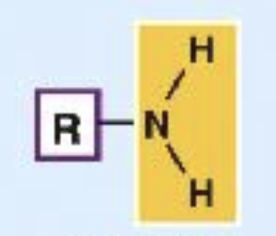
Amino group
Phosphate group

Biomolecules, their monomers, polymer/macromolecule examples, functions
Carbohydrates — monosaccharides eg) glucose — polysaccharides eg) starch, glycogen, cellulose — short-term energy storage, structural support
Lipids — fatty acids — triacylglycerol, membrane lipids — long-term energy storage, insulation, membrane structure (compartmentalization)
Proteins — amino acids — peptides & polypeptides — build muscle/structure, enzymes facilitate reactions
Nucleic Acids — nucleotides (1 nitrogenous base, 5-carbon sugar, phosphate group) — DNA, RNA — store genetic information, encode proteins
Amphipathic
Compound with both hydrophilic and hydrophobic regions
Glycosidic bond
covalent bond between sugars formed by condensation
Monosaccharide vs. Polysaccharide solubility
Monosaccharides are very H2O-soluble, while polysaccharides will need enzymes to speed up dissolving (still soluble, just don’t break as easily)
What does replacing hydroxyl groups (OH) in carbohydrates do? What are some replacement options?
Specializes sugar functions
Can be replaced with H (deoxy), amine (NH2), phosphate (PO4), N-acetyl amine
Types of polysaccharide structures, how their bonds affect functions, and examples
Linear = used for structural support; hydrogen bonds between hydroxyls within same molecules, making it stronger but more hydrophobic; eg) cellulose, chitin
Branched = digestible; water can perform hydrolysis with multiple hydroxyl ends at once to release glucose (which can be oxidized for energy); eg) glycogen, starch
Triacylglycerol vs. Membrane lipid
Triacylglycerol = main form of long-term energy storage (+insulation); 3 fatty acid tails connected to 1 glycerol
Membrane lipid = amphipathic to create phospholipid bilayer; 2 hydrophobic fatty acid tails connected to 1 glycerol and a hydrophilic/charged head (like a phosphate group)
Why are lipids more efficient at long-term energy storage than carbohydrates?
Lipids have more energy per carbon because of their oxidation state (carbohydrates are easier to oxidize into CO2 because they have less high-energy C-H bonds) and don’t have to store water like glucose does, taking up less space
Saturated vs. Unsaturated fatty acids
Saturated = straight single bonds and packs together better
Unsaturated = has kinks from double bonds, which makes harder to pack; can survive lower temperatures
cis vs. trans unsaturated fatty acids
cis = natural and often healthier
trans = associated with processed foods and often less healthy
Draw and label general amino acid structure + circle parts that will make water
N-terminus / amino group = left (NH3+ or NH2)
C-terminus / carboxyl group = right (COO- or COOH)
any of the Hydrogens on the amino group can make water, just only choose 2 for NH3+ or 1 for NH2 — also different than interacting with water; every part can interact with water, though the R-group may not be able to depending on what it contains
~either or for drawing—just stay consistent and be careful with charges

Draw 2 general amino acids making a peptide bond
~either or for drawing—just stay consistent and be careful with charges

Which dimensional isomer are almost all amino acids?
L isomer (the left-handed one, as opposed to D isomer)
Nonessential vs. Conditionally Essential v. Essential amino acids
Nonessential = human body makes on its own
Conditionally Essential = human body can make, though not enough under certain conditions (eg: during pregnancy)
Essential = humans must eat to get (can’t make on their own)
Five types of R groups and how they interact with water

How many amino acid types are peptides chained with? Is this the number of amino acid types that proteins can have?
20 types of amino acids are usually chained as peptides, but proteins can then be modified to allow for many more types
Native structure
functional [folded] state of protein
Residues
Amino acids linked to a peptide chain after losing H2O
What direction are peptides synthesized (start to end)?
N terminus (amino group) to C terminus (carboxyl group)
Polypeptide/protein structures and bonds that stabilize each
Primary structure = linear amino acid sequence; order defines how the protein will fold and function; has covalent peptide bonds
Secondary structure = hydrogen bonds between alpha helices (intramolecular H-bonds) and beta sheets (inter- or intramolecular H-bonds between beta strands) [NOT between R-groups] +covalent peptide bonds from before
Tertiary structure = folding with help of the 4 types of noncovalent interactions/bonds (especially the hydrophobic effect) & disulfide bonds [between R-groups] +all bonds from past structures
Quaternary structure = two or more polypeptide chains bonded with same bonds as past structures (especially those 4 noncovalent and disulfide bonds); just multiple bonded tertiary structures
What is the original method that protein structure was discovered through? What was built off this to do so faster?
X-ray crystallography
AI trained on patterns from^^^
Denaturing + some methods & the bonds they break
Denaturing proteins means to unfold their tertiary structure, which can happen by:
heat (breaks hydrogen bonds and other weak noncovalent interactions)
extreme pH (mainly breaks ionic bonds [due to H+ ions changing charges] and hydrogen bonds [because of partial charge interference])
detergents (mainly breaks weak noncovalent interactions like hydrophobic interactions [since it has nonpolar regions] and ionic bonds [if it has a charge])
mechanical agitation (breaks weak noncovalent interactions)
urea (breaks hydrogen bonds and hydropobic interactions [because it’s a strong H-bond donor/acceptor])
mercaptoethanol (breaks disulfide bonds)
Why do denatured proteins tend to be less soluble than the native protein?
Because the unfolding exposes their hydrophobic regions
Can proteins be renatured?
Yes, if their primary structure remains intact
Cooperativity of folding (cooperative process)
Polypeptide/protein bonds are NOT independent—all bonds have to be able to form to bring about the fully functional structure; if even some bonds are broken, the protein won’t properly fold / bond between the correct regions
in folding, polypeptide chain goes from high energy & high entropy (unstable) to low energy & low entropy (stable)
What is the pattern for α-helix bond formation?
Hydrogen bonds are formed* between every 4 residues (eg: #2, #6, #10…) between C=O and N-H (eg: O of #2 interacts with H of #6, O of #6 interacts with H of #10…)
*only between parts of the polypeptide backbone, NOT R-groups
What from the secondary structure may be maintained in the tertiary structure?
α-helices and β-sheets
Peptide vs. Polypeptide vs. Protein
Peptide = short chain of amino acids
Polypeptide = longer chain of amino acids that may function by itself or form a larger protein
Protein = one or more polypeptides that is folded to its functional/native structure
Antifreeze proteins structures & functions
Flat, hydrophilic side binds to small ice crystals while its irregular, hydrophobic region repels water to prevent further [larger] crystal growth
makes it thermodynamically unfavorable to add water molecules to the ice lattice
Evenly spaced hydroxyl (OH) groups on flat side allows for H-bonds with the crystalline ice lattice
has some hydrophobic parts on the flat side just to line up with crystal shape
Mucin glycoprotein structures & functions
Carbohydrate chains = hydrophilic and bind to water to create thick, viscous layer of protection (where pathogens get stuck to be destroyed)
Dimerization domains = regions to chain to more mucins, increasing total thickness
Cysteine residues = found throughout to allow disulfide bonding between more mucins (again, increasing thickness)
Only has small hydrophobic sections so that if denatured (like during a fever), those parts will open up for the mucins to group together at (again, increasing thickness)
+these extracellular glycoproteins can be membrane-bound or secreted
When can carbohydrate chains be added to proteins (glycosylation)? Where does this happen?
During post-translational modifications in the Rough ER* and Golgi
*instead of free-floating ribosomes since they lack specialized enzymes
How do K+ channels filter for the correct charge & size of ion?
Channels are lined with negative carbonyl oxygens, ensuring that only positive ions (cations) go through
Ions that are too big won’t fit through the channel
Ions that are too small will attract the negative walls together, making the channel close by collapsing in
Enzyme functions + where it gets energy for reaction from
Catalysts for biochemical reactions
almost always proteins
stabilize transition state, lowering reaction’s activitation energy requirement and speeding up the process
the bonds made between the enzyme and substrate in its induced-fit is where the rest of the energy comes from
often end in “-ase” (NOT -ose, which is for carbs)
Why are catalysts highly regulated?
Reactions shouldn’t be happening all the time — this would unnecessarily waste energy
Enzyme cofactors
Additional groups attached to enzyme to allow for specific functions
common eg) metal ions (for electron transfer)
eg) coenzymes = cofactors that contain carbon (organic)
6 types of chemical reactions catalyzed by enzymes
Oxidoreductases = oxidation or reduction reactions (electron is removed/added)
Transferases = moving chemical groups from one place to another
Hydrolases = breaking chemical bonds with water (facilitate hydrolysis)
Lyases = breaking chemical bonds without water
Isomerases = changing molecular shape (same atoms/formula, different arrangement)
Ligases = connect two molecules (facilitate covalent bond formation)
Lock-and-Key vs. Induced-Fit Model
Lock-and-Key Model = outdated; idea that substrate fits exactly into complementary enzyme
Induced-Fit Model = more accurate; enzymes are flexible and have a confirmational change in their shape to tightly fit around a substrate {has a more complementary binding site} (+makes more sense for why multiple substrates can bind to one enzyme!)
Specificity (with enzymes) & what it’s based on
Ability of enzyme to choose / bind to a specific substrate amongst similar molecules
Based on the structure of the active site
Why are enzymes globular instead of just having an active site?
The rest of the protein’s structure regulates the protein and is essential in forming the active site with the correct shape (during folding process)
How catalysts relates to equilibrium / ΔG and the activation energy
Catalysts do NOT change the equilibrium / ΔG of a reaction — they just lower the activation energy
Rate enhancement (with enzymes)
Factor by which catalyst increases the rate of reaction
Ways to regulate enzymes
Covalent modification = addition/removal of chemical groups to enzyme’s residues to alter its shape/properties (like charge)
Allosteric modulators = non-substrate molecules that bind to secondary location (allosteric/regulatory site) on enzyme to increase/decrease its catalytic activity (activator increases, repressor decreases)
repressors are an example of noncompetitive inhibitors = molecule that reduces enzyme’s activity by binding to allosteric site [which changes the enzyme’s shape]
Competitive inhibition = non-substrate molecule blocks enzyme’s active site from binding to the substrate