PSY- lecture 4 Growing and Learning in the Preschool Years (copy)
 Call Kai
 Learn
 Practice Test
 Spaced Repetition
 Match
 Flashcards
 Knowt Play
1/72

There's no tags or description
Looks like no tags are added yet.
73 Terms
Growth of the Body for early childhood
Slower growth than in infancy
On average
Increase 3 kilograms and 5–8 centimeters per year
Proportions become less top-heavy
Nutritional Needs and Issues
Calories/kilogram need decreases as growth slows
Many children become picky eaters
This may be adaptive – eating only familiar foods can keep them safe
Almost all children still eat enough for growth and health
Sleep for Preschoolers
Most trade their afternoon nap for more nighttime sleep at about age 4
Sleep comes without too much trouble for most, but about 20–35% have sleep issues
Some have trouble settling down if parents have not established a consistent bedtime routine
Others have sleep disturbances
Nightmares
vivid, frightening dreams occurring toward morning, that usually wake the dreamer
Occasional nightmares are normal
Generally happen in REM sleep
Recall is vivid at first
Night terrors
a byproduct of wakening too rapidly from deep sleep, in which the child appears to wake in a panicked state, is typically nonresponsive, goes back to sleep quickly, and doesn’t remember the incident in the morning
Frightening for parents
Not typically dangerous in any way
Don’t usually have narrative dreams attached to them
Sleepwalking
when children are in deep sleep and do not awaken but get out of bed and walk
Best to gently return them to bed
Automatic behaviours are common
Usually earlier in the night, coming out of nonREM sleep
If frequent, create a hazard-free environment
Bedwetting
Bedwetting occurs in about 10–15% of 5-year- olds
It is important to eliminate feelings of guilt and shame
Punishment increases stress and can make it worse
A conditioning alarm system is often helpful as treatment
What are the 2 types of bedwetting?
Primary and secondary bedwetting
Primary bedwetting
is not a concern, developmentally.
Secondary bedwetting
wetting that re-occurs after the child has been dry for over half a year – can indicate abuse or disturbance in their life
Gross Motor Skills: Beyond Walking
During early childhood, children begin
Walking with more ease
Running, with the ability to easily change direction and speed
Skipping
Hopping
Standing on one foot
Fine Motor Skills
At 2 or 3, children can put on simple clothing and use zippers
At 3 or 4, they can use buttons
At 5, they can dress and undress, except for tying shoes
At 6, they can tie shoes (allegedly)
Printing and drawing
In terms of printing and drawing
2-year-olds scribble
4- and 5-year-olds can draw recognizable objects
Gross and Fine Motor Development in preschoolers

Handedness
Cause of handedness is unclear
Many suspect a genetic contribution
Handedness seems to run in families
French Quebeckers are more likely to be left-handed than other Canadians
Environment definitely plays a role
Hand preference becomes stronger and more consistent during the preschool years
Lateralization
certain cognitive functions are located on one side of the brain more than the other
Because motor skills are controlled by the opposite hemisphere, some researchers believe in a link between handedness and lateralization
Some imaging and EEG studies will ask for only right-handed participants for this reason
Cognitive Development: Piaget’s Account
Schemes are now based primarily on functional or conceptual relationships, rather than actions
e.g., dogs, cats, and goldfish form a scheme, a category of “Pets”
Preoperational Thinking
This is the first stage in which symbolic thought becomes possible
The preoperational child can form mental representations
Egocentrism
difficulty in seeing the world from another’s point of view; typical of children in the preoperational period
Piaget’s three-mountains task is considered a classic test of egocentrism
Animism
crediting inanimate objects with life and lifelike properties such as feelings
Seen as an offshoot of egocentrism
Since the child has thoughts and feelings, everything must
Most common in objects with faces, or objects that move
Centration
according to Piaget, narrowly focused type of thought characteristic of preoperational children
They often can focus on only one aspect of a situation at a given time
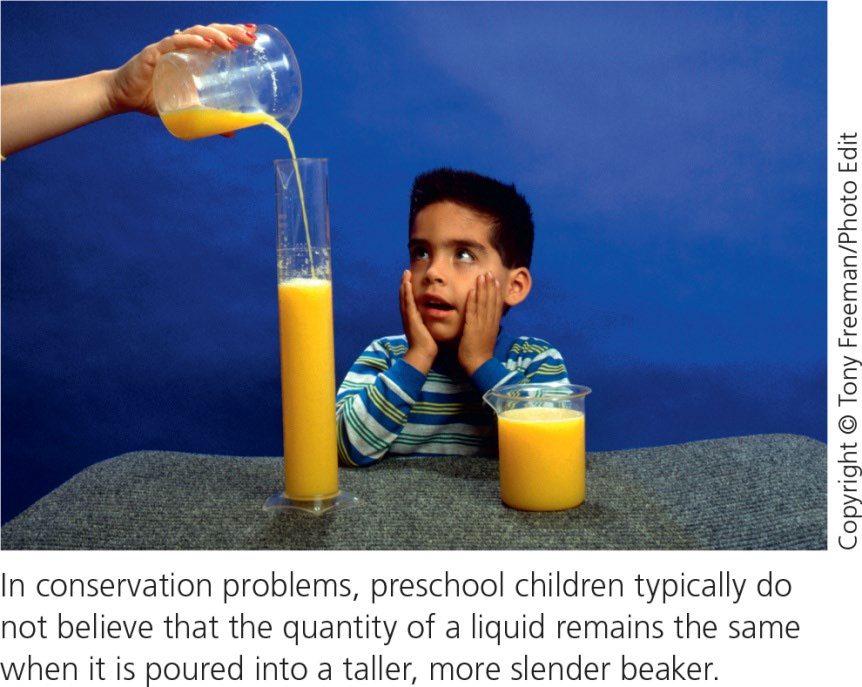
Conservation Problems
Seen as one reason why preoperational children fail to solve conservation problems designed to show whether they realize that changing appearance does not change amount or quantity
If this child focuses only on fluid level, he will assume the taller beaker contains more juice
Contributions of Piaget’s Theory
Piaget’s theory tells us that
Cognitive growth occurs as children construct their own understanding of the world
Implies that teaching will go more smoothly for young children if you encourage them to ‘discover’ what you’re teaching
Children profit from experience only when they can interpret this experience within their current cognitive structures
Implication for teaching: Material should be just ahead of child’s current knowledge; if it is too far ahead, learning will be impossible.
Criticisms of Piaget’s Theory
Piaget’s theory has also received criticisms
` Does not account for variability in children’s performance
Cognitive development is probably not nearly as stagelike as he suggested
Undervalues the influence of the sociocultural environment
Different conservation tasks are mastered at different times.
A child who is advanced in one domain of thinking may be average in another, and behind age-mates in yet another.
Bandura’s social learning theory
tells us that children learn how to accomplish some tasks just by watching others
Autobiographical memory
memories of the significant events and experiences of one’s own life
Believed to emerge gradually in early childhood as children acquire component skills
Basic memory skills to remember past events
Language skills for conversing about memories
Sense of self
Once children can talk about memories, parents guide them through remembering events, teaching them the important parts to remember.
When parents talk about past events in detail and encourage children to expand their descriptions of past events, we see earlier autobiographical memories.
Preschoolers as Eyewitnesses
Preschoolers are not particularly skilled at source monitoring, identifying the source of a memory
If you tell or ask them about an event that did not occur, they may confuse what you have said with actual events
When preschoolers are eyewitnesses, it is important to
Interview children as soon as possible after the event in question
Encourage children to tell the truth, to feel free to say “I don’t know,” and to correct interviewers when they say something that is incorrect
How do you ask Preschoolers questions as Eyewitnesses
When preschoolers are eyewitnesses, it is important to
Start by asking children to describe the event in their own words
Follow up with open-ended questions
Minimize the use of specific questions
Allow children to understand and feel comfortable in the interview format by beginning with a neutral event before moving to the event of interest
Joint attention
helps with word learning, but may not be necessary
Children learn new words that they overhear in the conversations of others
Developmental Change in Word Learning
At about age 2, children’s word learning increases significantly, showing greater use of
Language cues
Speaker’s social cues
Constraints on Word Names
There are several rules children seem to apply to new words they hear
If you already know the name for one object, a new name presented belongs to something else
“Grab the calculator on the table.”
If the new name definitely applies to that object, it denotes a subcategory of the original name
This is my poodle, Bippy.
Rules children apply to new words they hear
A name refers to a whole object, not its parts or its relation to other objects
It also applies to all objects of the same type
If it is consistently applied to that object only, it is a proper noun
Sentence Cues
Children can determine what type of word a new word is by how it is used in a sentence
Consider
– “I have a new pag.”
– “I just read a pag book.”
– “I was outside pagging yesterday.”
– “You did that quite pagly.”
Cognitive Factors
Development of intentions provides motivation to learn the language necessary to express those intentions
Improvements to attention and perceptual skills help children learn words and notice the basis for generalization
Words are usually generalized to other objects of similar shape
If I show you a round red object and call it a “ball,” you’re more likely to assume the word “ball” also applies to a round green object than to assume it applies to a square red object.
Underextension
when children define words more narrowly than adults do
“My pet is called a dog. Your pet has to be something else.”
Overextension
when children define words more broadly than adults do
Child looks at a horse. “What a big dog.”
Might still know the word horse, just couldn’t think of it
Bilingualism
Bilingual children
– Are often a little slow in language progress at first
– Catch up quickly
– Usually have larger total vocabularies than monolingual children, but slightly smaller vocabularies in each language
What are some advantages associated with Bilingualism
Better at understanding the symbolic and arbitrary nature of words
Better at switching back and forth between tasks
Better at inhibiting inappropriate responses
Encouraging Language Growth
Parents can encourage language growth by
Talking to children often
Especially by naming objects that are the focus of children’s attention
Reading to children often
Especially by carefully describing pictures, and asking children questions during reading
Encouraging Language Growth for preschoolers
Educational programs that ask children direct questions can help
Especially when the child watches with an adult
Sesame Street, Thomas the Tank Engine, Blue’s Clues, Dora the Explorer
Cartoons and other non-educational programs do not help
Paw Patrol, Kate and Mim-mim, Animal Mechanicals
Encouraging Language Growth for infants
For infants, not even educational videos help
Most are not well designed or developmentally appropriate
Infants have difficulty relating what they see in videos to objects and actions as experienced in their own lives
Speaking in Sentences: Grammatical Development
Young children often use common “formulas” for combining words
actor + action - “Mommy sleep.” “Timmy run.”
action + object “Gimme cookie.” “Throw ball.”
possessor + possession - “Kimmy pail.” “ Maya shovel.”
Telegraphic speech
speech used by young children that contains only the words that are necessary to get a message across
Grammatical morphemes
words or endings of words that make a sentence grammatical
are gradually acquired during the preschool years
overregularization
grammatical usage that results from applying rules to words that are exceptions to the rule
e.g., “I don’t want to wear socks, I’ll wear my feets.”
These can easily linger in speech until 5 or 6 years old if not corrected
B. F. Skinner and Behaviourist
ascribe children’s grammar learning to imitation and reinforcement
They imitate their parents and other adults
They are differentially reinforced for correct utterances
Problems with this approach
they produce utterances they’ve never heard
don’t imitate adults’ grammar until they’ve learned those grammatical forms for themselves
are usually reinforced for the factual correctness, not grammatical correctness.
The Linguistic Answer
Children are born with mechanisms that help them process language in helpful ways
The idea of some sort of inborn “grammar learning processor” is supported by several findings:
There are specific brain regions that are activated when sentences break simple grammatical rules
Efforts to teach grammar to nonhumans fail, suggesting neural mechanisms unique to humans
Grammar mastery and vocabulary growth are related in a way that suggests they are part of a common, emerging language system
There is a critical period for language learning, from birth to about 12 years
The Cognitive Answer
Children have powerful cognitive skills that help them to detect regularities in their environment
This includes patterns in the speech they hear
The Social Interaction Answer
Focuses on social interaction and motivation
Children are motivated to express themselves
Parents are motivated to teach and understand their children
Communicating with Others
Three key elements for effective oral communication are gradually learned:
People should take turns, alternating as speaker and listener
Parents often begin to encourage turn-taking in infancy, speaking to the infant and pausing for a response
By age 2, spontaneous turn-taking is seen in conversations between children and adults.
When speaking, your remarks should be clear from the listener’s perspective
When listening, pay attention and let the speaker know if his or her remarks do not make sense
By 3, they’ll repeat their last remarks if the listener doesn’t respond promptly.
What are two general dimensions of parenting
warmth and responsiveness
control
children tend to thrive best when parents are high in warmth and intermediate in control
What are the four prototypes of parenting styles
authoritative
indulgent oermissive
authoritarian
indifferent-uninvolved
Authoritarian parenting
parents show high levels of control and low levels of warmth toward their children
Authoritative parenting
parents provide a balance of warmth and structure and are responsive to their children
Indulgent–permissive parenting
parents are warm and caring but exert little control over their children
Indifferent–uninvolved parenting
parents are neither warm nor controlling and try to minimize the amount of time spent with their children
Which style do children respond to best?
There is some variation (esp with regards to cultural differences) but authoritative works best for most (North American/Western) children most of the time
They have higher grades
They are more responsible and self-reliant
They are friendlier
In authoritarian parents children are often?
Are unhappy
Have low self-esteem
Are overly aggressive
With indulgent-permissive parenting, children often?
Are impulsive
Have little self-control
With uninvolved parenting, children often?
Do poorly in school
Are aggressive
Direct instruction
telling a child how, when, and why certain behaviours are important
Explaining the reason for important behaviours helps children understand other people’s feelings, develop self-control, and internalize values
Modelling
occurs when children learn appropriate behaviour by watching their parents engage in that behaviour
Counterimitation
learning what should not be done by observing the behaviour
Often occurs when children see a sibling face Consequences for rule-breaking
Reinforcement
refers to any action that increases the likelihood of the response it follows
Punishment
refers to any action that decreases the likelihood of the response it follows
Negative reinforcement trap
unwittingly reinforcing a behaviour you want to discourage
Classic example: Mom tells son to clean his room. Son whines, argues, and complains. Mom gives in, teaching son that whining, arguing, and complaining get him what he wants.
Occurs most often between mothers and sons.
Physical punishment problems
Increased aggression
Mental health problems
Impaired parent–child relationships
Delinquent and antisocial behaviour
Delayed cognitive development
Increased incidence of child abuse
Three ways in which parental conflict affects
children’s development
Jeopardizes the child’s feeling that the family is stable and secure, producing feelings of anxiety, fear, and sadness
Spills over into the parent–child relationship, as parents begin to adopt the same ineffective styles of interacting with their children as they do with each other
When parents spend much time and energy fighting with each other, they have less to put into high- quality parenting
When might children also experience stress
Parents become unemployed or they worry parents will become employed
Parents suffering from work-related stress withdraw from family interaction or become less accepting of their children
Two characteristics of children that have major influence on parental behaviour
age
temperament and behaviour
Age
As children age, we see changes in both warmth and control
Parents remain warm, but their expression of that warmth changes
Cuddling a toddler and a teenager is not going to produce the same effect
Parents grant more autonomy, and expect more responsible behaviour as children get older
Temperament and Behaviour
We often see easiest relations when parents and children have similar temperaments
When temperaments and interests are different, less time may be spent together, and the parent may see the child as resistant to time together (rather than simply to the chosen activity)
Open communication (e.g., “I don’t want to go fishing with you, Dad, because I don’t really like hanging outside. I’d rather draw.”) can make a big difference here, especially if parents try to be understanding and tolerant.