Week 1: Acute Coronary Syndrome
 Call Kai
 Learn
Learn Practice Test
 Spaced Repetition
 Match
Match Flashcards
 Knowt Play
1/14

There's no tags or description
Looks like no tags are added yet.
Name | Mastery | Learn | Test | Matching | Spaced | Call with Kai | Chat |
|---|
No analytics yet
Send a link to your students to track their progress
15 Terms
Coronary Artery Disease
what is it
Risk factors (11)
s/s (7)
TX (7)
DX (7) (4 are labs)
PT Education (9)
CAD: Narrowing of the coronary arteries d/t atherosclerosis (plaque build-up in arteries from cholesterol deposits)
Risk Factors:
smoking and alcohol use
HTN
overweight/obesity
diabetes
high cholesterol
stress
sedentary lifestyle
Family Hx
Advanced age
race (African American)
gender (male)
Symptoms:
May show no s/s
chest pain that goes away with rest
diaphoresis
SOB
Heartburn
n/v
fatigue
DX:
EKG
Stress test
cardiac catheterization
Labs: HDL >60 and LDL <100 (cholesterol), triglycerides <150, total cholesterol: <200
TX:
Right away MONA (Morphine, O2, Nitroglycerin, Aspirin)
Antihypertensives
atherectomy: removal of plaque from artery
percutaneous coronary intervention (PCI): unblocks arteries to restore blood flow with balloon and possible stent placement
Patient Education:
Smoking cessation
Moderate exercise 3-4 times/week
stress management
weight managment
monitor HR and BP
Diet: low sodium, low saturated fat, increase fiber and fruits and veggies

A myocardial infarction (MI) is commonly known as what?
Heart attack
When someone is presenting with crushing chest pain what should you always assume until proven otherwise
MI
MI: Treatment and diagnostic
DX (imaging, procedures, labs, ect..) (3)
TX (8) (right away 4, later on 4)
DX:
12 lead ECG!!!
Troponins (now, 2hrs, and 4 hrs) (follow trend might not increase for a while)
chest x-ray
TX:
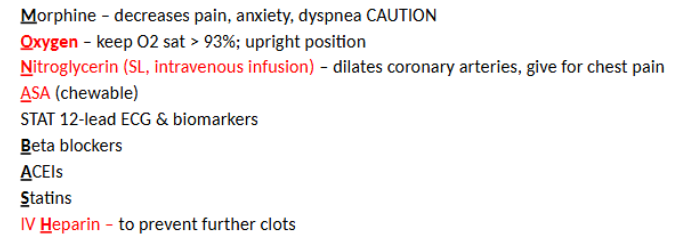
Right away: MONA (Morphine, O2, Nitroglycerin (can give 1 up to 3x Q5mins), Aspirin(chewable))
Later on: BASH (Beta blockers, Ace inhibitors, Statins, IV Heparin)
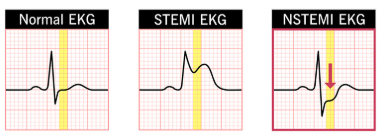
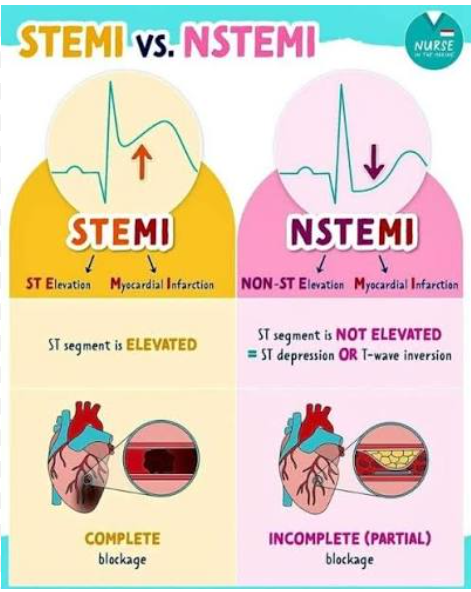
STEMI vs NSTEMI
Clinical Manifestations of Acute coronary syndrome (ACS): Unstable angina-
_____ blockage
describe (3)
what to keep in mind in terms of different presentations in different populations
what on a ECG = ischemic changes (2)
is this life threatening
temporary blockage
new pain, onset with ordinary physical activity
OCCURS AT REST, usually prolonged (> 10 minutes)
increased angina that is more frequent and longer in duration
Keep in mind:
Some women, older adults, and diabetics may not have chest pain but present with exertional symptoms (triggered or caused by physical or mental effort) of jaw, neck, arm; fatigue, nausea, unexplained worsening of exertional dyspnea
*ST depression and/or T wave inversion = ischemic change!!!
*Needs immediate treatment!!!
Clinical Manifestations of ACS Myocardial Infarction – _____ blockage
describe
s/s (6)
location (2)
may radiate to (5)
typically lasts how long
Drive mnenomnic for MI presentation
when does it often occur
Atypical presentation in what populations? (3)
other s/s (4)
Prolonged blockage
MI: Severe chest pain not relieved by rest, position change, or nitrate administration
• Heaviness, pressure, tightness, burning, constriction, crushing
• Substernal or epigastric
• May radiate to neck, lower jaw, arms, back, may follow ulnar nerve to pinky
• TYPICALLY LASTS > 20 MINUTES (CRUSHING, GRIPPING, HEAVINESS
DRIVE: (Diaphoresis, Radiation, I won’t get burned (burning), Vomiting, Exertion)
Often occurs in early morning
Atypical in women, elderly and diabetics (No pain if cardiac neuropathy)
Other s/s – JVD, HF, decline in BP, and Increased temperature up to 100.4 F (38C)

Unstable Angina and MI: Diagnostic Studies
DX procedures, imaging labs, ect… (2) (what testing is only done on stable patients and what other criteria? (1))
Serum cardiac Biomarkers (3)
Procedures (1) (when is this procedure used 3)
DX for angina and MI:
12-lead ECG, distinguish between STEMI and NSTEMI)
stress testing: for STABLE patients with abnormal but non-diagnostic ECG and negative biomarkers
Biomarkers:
cardiac specific troponin (cTnT, cTnl, Hs-cTn)
creatine kinase (CK-MB)
myoglobin
Procedures:
coronary angiography (heart Cath or cardiac cath):
For patients with a STEMI, US, and STEMI
critical physiological thresholds and clinical treatment window standards for MI:
20 minutes
30 minutes
90 minutes
20 minutes:
Irreversible myocardial injury begins
30 minutes:
door to needle goal
thrombolytics should be started within 30 minutes If PCI cannot be performed promptly and the patient is an appropriate candidate
90 minutes:
door-to-balloon goal
Percutaneous Coronary Intervention / PCI) should be performed to manually inflate a balloon and clear the arterial blockage within 90 minutes of arriving at a capable hospital.
Restoring blood flow within this window significantly preserves heart function and survival rates.
Acute Coronary Syndrome: interprofessional care
common care plan interventions (3)
interventions/tx for UA or NSTEMI (2)
what is to monitor (1)
common care plan interventions:
Ongoing monitoring
Treat dysrhythmias
Frequent vital sign monitoring
Bed rest/limited activity for 12–24 hours
Stool softeners
UA or NSTEMI interventions:
Dual antiplatelet therapy (ASA (asprin), ticagrelor (tye-ka-ga-lor) recommended over clopidogrel) and heparin
Cardiac catheterization with PCI once stable
Heparin Nomogram:
measuring therapeutic effectiveness aPtt, anti-Xa Assay
Interprofessional Care Acute Coronary Syndrome- STEMI
Emergent Reperfusion therapys (3)
think about time requrments
tx of choice for STEMI
what is only for patients with STEMI
conrdications (1)
Coronary artery bypass graft surgery (CABG) surgery
procedure to restore blood flow to areas of your heart
Emergent PCI (Percutaneous Cardiac Intervention)
• Treatment of choice for confirmed STEMI
• Goal: 90 minutes from door to catheter laboratory
• Balloon angioplasty + stent(s)
• Many advantages over CABG
Thrombolytic therapy - tenectaplase, alteplase
• Only for patients with a STEMI
• Agencies that do not have cardiac catheterization resources
• Given IV within 30 minutes of arrival to the ED
• Patient selection critical
• What are the absolute contraindications? (wounds)
Thrombolytic therapy –
used for (1)
drugs (2)
what to monitor (2)
how many IV’s should you start
best sign of reperfusion?
what should be done prior to procedure
what is used to prevent re-occlusion
used for STEMI
drugs: tenectaplase, alteplase
• Draw blood and start 2–3 IV sites
• Complete invasive procedures prior
• Administer according to protocol
• Monitor closely for signs of bleeding
• Assess for signs of reperfusion: Return of ST segment to baseline best sign
• IV heparin to prevent re-occlusion (nomogram)
Acute Coronary Syndrome
Nursing Management

A patient who has chest pain is admitted to the emergency department (ED), and all of the following are ordered. Which order should the nurse arrange to be completed first?
a. Chest X-ray
b. Troponin level
c. Electrocardiogram ECG
d. Insertion of a peripheral IV
C
A patient is admitted to the coronary care unit following a cardiac arrest and successful cardiopulmonary resuscitation. When reviewing the health care provider’s admission orders, which order should the nurse question?
a. Oxygen at 4 L/min per nasal cannula to keep sats >93%
b. Morphine sulfate 2 mg IV every 10 minutes until chest pain is relieved
c. Tissue plasminogen activator (tPA) 100 mg IV infused over 3 hours
d. IV nitroglycerin at 5 mcg/minute and increase 5 mcg/minute every 3 to 5 minutes PRN for chest pain
C