SOIL 460 - Exam 1
 Call Kai
 Learn
 Practice Test
 Spaced Repetition
 Match
 Flashcards
 Knowt Play
1/30

There's no tags or description
Looks like no tags are added yet.
Name | Mastery | Learn | Test | Matching | Spaced | Call with Kai | Chat |
|---|
No analytics yet
Send a link to your students to track their progress
31 Terms
define soil particle-size distibution
differentiate sand, silt, and clay
course fragment > 2 mm (so soil is less than 2 mm)
sand: 0.05 - 2.0 mm
silt: 0.002 - 0.05 mm
clay: < 0.002 mm
explain how particle-size distribution is measured
can be measured with:
sieve analysis
coarse fragments and sand fractions
hydrometer
suspension density through time
pipette
timed sampling at a known depth
laser diffraction
light-scattering estimate of size distribution
texture by feel
field estimate, not a laboratory

prep for a particle size analysis (PSA) with…
removal of organic matter (combustion at high temp)
treat with hydrogen peroxide (oxidize)
removal of carbonates (acid treatment)
interferes with dispersion, issue in some glacial soils in the midwest
removal of iron oxide cements (chemical treatment)
bids clays, not really a concern in the midwest
dispersion (breaking apart) of soil aggregates
required for all soils
using sodium hexametophosphate
describe sieve, hydrometer, pipette, and laser methods
sieve: sample is passed through screens of various sizes
sedimentation: particle settling in a fluid based on size (calculations of Stoke’s Law)
explain stoke’s law
predict how particle-size distribution affects infiltration and water retention
soil composition
45% mineral matter
5% organic matter
50% water and air
formation of sand & silts
sand and silt are produced from the physical breakdown of rocks
feldspar is the most common mineral in the crust of the earth, but the most common mineral in soil is quartz
quartz is physically hard and very resistant to breakdown (chemically inert)
offers no plant nutrients
particle density of soil matches the density of quartz
formation of clay
clay forms from chemical alteration of mineral (like feldspar)
hydrolysis reaction: feldspar + water → clay mineral + ions in solution
has high surface area
charges surfaces (both positive and negative)
attracts and retains nutrients and water
USDA sand subclasses
very coarse sand: 2.00 - 1.00 mm
coarse sand: 1.00 - 0.50 mm
medium sand: 0.50 - 0.25 mm
fine sand: 0.25 - 0.10 mm
very fine sand: 0.10 - 0.05 mm
very coarse sand
2.00 - 1.00 mm
coarse sand
1.00 - 0.50 mm
medium sand
0.50 - 0.25 mm
fine sand
0.25 - 0.10 mm
very fine sand
0.10 - 0.05 mm
coarse fragment class
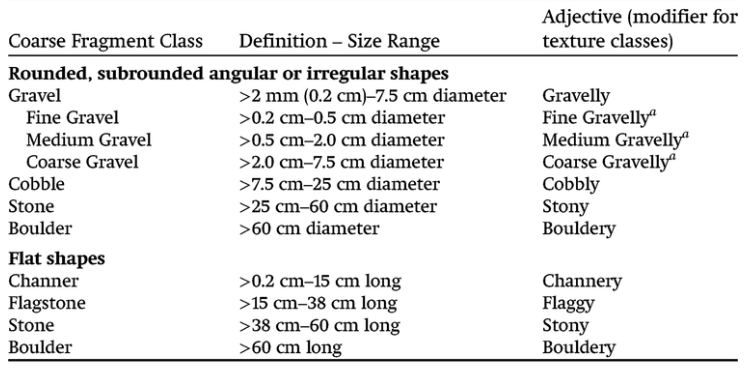
textural modifiers for rock fragments

sieve
sample is passed through screens of various sizes
works best for particles > 0.05 mm (sand fraction)
labor and time intensive
size and shape influence results (rounder shape is better results)
loss of sample (especially with wet sieving)
sedimentation
particle settling in a fluid based on size
sedimentation principles: an object moving at a constant speed (terminal velocity) is acted upon by forces equal in magnitude
forces accelerating it (downwards)
downward force (Fg): particles accelerate due to gravity
forces slowing it (upwards)
upward force (Fd): resistance/drag due to viscosity of fluid
sedimentation concept:
particles uniformly mixed (at time0)
at timen all particles with a diameter (d) > some critical diameter are below that line
larger diameter particles (more massive) settle faster
sedimentation assumptions:
particles are not affected by thermal (or other) motions
particles are smooth and spherical
particles have the same density
particles settle independently (no collisions)
smooth flow of fluid around particles (no turbulence)
particle density
ρs = 2.65 g cm-3
density of fluid (water)
ρw = 1.00 g cm-3
stoke’s law, time to settle
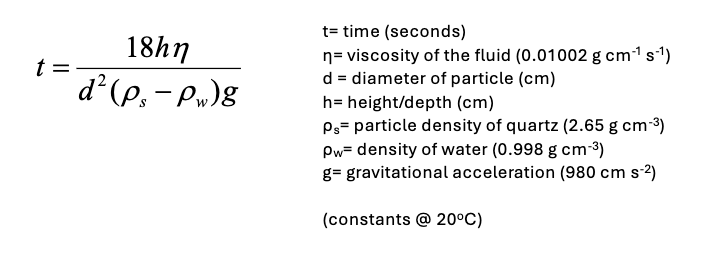
pipette method
procedure:
suspend soil sample in cylinder
as specified times, lower a pipette into the solution
extract a sample an oven-dry it to determine a mass
calculate corresponding particle diameter using (Stoke’s Law)
notes: generally straightforward and accurate
hydrometer
procedure:
hydrometer measures the specific gravity (relative density of a solution)
approaches to account for changes hydrometer effect depth:
determine diameter for a given depth
adds additional computations
diameter will likely not represent the boundary between USDA size class - will need to extrapolate
use standardized sampling times
assumes some error (generally small)
easy
no universal agreement on times
quick method = 40 sec for sand 2 hr for sand and silt
recommended: 40 sec for sand, 8 hr for sand and silt
convenience: 40 sec, 1.5 hr, and 24 hr
notes:
more particles = more mass = higher specific gravity/density
use of equipment is quick, easy, and straightfoward
determination of sampling times/depths is more complicated
geometric mean diameter
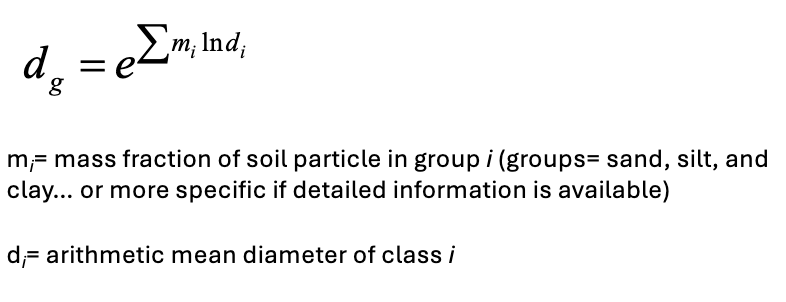
geometric mean standard deviation
a measurement of variability/dispersion around a mean

soil
an open porous system consisting of soils, liquids, and gases in which matter and energy are exchanged within the soil system and externally
energy in soil
chemical: water, redox reactions, mineral transformations
biological: transpiration, photosynthesis, respiration
thermal: heat
soil health
continued ability of soil to function as vital ecosystem
maximize continuous living roots
minimize disturbances
maximize soil cover
maximize biodiversity
accuracy
like how close to the bullseye
precision
multiple values grouped together (how close they are together)