I/O Psych, chap 8 Training/ Onboarding
 Call Kai
 Learn
 Practice Test
 Spaced Repetition
 Match
 Flashcards
 Knowt Play
1/76

Earn XP
Description and Tags
I/O Psych, chapter 8 Training/ Onboarding
77 Terms
Training Needs assessment
Process of Organizations identifying what needs to be trained, who needs training, and cons of the organization support (such as money). Considered best practice for starting a training program within an organization

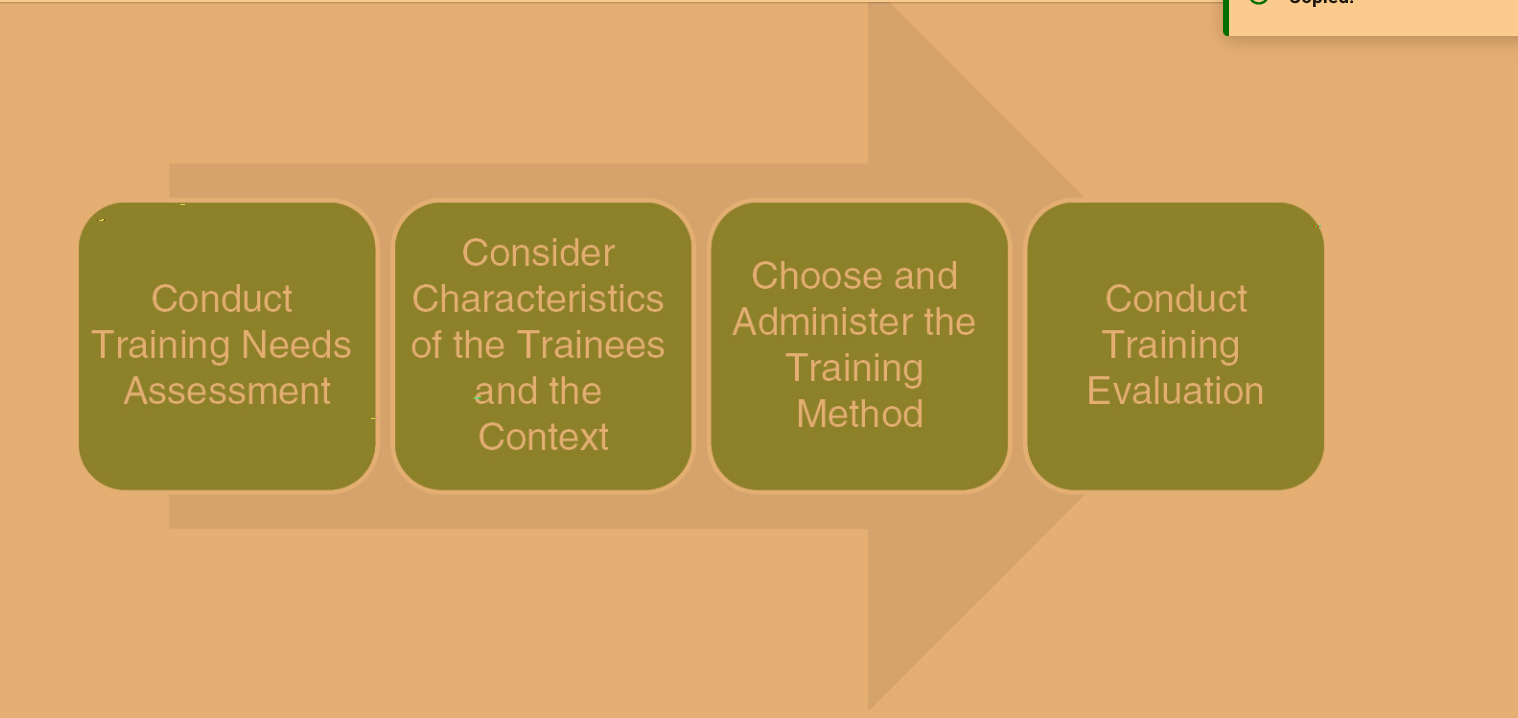
Training process (4 steps)
Organizational analyis
Identification of a set of organizational issues that can either help or hurt the effectiveness of a program.

How to do an Organizational Analysis (First 3 steps)
1.) Find out why the organization wants to do a training program. List general goals. Explain how this training will address those goals and why the organization is interested in this specific training. It needs to align with the organization's strategies and objectives.
2.) Identify the workers who need this training.
Ex: Development team or managers
3.) Identify resources needed/availible for training
-Training budget
-Identify trainers (Outside consultants, internal trainers, expert employees).
-Place/ Facility and equipment needed to conduct training (conference room, virtual)

How to do an Organizational Analysis (Last 2 steps)
4.) Workplace culture. There needs to be support for content being trained by supervisors. Cannot train something no one cares about.
5.) Competitors and legal. Do Competitors have this training too, making them better? Think about MANDT. What laws are put into places as to how it should be trained. Ex: Wheel chair training for relias.
Training Needs Assessment process
1.) Organizational Analysis. What resources o we have for training? Like Money, internal trainers, facilitated. And does the workplace culture support / want to do this training.
2.) Job Analysis: KSA’s needed to perform job. List critical incidents employees can face at work.
3.) Person Analysis: Employees skill set, KSAs employees need to be trained on. List training goals.
4.) Demographic analysis: Background and experience of those being trained. Are they motivated to learn?
Job Analysis
Identifying which tasks employees currently perform on their job and KSA needed to do those tasks.

Person Analysis
Identifying what the currently employee can actually do and what KSA’s they currently possess.
Ways to see what they know:
Employee performance ratings
Customer ratings
Test
Interview their supervisors.
Google'‘s “Project Oxygen” Name Goal and Data taken
Goal: Train managers how to be a better boss
Data taken: Performance reviews, nominations for manager awards, feedback surveys, interview with bosses.

Google'‘s “Project Oxygen” 8 behaviors for managers
Be a good coach
Empower the team to avoid micromanaging
Express interest in employees' well-being
Be productive and results-oriented
Be a good communicator and listen to team members
Help employees with career development
Illustrate a clear goal from the start for the team
Having the technical skills to guide the team
Training goals
A specific statement that tells us the purpose of training/ what employees are expected to learn by the end of training.
How to get training goals
What the job analysis says that an employee should know / be able to do
What the person analysis says the specific employee already knows / is able to do.

Demographic analyis
Identifying the people that need to be trained. Know their education, age, how tech savvy they are, are they motivated to learn, and what their personality like?
Ex: Typical Comop employee: Gen X, immigrant from Africa, not tech savvy, and a willingness to learn practical skills.

Transfer of training
The degree that training leads to improvement at work. How applicable it is IRL.
individual and organizational characteristics on training motivation and training outcomes.


Learning self efficacy
A person’s internal belief that they can actually do well and master the training material.
Can be tested via Core Self evaluation (CSE)
Reasons (2) that individual differences matter in training
1.) Everyone learns differently so we need to find an approach that works for them. Ex: Visual, auditory, or kinetic
2.) A wide variety of individual differences in a group can be difficult for a training. Such as if a group has 60% beginners while the other 40% is advance.
5 Individual differences determinants that effect learning
Cognitive ability (“g:)
Big 5 personality (specifically Conscientiousness, openness, and extroversion).
Learning Self efficacy.
Learning style
Meta-cognitive Skill
Goal orientation
Goals a person has when learning. An individual difference
2 types:
Learning goal orientation
Performance goal orientation

Learning goal orientation
Focusing on mastering the training material for ones self

Performance goal orientation
Internal urge to do well on outcomes, to prove one’s competence to others and avoid criticism of their performance.

Meta-cognitive skills
The ability of learners to take a step back and assess their own learning and mastery of the material.
Low meta-cognitive causes people to overestimate their abilities.They might even discount negative results or feedback.
Short assessments can help them improve.

Identical Elements
The degree to which the context of the training is transferable / similar to IRL
Psychological Fidelity and the 3 types
When training elicits the KSA’s needed for job.
Physical fidelity
Transfer through principles
Transfer Climate

Physical fidelity
(A psychology fidelity) When training resembles physical aspects of the job.
Ex: Using a simulation for deep oil drilling job instead of classroom lecture.

Transfer through principles
(A psychology fidelity) Training employees to understand why they should perform their job a certain way and the principles behind the actions for the job. Allowing them to think critically and handle unique situations better

Transfer climate
(A psychology fidelity) When workplace culture (between employees) reinforce things taught in training in IRL.
Ex: In training, nurses are taught to give meds with milk or apple sauce. But IRL, the hospital only has water. SO nurses give them the pills with only water
Trainee Motivation
How motivated a learner is to gain the KSA’s provided to succeed in training
Ways organization can enhance learning transfer (5)
Physical fidelity
Transfer through principles
Transfer climate
Treat errors in training as a natural part of learning
Cognitive ability and conscientiousness
Massed Learning
Training delivered in 1 (or more) condensed sessions.
*Provides faster deliver of new knowledge or skill
Meaningfulness
The degree of relevance of training to workplace/learner
High in hazardous workplace like construction for safety training.

Spaced learning
Training delivered in small sessions over a long period of time.
This is better than mass because it allows learners to organize and integrate what they learned.
Feedback
Trainer gives learners information about how well they are doing and how close their knowledge is to their results.
Great for those with low Meta cognition.

Learning Schema
A framework for organizing learning content. Allows learner to see the big picture.
Ex: In class, we get syllabus
A better schematics (fitting/organizing material in head), the closer to an expert one becomes.
Overlearning
A training approach where the trainee practices a behavior so much that it becomes automatic. Learning in stressful conditions ensures correct performance during emergency situations. This requires a lot of training time.
Ex: Nuclear power plant worker

Machine Simulator
An environment that reflects the job situation as closely as possible both psychologically and physically. Safer and allows learners to experience critical infrequent occurring situations.
Ex: Pilots training in a Machine cockpit simulation
Debriefing
After training, trainees discuss the program to tell us (or others) what happened, what could’ve been done better and what they learned.
Lecture (Training method)
Oral presentation of information. Can be done with or without feedback and discussion. This is best for large groups.
most frequently used training method.

Programmed instructions (Training method)
Presenting training materials in modules. At the end of a module, must pass quiz to move on to the next. Ex: Relias.
Two types:
Linear Programmed instruction
Branching programmed instruction

Improvement of technology in sophisticated Analytics (Pros and Cons)
Pros:
Organizations training can be assessed quickly via collection of metrics (such as sales and productivity).
Training evaluation can happen quickly, giving learner immediate feedback.
Follow-up surveys are given to learners to ask about their learning experience or recommend specific training based on past behavior.
Cons:
Learner control, they get choices about training features. Doing activities that are potentially unhelpful instead of actually learning.
Ex1: How much feedback they want.
Ex2: How much training content do they want to do.
Behavior modeling training
There is a model that gets observed. Then learner role-play in a similar situation. Then gets feedback from trainer and other learners. Usually used in a supervisor training. Showing positive and negative models help with job transfer.
Ex: MANDT physical training.
Diversity training
Training geared toward working with a diverse group of employees. A long with sensitivity to different groups.
Results of this training:
Increase in trainee motivation/attitude
Increase skills/behaviors
Increased cognition/knowledge.
Developmental association centers (MGMT development Training method)
Centers that give feedback and development plan for managers
Executive coaching (MGMT development Training method)
1 on 1 coaching for manager and coach on their own or at the company’s expense. Typically discussing challenges at work.
When managers coached employees, this Leaders to an increase of sale goals/productivity.
Ex: Mentor Matt
Case Study Analysis (MGMT development Training method)
In-depth analysis of a business case.
Business Games / Simulation (MGMT development Training method)
Friendly competition between business teams to improve business decisions.
EX:Jssapordy
Role-playing (MGMT development Training method)
Individuals act out challenging work situations to enhance their ability in future situations

Cross cultural training (MGMT development Training method)
Training to develop their skills working with overseas assignments.
Includes:
Culture awareness insensitivity
Language training

Onboarding
New employees go through a process to become more familiar with tasks and social demands of their new role
New Employee Orientation (NEO)
Training process that gives new employees basic information to help them prepare to contribute to the organization ASAP
Reaction ( criteria for Training effectiveness)
How employees perceive the training. Do they like it? Is it appropriate IRL
Learning ( criteria for Training effectiveness)
Trainee displays indicators / signs of learning material during training session. Do they actually gain knowledge/skills?
This can be measured by test and assessments
Behavior ( criteria for Training effectiveness)
Determines if the training leads to changes in on-the-job behavior.
Measured by performance ratings or other job performance indicators.
Results ( criteria for Training effectiveness)
Determines if the training leads to a change in the organization’s performance such as profitability.
Threats to experimental validity
Any compounding factors that can affect our ability to interpret results of a study correctly such as a training evaluation.
Threats to internal validity (Defintion)
Any factors that causes us to be concerned with the accuracy of the results obtained from this experiment.

First 6 threats to internal validity
History: An event that happens between pretest and post test. Ex: Pay rasies or lay offs.
Maturation. Participants changes between pretest and post test. Ex1: Kids entering puberty. Ex2: Workers starting the position and gaining more skills before post test.
Testing: Pretest affects post test. Understanding the pretest can give learners the upper hand with understanding the key learning goals. Ex: PSAT and SAT
Instrumentation: Change in test measures between test. Ex1: Change in evaluator/ supervisor grading the test more lenient or more severe. Ex2: Evaluated uses different non-equivalent test.
Statistical regressions to the mean: An individual might score much lowered or much higher on post test. Could be because of a random factor like a good or bad day. It’s a mess because it affects who we should give remedial training or determine high potentials are.
Differential Selections of participants: Non-random assignment of training or control conditions. Causing any differences between groups could be caused by training or other factors. Ex: Group 1 is San Francisco and group 2 is Seattle. Since it is not random, any difference can be because of other factors.

Last 5 threats to internal validity
7. Experimental mortality: When a bunch of participants drop out of a study. Ex1: Someone died. Ex2: Huge Layoffs / series of staff quit.
Compensatory equalization of treatments: When someone outside the training group / program does something “Special” for those in the control group. Ex1: An executive manager decides to give “perks” to those in the control group who did not get the opportunity to take the training.
Compensatory rivalry between respondents receiving less-desirable treatments: When individuals in the control group realize they are not getting the training/ in the experiment. Ex1: Training for elementary school teachers gets new technology, but the others across town didn’t get it and found out. Then the control group tries harder to prove a point.
Resentful demoralization of respondents receiving less-desirable treatments: Those in the control group resent the fact they cannot receive the training and decide to perform worse as a result.
Diffusion of treatment: During the training, the experimental group returns to work, then trains the control group on details about their training.
This could cause issues because the control group will then perform as well as the experimental group.
Threats to external validity (2)
Any factors that causes us to be concerned if the training evaluation can be generalized to other settings.
Reactive effects of pre-testing: Learners preformed better because during the pre-test they paid great attention to the material related to it during the training sessions.
Reactive effects of the experimental setting: When people in the experiment know they are part of a study and tries harder (like the Hawthorne effect)
Experimental Rigor
The degree to how close an experiment is to the true experimental design.
You increase this with elements such as control group, random association, and pre-test.
Training evaluation design options
Experimental vs control
Random assignment
Pre-test compared to post test
How to help those with a low self-efficacy and external locus of control
Break up training into smaller steps.
Factors that help trainee motivation
More money
satisfaction for doing job well
to get a promotion
do one’s job better
Goal setting theory
People perform best when they are given a specific difficult goal.
You can do this with SMART goals
SMART Goals
Specific
Measurable
Attainable (Aggressive and achievable)
Relevant
Timely
Expectancy / VIE theory
High effort → Good Performance → Great/Desirable outcome
Reinforcement theory
Actions/ learning efforts → Desirable outcome
Social learning theory
Learning by observing others
On the job training (OJT)
Employee trains coworker (new hire) a job while still doing all their own tasks and responsibilities.
This can build resentment
Program instruction (Pros and cons)
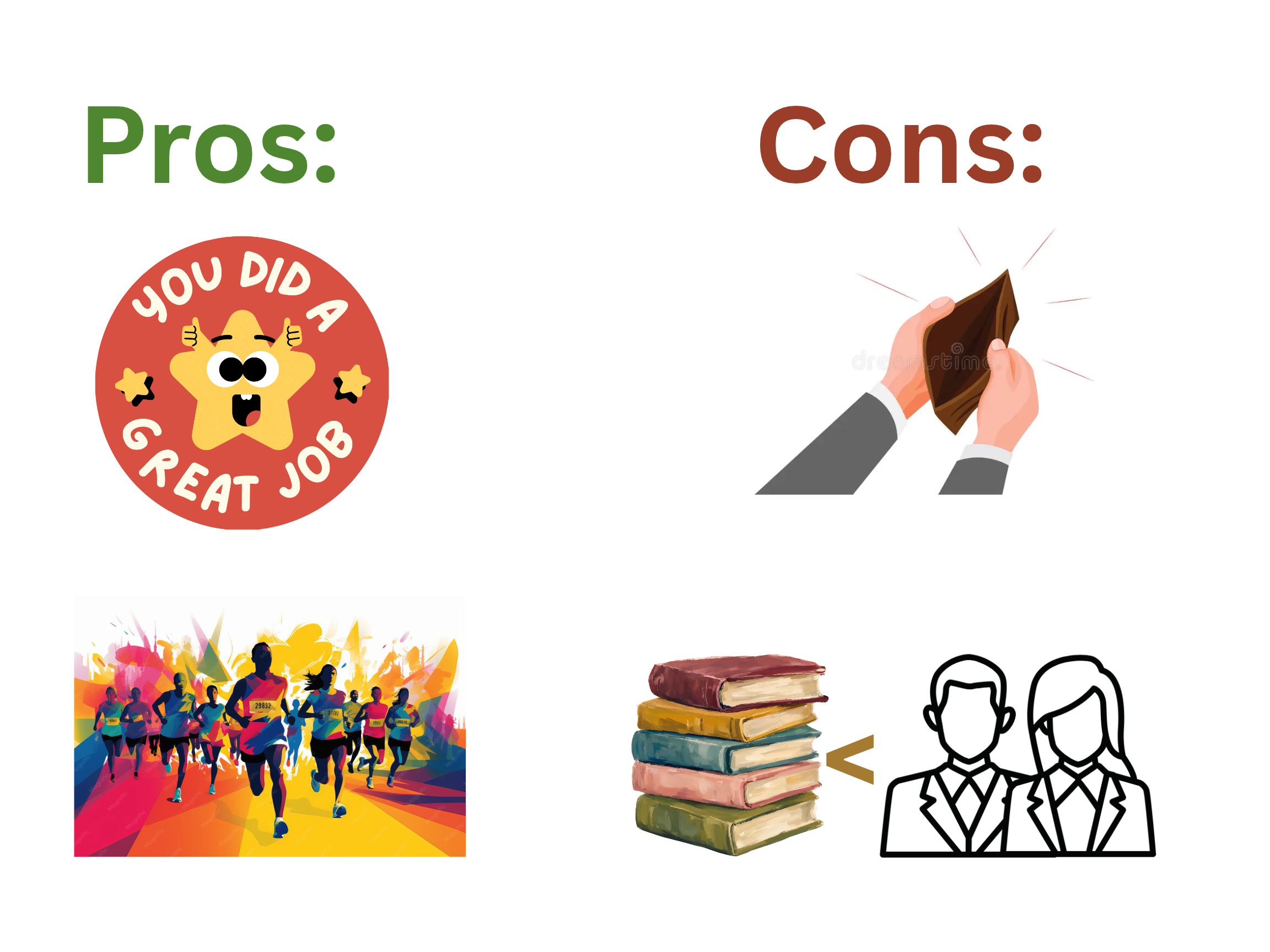
Pros:
Learners can go at their own pace
Gives feedback to learners. Great for those with poor cognitive skills
Cons:
Costly to develop (especially branching approach) unless there already made module.
Some learners preference physical trainers over books/CPU
Best practices with program instructions
Program instructions used in conjunction with physical training. This frees up trainers time and address the learner’s needs.
Diversity training effect on learners:
Training that involved social interaction had a greater effect.
Other diverse initiatives are in place.
Training focused on skill and awareness
Conducted over a period of time (learners like this more).
Goals for new hire orientation
Communicate information about the job and organization
Acquire essential job and safety skills.
Discuss norms and attitudes within the organizational culture
Understanding of how things are done in the organization
Outline of who does what in the organization.
NEO notes
Employees prefer coming in and being told how great the organization is.
New employees are nervous. Make them comfortable.
If paperwork can be done in advance, do it.
Valued people are motivated people.
Evaluating on boarding program (4 levels)
Level 1: Assess employees’ reaction to the program
Level 2: Knowledge they have at the end of the on boarding
Level 3: Their behaviors
Level 4: Business outcomes associated with the program.
Benefits of e-learning
Easy to use
distributed to employees around the world
Convenient
Reasons organization don’t evaluate training programs (3)
Some organizations don’t see the need to formally evaluate. Especially if people are happy.
Some trainers want to avoid evaluation of training
Can be time consuming and challenging. Most trainers are not trained how to do a proper evaluation.