MGCR 382 (Part 2: International Business Strategy)
 Call Kai
 Learn
 Practice Test
 Spaced Repetition
 Match
 Flashcards
 Knowt Play
1/57

There's no tags or description
Looks like no tags are added yet.
58 Terms

What does the Total Created Value include?
Willingness to Pay
Price
Cost
Willingness to Sell
What are the different levels of strategy?
Corporate
Business
Operational

Corporate Strategy
Value added by different business of an organization

Business Strategy
Competition with rival business
Wider band of TCV

Operational Strategy
Functional components of organization contributes to corporate and business level strategies through resources, processes, and people

Cost-Leadership
Serving a price sensitive customer

Differentiation
Willingness to pay is SUPER sensitive (volatile)
What are the paths to diversify?
Different industries (interindustry)
Geographies
With-in Industry Diversification (intraindustry)
Triple D Strategy
Deployment
Development
Deepening

Deployment (Triple D)
replication of competitive advantage in home counrty
aggregated demand
target homogeneous segments (needs of market across regions
standardization of service products

Development (Triple D)
identifying where potential new capabilities reside
GOAL: to get integrated competitive advantages
“different enough” rather than “too different”
Deepening (Triple D)
widening competitive advantage (w/o changing primary strategy)
increase willingness to pay (adjust local tastes)
lower costs (aggregation of demand)
internationally dispersed = value for stakeholders
Challenges of firms going abroad
Liability of being a foreigner
Paradox of being consistent

Challenge: Liability of being a foreigner
Local laws
Cultural differences
Different contract structures
Challenge: Paradox of being consistent
market adaptation
complex decision-making
risk of strategic misalignment
Triple A Strategy
Aggregation
Adaptation
Arbitrage

Aggregation (Triple A)
Achieving economies of scale by standardizing operations across regions
same customers and resources

Adaptation (Triple A)
Customizing processes and offerings to meet local market needs
adapting product to customers

Arbitrage (Triple A)
Exploiting differences, such as offshoring to countries with lower labour costs
about resources
Strategic Alignment
Type of business expenses indicate which strategy to prioritize
How do firms implement global strategies?
Change strategy as needed
Consider integrating two strategies (builds competitive advantage)
Explore external integrative mechanisms
Enterprise Valuation → Profitability → ?
reduced costs
add value and raise prices
Enterprise Valuation → Profit Growth → ?
sell more in existing markets
enter new markets
Efficiency Frontier
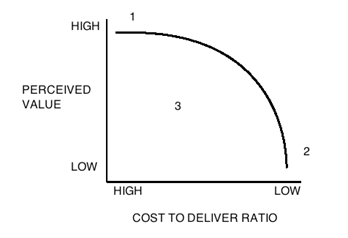

Location Economies
creating a global web (different stages of value chain dispersed)
HOWEVER → transportation costs, trade barriers, political and economic risk
Exprience Curve


Learning Effect
Doing something for longer becomes more efficient
Economies of Scale
If firm’s average cost of producing a good decreases as output of good increases
Leveraging Subsidiary Skills
recognize valuable skills
establish incentive system
process that identifies when valueable new skills have been created
act as facillitators
Pressures for Local Responsiveness
customer taste/preference
traditional practice
regionalism = tendency toward the converges of tastes, preferences, insfrastructure, etc.

Global Standardization
GOAL: pursue low-cost strategy on global scale
reap cost reductions from EoS
production, marketing, R&D, supply chain (concentrated in few locations
NO: geographical customization
YES: strong pressures for cost reduction & demand of local response

Localization Strategy
GOAL: customize goods or services (match taste/preferences in different national markets)
appropriate when: substantial differences/not intense cost pressures
customization limits ability to capture cost reductions

Transactional Strategy
low costs and differentiated products
WHEN: increase cost pressures and demand for local responsiveness
CONFLICTING DEMANDS: raises costs to differentiate product
CONFLICTING DEMANDS: complex and challenging to achieve
multidirectional flow of skills b/w subsidiaries

International Strategy
little competition
products from domestic → selling internationally (minimal local customization)
tends to centralize product development functions
establish manufacturing and marketing functions
resulting duplication increases costs
Entry Decisions: Which foreign markets?
size of the market
spending power (present + likely future wealth of consumers)
costs + risks (think about regulations/exporting + financial/social/political risk
suitability of products to the market (value)
nature of indigenous competition (value)
First Mover ADVANTAGES
pre-empt rivals
build strong brand name
capture demand (customer satisfaction)
build sales volume and experience curve
create switching costs
First Mover DISADVANTAGES
considerable effort, time, and expenses of learning rules
costs of business failure
cost of promoting and establishing product offering
Entry Decisions: Scale
a strategic commitment has a long-term impact is difficult to reverse
rapid scale → influence on competition
balance against resulting risks and lack of flexibility → commitments
small-scale entry → learn about foreign market with limited exposure
Modes of Entry
exporting
turnkey projects
licensing
franchising
joint ventures
wholly owned subsidiaries

Exporting - Advantage
no establishing costs
experience curve
location economies

Exporting - Disadvantage
may not be appropriate (low-cost locations already there)
high transport costs
tariff barriers

Turnkey Projects
I build the company → give you the key → you run it!
selling onwership

Turnkey Projects - Advantage
Less risky than conventional FDI - risk averse

Turnkey Projects - Disadvantage
no long-term interest in foreign country
may create a competitor
may sell competitive advantage to potential/actual competition

Licensing
Give them the knowledge and let them do the rest

Licensing - Advantages
no development risks and costs
no barriers to investment
good use of intellectual property
Licensing - Disadvantages
no control over manufacturing, marketing, and strategy
limits firm’s ability to coordinate strategic moves
firm can lose control over technology
Franchising
Similar to license but more for service (hotels, restaurants, etc.)
Franchising - Advantages
firm experiences lower costs and risks
builds global presence quickly
Franchising - Disadvantage
set up subsidiaries
quality control
may inhibit firm’s ability to take profits out of one country to support competitive attacks in another
Joint Ventures

Joint Ventures - Advantages
local partner knowledge (competition, language, culture, political systems, and business)
shared costs and risks
political considerations (gov. interference, nationalism)

Joint Ventures - Disadvantages
loss of technology control
lack of control over subsidiaries
lead to conflicts and battle of control between investing firms
Wholly Owned Subsidiaries

Wholly Owned Subsidiaries - Advantages
low risk of losing control over technology
tight control of operations in different countries
location and experience curve economies
100% share of profits
Wholly Owned Subsidiaries - Disadvantages
full cost and risk of establishing new market
problems associated with acquisition

Acquisitions
quick to execute
may help pre-empt competitors
may be less risky than Greenfield Ventures
often produces disappointing results (overpaying, culture clashes)

Greenfield Ventures
greater ability to build subsidiary company that it wants
slower to establish
risky → but les risky than acquisitions
pre-emption by global competition