genetics exam 2 (improved version)
 Call Kai
 Learn
Learn Practice Test
 Spaced Repetition
 Match
Match Flashcards
 Knowt Play
1/49

There's no tags or description
Looks like no tags are added yet.
Name | Mastery | Learn | Test | Matching | Spaced | Call with Kai | Chat |
|---|
No analytics yet
Send a link to your students to track their progress
50 Terms
what are the levels of nucleic acid structure
nucleotides, single strand, double helix, three dimensional structure
what is dna
what is the central dogma
what is rna
define transcription
what percentage of nuceltodies code for protein
dna=where information is stored
the flow of biological info
rna=how we use that info
transcription is dna to rna
in dna we have 3.2 billion nucleotides, abt two percent codes for protein
what shape is eukaryotic dna which is organized into chromosomes
what structure is dna
what is a nucleosome
linear
tertiary structure
DNA wrapped around histone proteins
extra: around 80 percent of your DNA is read and copied into RNA molecules however only abt 1-2 percent of that DNA actually holds the instructions to make proteins
the DNA structure can be described as two blank and blank nucleotide strands that form a blank blank
the secondary structure is what gives DNA it’s blank 3d structure
what is primary structure for DNA, how do they join together
complementary, antiparallel
double helix
stable
string of nucleotides joined together by phosphodiester linkages
Nucleic acids are linear models made up of repeating subunits of blank
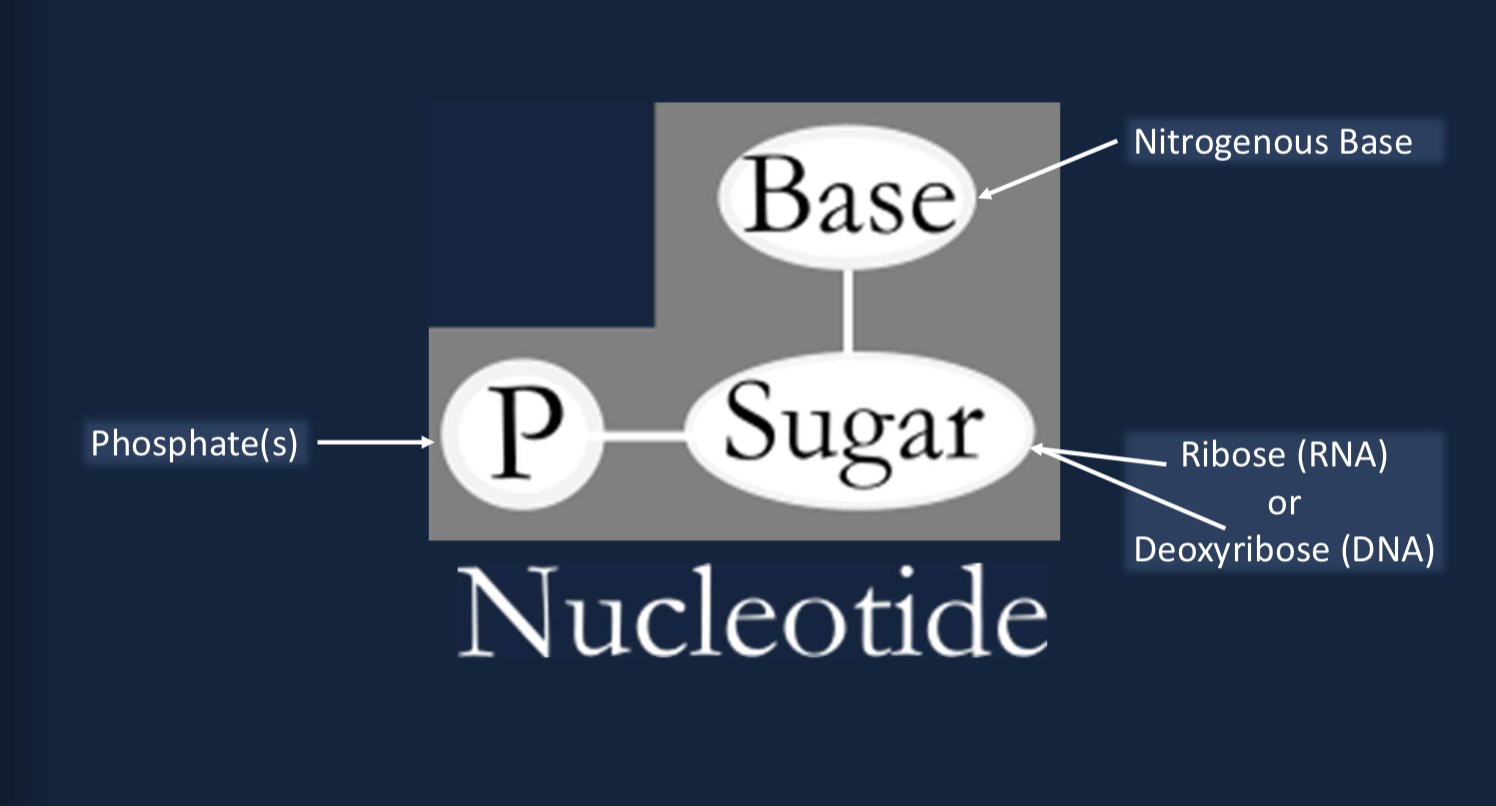
what 3 molecules make up a nucleotide
Nucleotides
phosphate, nitrogenous base, and sugar-ribose for RNA or deoxyribose for DNA
what two molecules are purines
what does a purine have ring wise
Adenine and Guanine
PURe As Gold

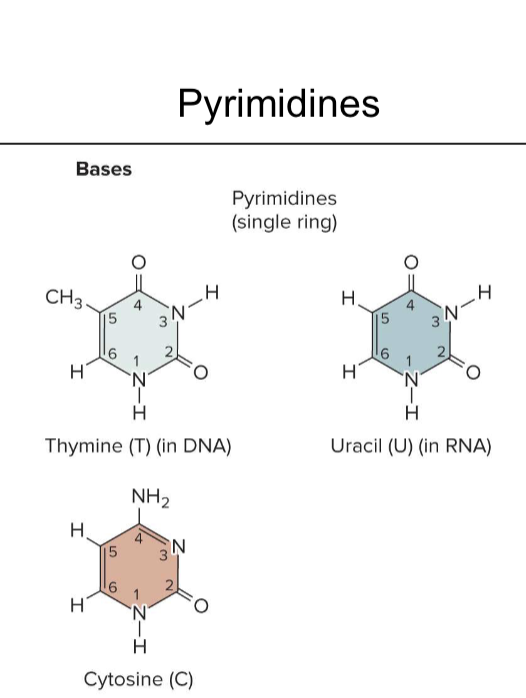
what two molecules make up pyrimidines
what do pyrimidines have ring wise
Thymine, Uracil, and Cytosine
they are a single ring
CUT the PYRamid
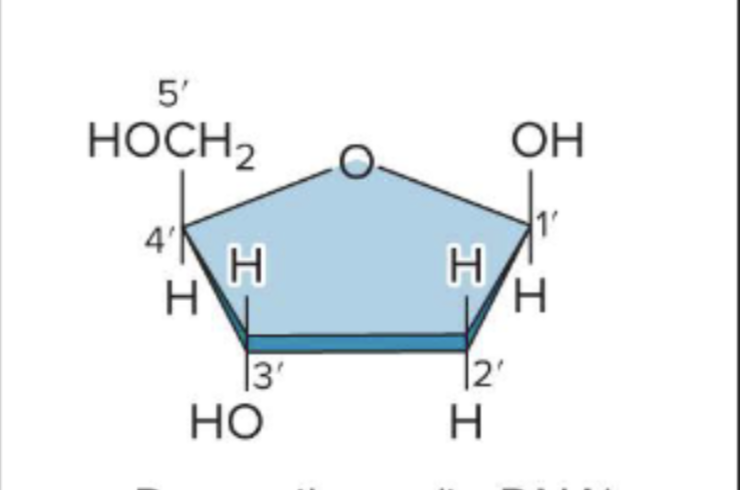
is this sugar for DNA or RNA why
DNA bc there is no oxygen on the 2’ carbon

is this sugar deoxyribose or ribose and why
ribose bc there is an oxygen on the 2 prime carbon
the base is always at which carbon
synthesis always occurs in what direction
what molecule is on 5 prime
what molecule is on the 3 prime
one prime carbon
5’ to 3’
the phosphate
hydroxyl (required for DNA/RNA synthesis
what does the promotor do
after we open up the helicase at a particular spot what do we use
what defines where we have rna go
where we recruit the proteins to start prescribing mRNA
an RNA polymerase
promotor
eukaryotic DNA is blank and organized into chromosomes
what structure is it
what is chromatin
what are nucleosomes
tertiary structure
the complex packaging of DNA
DNA wrapped around histone proteins
a blank bond links nucleotides together between the blank blank group and the blank blank group of the next nucleotide
3’, hydroxyl, 5’, phosphate
in DNA there are two blank and blank nucleotide strands that form a blank blank
the secondary structure is where the dna is blank 3d structure
what is the primary structure
complementary,. antiparallel
double helix
stable
string of nucleotides joined together by phosphodiester linkages
two strands are not identical, they are blank DNA strands
what two things pair together
what other two things pair together
( molecule wise in a nucleotide)
complimentary
A pairs with T
G pairs with C
hydrogen bonds are blank energy bonds what do they do
A and T bonds have how many hydrogen bonds between them
how many bonds are between G and C
low
stabilize the molecule (can be disrupted by enzymes/heat energy)
2
3
if one side goes 5 prime to 3 prime
what direction will the other side go
3 prime to 5 prime
what id dna stabilized by
the hydrogen bonding between base pairs
base stacking -nitrogenous bases=directly on top of each other

what are the names of these
left=ball and stick model of DNA
right=space filling model of DNA
most rna is blank stranded
what’s the exception
single stranded
dsRNA viruses
how do single stranded RNA molecules stabilize themselves
regions of the RNA blank blank blank with itself forming regions of blank blank that blank the structure
the secondary structures give different places for…
by taking secondary structures
complementary base pair, double strandedness, stabilize
proteins to bind onto

define each of these loops
bulge loop
internal loop
multi branched loop
stem loop
what two factors contribute to the tertiary structure of RNA
base pairing and base stacking within RNA
interactions with ions, small molecules, and large proteins
to fulfill it’s role, genetic material must meet several criteria-what are the four words
what does the first one that starts with an I mean-define it
information, transmission, replication, variation
information: must contain the info necessary to make an entire organism
what does transmission mean
what is replication mean
it must be passed from parent to offspring
it must be copied in order to be passed from parent to offspring
what does variation mean
it must be capable of changes to account for th known phenotypic variation in each species
what did Griffith discover in 1928
what did he isolated two strains of
what happened when Griffith injected the rough strain into the mouse
what happens if Griffith injected the smooth strain into the mouse
the principle of transformation
Streptococcus Pneuomoniae
rough(non virulent strain)=mouse lives
smooth (virulent strain)=mouse dies
what happened when Griffith injected the heat killed smooth into the mouse
what happens when Griffith injected the heat killed smooth with rough , what was recovered
mouse lives (no bacteria recovered)
the mouse dies -virulent bacteria=recovered
what did Avery, Mccloud and McCloud, and McCarty show in 1944
When RNased(enzyme that destroys RNA) was placed in a bottle with llR bacteria what were the results
When protease(destroys protein) was placed in a bottle with llR bacteria what were the results
when DNase(destroys DNA) was placed in a bottle with llR bacteria what were the results
that the transforming pincriple is DNA
type llR and llS bacteria
type llR and and llS bacteria
type 2R
only DNA has the ability to transform
what did the Hershey chase experiment do
what main thing did they use
what does the DNA genome contain
what does the protein coat contain
confirmation that DNA is the genetic material
through a bacteriophage( a virus that infects bacteria)
phosphorous
sulfur
what were the results, what were the results
radioactive P in DNA
radioactive S in protein s
radioactive P. was found inside bacteriophage
what did Erwin Chargaff discover
found that the amounts of the four bases varied between species but their ratios did not
what did Rosalind Franklin do
performed x ray diffraction of DN fibers
it rpvodes info concerning the structure of a molecule
what did James watson and Francis crick discover in 1953
whose existing data did they steal from
whose other rule did they use
the 3 dimensional structure of DNA
they used existing data from Rosalind franklins molecular models and knowledge of structural chemistry
char gaffs rule (adenine and thymine bond) and guanine and cytosine bond)

DNA REPLICATION NOW
what is this
deoxyribonucleotide triphosphates
(fundamental chemical building blocks and energy sources used to synthesize DNA)
replication is blank
Each strand (or side) of the DNA acts as a blank to blank the
other strand through blank blank
semiconservative
template, recreate, complementary base pairing
in DNA replication, one double strand is used to make..
two identical strands of DNA

2nd one, semiconservative model
phosphodiester bonds happen where
what is also important abt phosphodiester bonds
between 2 nucleotides, OH and PPP bond
they’re the way we know what nucleotide to bring in the template strands
bond between strands are blank and blank
complimentary and antiparallel
deoxyribonucleotide triphosphates/dNTPs include..
which has 2 rings, which has 1 ring
purines and pyrimidines
purine=2 rings (A,G)-PUR As Gold
pyrimidines=1 ring CUT the PYRamid (C,T,U)
int he semiconservative DNA replication
you use one parental strand and one blankstrand to make how many daughter cells
new, 2
what was the conservative model
what is the semiconservative model
new and new, old and old, everything stays intact, new double helix=built from scratch
the correct one: double stranded DNA copies itself, the two original strands separate, each one serves as a template to make new complimentary strand
what is the dispersive model (last of the 3 models)
little bits of genome break apart and reassemble
experiment proving that DNA replication is semiconservative
Cells / bacteria grown in media with blank blank blank
Cells then grown in media with blank blank blank
Cells divide every 30 minutes
After synthesis you should see…
DNA assessed with blank to determine the blanks of heavy and light nitrogen was in DNA
Moved through a gradient based on weight to measure it
heavy nitrogen, 15N
light nitrogen 14N
half heavy half light if semiconservative (we did)
centrifugation , amounts
what is ase
what is mer
waht is poly
enzyme puts together….
an enzyme that speeds up /helps a reaction
a short stretch of nucleotides
multiple
multiple stretch of nucleotides (makes DNA by reading template)
what is one of the main functions of DNA polymerase
it has what characteristic
waht can it identify
what does it use to blank newly made strand until mismatch is removed
after this what will resume, and in what direction
to act as a proofreader
high fidelity-low error rate
mismatched nuceltodie and remove it from daughter strand
3’-5’ exonuclease activity, digest
DNA synthesis, 5’-3’
DNA can attach nucleotides only in what direction
what can it not work with, what does it need
how is this problem overcome
5’ to 3’
monophosphates, triphosphates
by synthesizing new strands both toward and away from the repication fork
DNA polymerase cannot start DNA synthesis by linking 2 nucleotides on bare template strand