PUBPOL 3280 Prelim 2
 Call Kai
 Learn
 Practice Test
 Spaced Repetition
 Match
 Flashcards
 Knowt Play
1/153

There's no tags or description
Looks like no tags are added yet.
154 Terms
What is the healthcare value equation formula?
value = quality/cost
What purpose does the healthcare value equation serve?
The healthcare value equation is a framework to change the meaning of value from providing more care to achieving better outcomes relative to cost. Quality includes both patient experience and health outcomes.
How was quality defined in the past? What changed about the definition about quality?
Quality used to only incorporate health outcomes. Quality now incorporates patient experience and health outcomes
Aside from health outcomes and patient experience, what do new healthcare value frameworks also value? Why?
accessibility, because high-quality care is meaningless on a population health level if people cannot access it
How are equity and quality related?
High quality cannot exist without equity.
What are health inequities? What are health disparities? How are they different?
Health disparities only indicate a difference between health outcomes, while health inequity indicates the difference in health outcomes is due to an injustice. Inequity forces us to reckon with what systems, structures, and policies caused these disparities and lead to justice.
What is the significance of curb cuts? What is centering care, and why is it important?
Centering care around the most vulnerable eventually helps everyone. For example, the American with Disabilities Act led to the creation of curb cuts in sidewalks, which were geared toward helping those with mobility disabilities (i.e., wheelchairs). Curb cuts help the disabled as well as able-bodied people, whether that be pushing a baby in a stroller, pulling luggage, etc. By centering health equity (i.e., disability), it helps everyone by making mobility significantly easier. bottom line: designing for the most vulnerable leads to everybody winning
How is race and racism related to health?
Race is not a risk factor, racism is. Race is a social construct, but the systemic racism within medical and healthcare systems affect health. For example, worse care due to implicit bias, chronic stress because of racism, social program stigmatization --> racism.
What is meant by co-designing care? Why is it important?
Co-designing care gives more agency to the patient and allows for the care to be tailored to the patient's needs. Co-designing and redesigning care allows us to work toward health equity
What is the triple aim? How has it evolved into the quadruple, quintuple, and hextuple aims?
Triple aim is the simultaneous improvement of the experience of care and health outcomes of a population while decreasing the per capita cost. Quadruple aim is better health outcomes, lower costs, improved clinician experience, and improved patient experience. The quintuple aim is enhancing patient experience and care team satisfaction, improving population health, and reducing costs to promote health equity. Hexagonal aim is population health, care experience, professional experience, reducing costs, health equity, and future generations and planet health improvement.
According to the tale of 4 babies and the new quadruple aim from Olayiwola, what causes observed inequities?
Historical injustice and racism lead to inequities, not biology. Upstream factors have downstream effects.
What is the essence of the quadruple aim?
Health equity
Are wide gaps in race-based health outcomes unique to the United States?
Uniquely American
What does it mean to redesign care with communities?
Incorporating community perspectives in how healthcare and interventions are delivered, ensuring this is what they need, helpful, wanted etc
What is REaL data? SOGI?
Race, Ethnicity, and Language; Sexual, Orientation, Gender, Identity
What do REAL and SOGI data achieve? How?
REAL and SOGI data helps achieve health equity through data equality. It allows for the stratification and segmentation through social identity and demographics to identify disparities
What are ecological fallacies?
Attributing area level characteristics to individuals rather than the area. Ex: poor people don't have greater/lower severe COVID Risk, areas are associated with that.
What are examples of upstream factors?
Historic lending maps, racially based physical structures, negative economic events (e.g., coal mine closure), negative environmental exposure
What is primary care?
Coordinated, comprehensive, and tailored care in collaboration with communities to serve communities. Primary care focused on promoting health, proactively addressing health issues, and prevention. Primary care is a team sport that requires collaboration between clinicians, other care team workers (e.g., social workers and resource navigators), IT, and community based organizations to support health and provide tailored, person-centered care. They are often the first point of contact in the healthcare system as they examine both medical and social needs.
What differentiates primary care from specialty care?
Primary care is a generalist team at the front door of the healthcare system. They are the first point of contact, generalist in nature, focused on holistic health, longitudinal (long-term relationships and trust-building), integrative, and contextual. Specialty care is focused on diseases, single conditions, episodic, fragmented, and technical. For example, primary care is focused on improving health holistically (nutrition, mental health, medical needs), while a specialist focuses on a specific condition/body system (ex: cardiologist --> heart).
What are the 5 Cs of primary care? What are their core functions?
Patient CENTERED
First CONTACT
COORDINATED
CONTINUOUS
COMPREHENSIVE
Match the Five Cs of primary care, and how do they relate to being a generalist, whole person, longitudinal, integrative, contextual?
Patient CENTERED --> Contextual
First CONTACT --> Generalist
COORDINATED --> Integrative
CONTINUOUS --> longitudinal
COMPREHENSIVE --> whole person /integrative
What is patient-centered care?
Patient-centered care's goal is to understand what matters to the patient while following evidence-based medicine. It incorporates evidence-based medicine and patient and family needs, culture, values, and preferences. Core question: "What matters to you?"
What is the "first contact" function of primary care?
Care from primary care providers, including family physicians, internists, PAs, and NPs
What is the coordinated function of primary care?
Making referrals and conducting tests and procedures as needed
What is the continuous function of primary care?
Continuous care over a large proportion of the patient's health encounters. (sustained relationships with follow ups)
What is the comprehensive function of primary care?
Comprehensive care to address physical, mental, behavioral, and chronic health needs (holistic approach to healthcare).
What core functions does primary care have?
They are the first point of contact access for health needs, long-term person-centered care, comprenhsive care for holistic health needs, and coordinated care by connecting patients with community based organizations.
How can primary care achieve the Triple Aim?
PCP can improve health outcomes by improving immunization, preventative screening, counseling, chronic disease management, and increasing access to preventive services
PCP can decrease costs by reducing unnecessary hospitalization, specialist visits, and emergency department visits
PCP can improve patient experience through continuity of care
How do primary care physician-to-population ratios affect health outcomes, patient experience, life expectancy, and premature deaths?
Higher ratios of primary care physicians to population are associated with better health outcomes, such as decreased mortality from cancer, heart disease, or stroke; patients are more likely to report good health compared to lower ratio; and decreased premature deaths.
Where does primary care fall between prevention 3.0, 2.0, and 1.0?
Prevention 1.0 because of medical interventions
How did the ACA affect screening rates?
Improved screening rates by making USPSTF-recommended screenings free (no cost-sharing)
What are the five USPTF recommendation grades
A, B, C, D, I
A: high certainty that the net benefit is substantial
B: high certainty that there is moderate benefit; moderate certainty that the net benefit is moderate to substantial benefit
C: moderate certainty and small net benefit
D: not recommended -- moderate or high certainty that there is no net benefit or that the harms outweigh the benefits (most likely useless or harmful)
I: not enough evidence

How does USPSTAF A and B screenings deliver real value?
Screenings improve health outcomes and patient experience while reducing long-term costs.
How can USPSTF A and B screenings improve health outcomes?
Screenings allow for diseases to be detected earlier, allowing for less invasive treatment and for treatment to be more effective; prevent disease progression; and extend healthy life expectancy, not just lifespan
How can USPSTF A and B screenings improve patient experience?
Screenings improve experience by preventing crisis-driven, late-stage diagnoses, enabling proactive, planned care rather than emergency care, and building trust through ongoing primary care relationships.
How does USPSTF reduce long term costs?
Screenings are cheaper than treatment (ex: colon cancer treatment costs 10x or more than screening and removing pre-cancerous polyps). Prevention shifts spending from expensive downstream care to lower-cost upstream care
How many people receive the recommended preventative care?
only 54.9% receive the preventive care
Why do only about 50% of people receive quality preventive care?
Physicians only deliver 55% of recommended care and 42% report not having enough time with their patients. Providers report spending 13% of their day on care coordination and only half of their time actively using their medical knowledge. Physicians are unable to deliver recommended care to more patients because they do not have enough time with their patients, spend only half their time using their medical knowledge, and 13% of their time on care coordination tasks. Physicians also have a huge patient population that require complex treatment and procedures, including chronic care, acute care, and screenings. This amounts to 18.7 hours per day spent on patient care, not including other administrative tasks
Essentially, too many patients that require a lot of time intensive care, spending too much time on administrative tasks rather than actually using their medical knowledge.

What is the prevalence of chronic conditions? What does this highlight?
High chronic disease burden in patient populations that require complex support from PCPs; requires team-based care
What is the doctor's new dilemma? What specific example is brought up by Koven?
The new dilemma is rationing and balancing a doctor's time and emotional energy. Doctors have limited time and energy. Probing further to understand underlying issues or connecting with patients to form a relationship consumes more time and energy, but failing to do so may allow the health issue to worsen and lose the opportunity to connect with your patient, losing the intimacy that nourishes PCPs. Essentially, opportunity costs b/w time and energy. Failing to probe further and connect leads to lost time to do administrative tasks or help other patients, but can lead to worse health outcomes for the patients who aren't forthcoming and physician burnout.
What does it mean to practice at "Top of License"
each member of the care team is doing their respective role and what they were trained to do. For example, physicians should spend time using their medical knowledge rather than doing administrative tasks. Applies to other clinicians (e.g., nurses)
How can prescription standing orders management demonstrate how they can be used to support the Triple aim?
Management of Prescription standing orders through meaningful use information technology and automated efficiency systems allows standing prescription orders to be streamlined and sent without expending too much time and energy. As seen in the diagram, it provides a workflow and decision tree that allows for easy decision-making

What is the ideal scenario for patient care?
PCPs have long term relationships with patients, comprehensive care is provided, continuity is present, person centered, and serves as first contact for patient
How does the clinical ideal compare to the operational reality?
Physicians have limited time and experience burnout, which can affect their relationship with their patients. The healthcare system is fragmented, leading to a lack of continuity of care. There is a high volume of patients, so accessibility can be challenging. Focus is on efficiency, not patients.
How can management address the primary care challenges?
Expanding the care team/changing the team design to allow team members to be doing what they are trained to do, coordination systems to address fragmentation (no one falls through the cracks; referrals and follow ups), improving scheduling by managing how many patients that a PCP sees, making it more manageable and panel management so they are not responsible for too many patients; payment and incentives (compensating/reimbursing for social care navigation)
What is the primary care paradox?
Primary care is a foundational part of the US healthcare system, but it is structurally underinvested.
Primary care accounts for almost 50% of office visits but less than 6% of health spending.
Primary care workforce supply is declining (i.e., less PCPs)
Timely access challenges (high volume of patients, hard to get an appointment with a PCP)
PCPs have increasing workload from more patients/complex patient needs (chronic and social care, etc) and administrative hurdles --> physician burnout
Why is primary care underinvested in?
Traditional fee-for-service does not reward primary care, primary care works for the average patient NOT the 5% of high risk patients that account for 50% of the spending --> less profitable; additionally, it works well for the average patient, not patients with complex needs.
How does the fee-for-service system fail to reward primary care?
FFS rewards providers for doing more procedures, not for achieving better health outcomes, which contributes to physician burnout. FFS rewards volume, while population health is about value. Also, FFS rewards complex cases (i.e., complex medical procedures receive higher reimbursement than PC procedures --> neurosurgeon vs PCP), despite PCPs still doing complex work
Describe the standardization of Primary care treatment for patients.
Primary care is not a one size fit all, requires tailored plans and treatment. Primary care works will for average patients, but complex patients have more complex needs. Complex = high risk patients with multiple chronic diseases, unmet complex social needs, etc
How does the US compare to other countries on primary care?
US has the worst health outcomes and the lowest primary care score compared to other high-income countries.
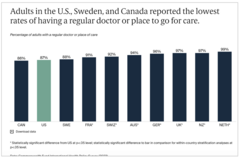
How does the US compare to other high income countries on primary care regarding PCP accessibility?
US has one of the lowest rates of having a regular doctor or place for care --> fragmented relationship with MD (second lowest; better than canada ig)
How does US primary care coordination compare to other high-income countries?
US has very poor coordination with specialists and hospitals about patient care plans; very uncoordinated care. US is 3rd lowest; better than Germany and the Netherlands but still abysmal as less than half of PCPs report adequate levels of coordination

How does US healthcare's continuity compare to other countries?
US Healthcare performs the worst for continuity. Less than half of US adults report having a longstanding relationship with a primary care provider
What is primary care typically accustomed to doing?
Screening, diagnosing, treating individual medical conditions (i.e., prevention 1.0)
What percent of health outcomes is determined by nonmedical factors?
80% of health outcomes determiend by non-medical factors
The healthcare industry is shifting from fee for service to value based care, how can health providers adapt?
Providers will be more incentivized from business, mission, and value driven reasons to address and screen for individual health related social needs (HRSN); PCPs motivated to do Prevention 2.0. PCPs motivated has extrinsic and intrinsic motivators to also do prevention 2.0 work.
Thinking about Prevention 2.0, what role do community based organizations play and how can EHRs be adapted to achieve the triple and quadruple aims?
To achieve the triple/quadruple aim, health systems to need EHR compatabile and standardized health related social needs screening tools and partnerships with tailored community based organizations
What is health leads?
non-profit organization dedicated to connecting patients with unmet social needs with community-based organizations. Volunteers create tailored plans to support community members with the patients they are working with.
How often are social needs screenings conducted for this Health Leads clinic?
every visit and doctor goes over it with them each time.
How do health leads show empathy, respect, autonomy, trust, and dignity?
Volunteers co-create care plans with patients, actively listen to them, collaborate with patients so they feel empowered, and follow up. By following up with patients, they establish continuity of care and trust through long term relationships
What is the ICD-10-CM?
Alphanumeric designation for all inpatient and outpatient medical diagnoses related to injury, illness, severity of symptoms, and cause of death for human beings. A standardized nomenclature system using numbers and the alphabet to describe medical conditions, injuries, illnesses, severity of a disease, and cause of death.
What does ICD-10-CM stand for?
International Classification of Diseases - 10th version - Clinical Modification
What is nosology?
Branch of medical science that classifies diseases (the study of classifying diseases)
How are ICDs organized? Are they static?
ICDs are organized by body system and updated
What is a CM? PCS?
CM = Clinical modification (i.e., diagnosis)
PCS = Procedures
Describe the adoption of ICD over time in the US. What policies and government organizatiosn affect its usage?
For the past two decades, US is the only high income country to not have consistently adopted/used the ICD-10. ACA provided "meaningful use" funds to incentivize US ICD-10 adoption and the Department of Health and Human Services mandated its adoption for all parties covered by HIPAA (i.e. US healthcare system)

Does the ICD-10-CM only have disease and medical conditions?
No, ICD-10 also has social risk factor diagnosis codes
What are ICD Z Codes used for? What codes for social drivers of health?
ICD Z codes are used for factors that influence health and accessibility to health services unrelated to diseases, injuries, or external causes (codes Z000 to Z99) ICD Z codes for "potential health hazards related to socioeconomic and psychosocial circumstances" (i.e., social drivers of health) are Z55-65
When were Z-codes first introduced? How many categories of social factors does it have?
9 categories, implemented in Medicare Fee for service in 2016
How can z-codes be used for diagnosis?
can be the first-listed, principal diagnosis code or a secondary code, depending on the circumstances of the encounter (could be the main or secondary diagnoses)
How are Z-codes "diagnosed" or given?
"Clinicians" from patient self-report and social needs screening tools incorporated into the EHR. The term "clinicians" is used loosely; could be a variety of care team members and doesnt have to be MD.
How often are z-codes updated?
Z codes updated anually
How can social driver of health data be collected during primary care?
Collected from community vital signs data or patient-reported data. Community vital signs data is public data sources about community-level information matched to patient addresses (government data that is matched to patients). Patient-reported data is information collected by asking patients directly about their individual circumstances.
What are three ways to collect patient-reported data about social drivers of health?
comprehensive health risk assessment, universal social needs screening tool, or dialog during clinical encounter
Describe how SDOH can be integrated into primary care
First, collect and organize SDOH data from the government or from the patient themselves
Second, apply insights from the data to enhance primary care by integrating them into workflows (i.e., point-of-care [individual patient care] and panel management). This can improve clinical decision-making regarding screenings, referrals, progress tracking, tailored services, and panel management by identifying and prioritizing high-risk patients for more focused out reach.
Third, developing automated systems to harness SDOH data to allow for action, including warm handoffs to community-based organizations and referrals to specialists, patient engagement, and clinical and social services coordination.
1. Gather data
2. apply data into current workflows
3. use automated systems to streamline work, and improve coordinated care and patient engagement
What are social drivers of health?
Environmental conditions that affect health, functioning, and quality of life. They can be either positive AND negative. SDOH, in and of itself, is not intrinsically good or bad. Examples include education, transportation, employment, housing, language, healthcare access, food security
What is a social risk factor?
negative social driver that can be screened for through a questionaire or from a patient interaction
What is a health related social need?
Patients gave consent to receive resource connection support for a patient identified social need. Allowing the patient to choose whether or not they receive social care navigation respects their agency.
How does Kaiser Permanente address food insecurity in Colorado?
Kaiser used patient panel information to collect data on food insecurity, which led to a collaboration with Hunger Free Colorado to reduce avoidable hospital admissions
How did Cincinnati Children's Hospital address housing needs?
Cincinnati Children's Hospital collected and combined/aggregated patient data on housing at a population level to help enable lawyers to address housing code violations. From the hospital data, lawyers were able to work on a multidisciplinary team to address code violations, reducing ED usage by children with asthma.
The hospital gathered data and collaborated with lawyers to reduce housing violations, leading to fewer emergency department visits (improved population health, decreased hospital costs)
How did the University of Arkansas Medical Center use SDOH data during the COVID-19 pandemic?
The University of Arkansas Medical Center used SDOH data to gauge self-quarantine capacity for patients who tested positive. If patients were identified as not having stable housing, they received case management; a social worker would send referrals on their behalf; and the system would coordinate with state entities to place those with unstable housing into specialized state quarantine rather than releasing them back into high-density environments/shelters.
1. Screened patients
2. social care navigation
3. connected patients with resources; were not sent back out to high risk environments.
How did Veterans Health Administration address housing concerns?
Veterans Health Administration reduced primary care panel sizes for their primary care teams that worked with unhoused patients. This allowed primary care providers to spend more time with patients, accommodate patients with more frequent appointments, case management, flexible scheduling, and care coordination. TLDR: alleviated burden for PCPs by reducing the # of patients they were responsible for so they can focus on serving unhoused veterans.
How did the Alameda health system implement Z codes during COVID?
Alameda health system implemented Operation Comfort. Under this initiative, Alameda Health system provided isolation housing for unhoused symptomatic or infected patients
How did the Henry Ford Health System (HFHS) implement z codes during COVID?
HFHS identified patients with food and financial insecurity in highly vulnerable Black neighborhoods. HFHS provided contact-free food box deliveries, PPE, diapers, culturally informed education, and equipment for virtual support to reduce the risk of exposure.
Who is Dr. Amanda Parsons? What did she advocate for based on her research? What did her reserach find?
Dr. Parsons was the VP of community and population health at Montefiore Health System. Their research found that 26.3% of patients missed their appointments. 31.5% of patients who missed appointments had an unmet social need. Of the missed appointments, 36% cited transportation challenges. Dr. Parsons advocated for destigmatization of patients who miss their appointments because SDOH affects access to medical care
What are the benefits of screening for social needs?
Social needs screenings allow for panel management initiatives and value-based payment reforms.
How can social needs screenings improve panel management?
Social needs screenings enable panel management initiatives by identifying expertise and labor gaps in the care team and team members that can fill it (e.g., community health workers, language gaps, etc) and supporting quality improvement activities. Social needs screening can support panel management by adjusting provider panel sizes by modifying the number of patients a provider is responsible for based on their patient population's complexity and visit frequency, improving patient and provider experience through higher-quality time and better access.
How can social needs screenings improve value based payment models?
Social needs screening allows for more accurate risk adjustment in a pay-for-performance system for penalties and bonuses, so to prevent unfair penalization of providers or health systems with more complex patients if they have "worse" outcomes because they have more complex patients. Social needs screening can also improve capitated payment accuracy by capturing social acuity, or the population's social complexity and vulnerability. Social needs screening forms can also better align care coordination and care management payments by aligning their incentives. Social needs screening forms can inform payment structure and allow for reimbursement for social care work. Essentially, it allows for more accurate capitated payments, prevents inequitable punishment/bonuses, and allows social care work to be reimbursable.
How does health-related social needs screening achieve the quintuple aim?
Health related social needs screneings improved patient satisfaction, overall health outcomes, quality of life, and trust between care team and patients. It also leads to reduced spending, readmission rates, and urgent/ED visits. It can also increase long term revenue because social care work (i.e., screenings, referrals, diagnoses, treatment for social needs) in value based care. Essentially, generates revenue, reduces spending, and promotes healthy living for patients and improved patient-care team experience
What are barriers to Health Related Social Needs screenings? What are the barriers from a clinician/health system POV and a patient POV?
50% of doctors do not believe they are responsible for screening for HRSN and that patients can handle it themselves. Clinicans also lack the time, not compensated under FFS, and requires integrated, comprehensive community based organization referral and support system. The benefits/RoI is farther in the future and not immediate and the short term costs increase, which makes it unappealing. Essentially, doctors may not view it as their role or as a patient responsibility, lack of time, lack of financial incentive (changing though!), high short-term costs, and requires comprehensive EHR and CBO ecosystem to be effective
Patient barriers include a lack of trust and privacy, fear of child welfare reports (may want to support, but doesn't want to be viewed as a bad parent/have their kids taken away), views screenings as long/impractical, limited comprehension (limited literacy/speaks other language), doesn't see value in it.
When are z codes applied? Are they applied for all social drivers of health?
Z codes are applied for social risk factors; only when it is considered "problematic" (e.g., food insecure, low income, etc)
How are HRSN screenings administered?
HRSN screenings have flexible administration. Patients can take it individually on paper or virtually. Patients can speak with careteam about social needs.
What is the most asked question on social needs screening forms?
Health behaviors, NOT OTHER SOCIAL DRIVERS OF HEALTH/MIDSTREAM FACTORS --> problematic because we behave in the context of our environment; so just behaviors is a narrow view
How many physicians in the US screen their patients for social needs?
63% of primary care physicians screened for any social need
In what environment do physicians screen for social needs the most?
Community health center practice physicians screen the most compared to other physicians at different practices
What are the five most utilized z codes in medicare FFS beneficiares?
Homelessness, problems from living alone, loss of a family member, other problems related to psychosocial circumstances, relationship issues w/partner or spouse

What is the association between z code claims and chronic disease prevalence
Z code claims associated with higher chronic disease prevalence in medicare beneficiaries
How much is the national average reimbursement for a SDOH assessment?
$18 (not much)
How many medicaid agencies provide nonclinical services to address HRSN?
majority do but around 22 don't