Formula Quiz 3
 Call Kai
 Learn
 Practice Test
 Spaced Repetition
 Match
 Flashcards
 Knowt Play
1/17

There's no tags or description
Looks like no tags are added yet.
18 Terms
Definition of a Critical Number and Critical Point
If f(c) is defined and f ‘(c) = 0 or is not differentiable, then…
→ c is a critical number of f(x)
→ (c , f(c)) is a critical point of f(x)
Extreme Value Theorem (EVT)
If f(x) is continuous on [a,b], then…
f(x) has an absolute maximum value f(c) for c on [a.b]
f(x) has an absolute minimum value f(d) for d on [a,b]
Candidates Test
Finds extrema on continuous function f on [a.b]
Find f ‘(x) and critical numbers of f on [a,b]
Evaluate f at each critical number in (a,b)
Evaluate f at each endpoint in [a,b]
The least of these values is the minimum. The greatest is the maximum.
Candidates Test Justification
f has an absolute max/min of f(c) at x = c by the Candidates Test
Mean Value Theorem (MVT)
If a function f is…
continuous on [a,b], and
differentiable on (a,b), then there is at least one number c in (a,b) such that
→ f ‘(c) = [f(b) - f(a)] / b - a
Rolle’s Theorem
If a function f is…
continuous on [a,b], and
differentiable on (a,b), and
f(a) = f(b), then there is at least one number c in (a,b) such that…
→ f ‘(c) = 0
Test for Increasing and Decreasing Functions
f ‘(x) > 0 for all x on (a,b) → f is increasing on (a,b)
f ‘(x) < 0 for all x on (a,b) → f is decreasing on (a,b)
f ‘(x) = 0 for all x on (a,b) → f is constant on (a,b)
First Derivative Test
f is continuous and differentiable (except possibly at c) on (a,b) containing critical number c…
If f ‘(c) changes from + → - at c, then (c, f(c)) is a relative maximum of f
If f' ‘(c) changes from - → + at c, then (c, f(c)) is a relative minimum of f
Linear Approximation
y - f(a) = f ‘(a)(x-a)
dy & dx
y = f(x) is differentiable.
dx is a differential and an independent variable.
dy is a differential and always dependent on x and dx
dy = f ‘(x)(dx)
L’Hopital’s Rule
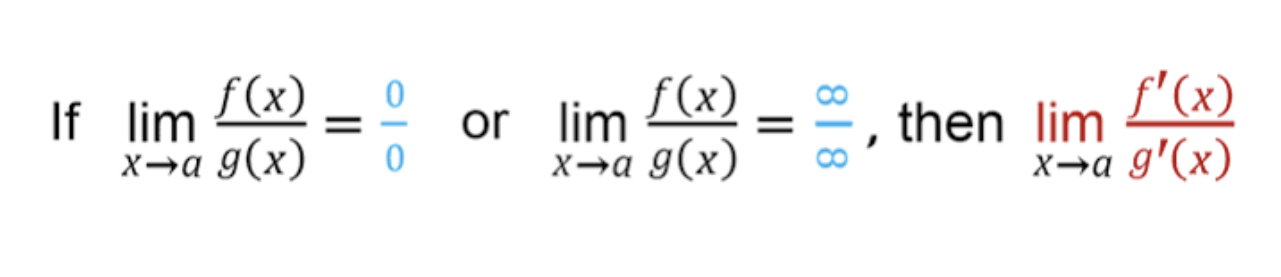
Definition of Concavity
Let f be differentiable on (I)
f is concave up if f ‘(x) is increasing on I
f is concave down if f ‘(x) is decreasing on I
Test for Concavity
Let f be a function whose second derivative exists on (I)
f is concave up if f ‘‘(x) > 0 on I
f is concave down if f ‘‘(x) < 0 on I
Definition of an Inflection Point
f has an inflection point at (c , f(c)) if…
f ‘‘(c) = 0 or DNE
f ‘‘ changes from positive to negative or negative to positive at x = c
or f' ‘(x) changes from increasing/decreasing or decreasing/increasing
Second Derivative Test
Let f be a function such that the second derivative exists on (a,b)
If f ‘(c) = 0 and f ‘‘(c) > 0, then f(c) is a relative minimum of f
If f ‘(c) = 0 and f ‘‘(c) < 0, then f(c) is a relative maximum of f
Evaluating Limits going towards infinity
Plug in infinity OR
Divide numerator and denominator by the highest power of x in the denominator
Even Function
f( -x ) = f(x)
Y-axis symmetry
Odd Function
f( -x ) = -f(x)
Origin symmetry